
AI Share of Voice: How to Calculate It Properly

Othmane Khadri · Founder, Earleads

Summary
AI share of voice is how often AI assistants name your brand on a fixed set of buyer questions, compared with named competitors. Calculate it as an appearance rate, the share of answers that name you across many repeated runs, per engine. One run is noise, because AI answers change every time you ask.
On this page
- What is AI share of voice?
- Why one run lies
- The AI share of voice formula: three numbers from the same answers
- How many runs make a share of voice number trustworthy
- Step 1: Build the question list from buyers, not from a keyword tool
- Step 2: Run the questions natively in each engine
- Step 3: Score every answer three ways
- Step 4: Calculate share of voice per engine, never blended
- Step 5: Report it monthly, with the formula on the page
- Using a share of voice calculator
- AI share of voice for B2B vs B2C
- Common AI share of voice mistakes
What is AI share of voice?
AI share of voice is how often AI assistants name your brand when buyers ask about your category, compared with how often they name your competitors. It’s measured on a fixed list of buyer questions, in each engine you care about (ChatGPT, Perplexity, Gemini, Claude, Google’s AI Overviews and AI Mode), and it’s the closest thing AI search has to a market share number.
The formula looks simple. Most guides give you one line, divide your mentions by everyone’s mentions, and move on. The trouble starts when you run the same question twice and get two different answers. Then a third. Then a tool reports 34% and another reports 12% for the same brand in the same month.
This guide covers the formulas that compete for the name, which one to report, how many runs it takes before a share of voice number means anything, and why every engine gives you a different share. A word on who’s writing. Earleads runs AI search visibility programmes for B2B and B2C brands, and the method below is the one we use to track buyer questions for clients. If you want the board-level view that sits on top of this number, our guide to GEO KPIs covers it.
Why one run lies
AI answers are not search results. Ask ChatGPT the same question twice and it can name a different set of brands, in a different order, each time.
SparkToro measured how much. Working with Patrick O’Donnell of Gumshoe, they had 600 volunteers run 12 prompts through ChatGPT, Claude and Google’s AI a combined 2,961 times. They found “a <1 in 100 chance” that ChatGPT or Google’s AI would give the same list of brands in any two responses, and roughly 1 in 1,000 that two lists would come back in the same order (SparkToro, January 2026).
The same study found something useful hidden in the noise. Some brands showed up again and again. In one category, a single agency appeared in 85 of 95 responses. SparkToro’s conclusion was that “visibility % across dozens to hundreds of prompts run multiple times is a reasonable metric”, while “any tool that gives a ‘ranking position in AI’ is full of baloney.”
That’s the whole case for how AI share of voice should be calculated. Not as a rank. Not from a screenshot. As a rate across many runs.
It also explains a story that comes up in marketing forums often enough to be a pattern. A CEO types the category’s top question into ChatGPT in the middle of a meeting, sees no mention of the company, and asks why the dashboard said things were going well. Both can be true at once. A brand that appears in 40% of answers is missing from 60% of them, and one look is a single draw from that distribution.
The AI share of voice formula: three numbers from the same answers
Four calculations compete for the name “AI share of voice”. They use the same raw answers and give different numbers.
| Metric | Formula | Sums to 100% across brands? | What it tells you |
|---|---|---|---|
| Appearance rate (share of answers) | Answers naming you ÷ total answers × 100 | No | How often a buyer asking this question hears your name |
| Share of mentions | Your brand mentions ÷ all brand mentions × 100 | Yes | Your slice of the names that do get mentioned |
| Citation rate | Answers linking to your domain ÷ total answers × 100 | No | How often the engine uses your pages as a source |
| Position weighted score | Each mention weighted by its place in the list | No | Rough prominence, but built on an order that rarely repeats |
Here’s how far apart they land. Take one buyer question, run it 20 times in one engine, and record every brand named. The figures below are invented for a fictional brand to show the arithmetic. They aren’t benchmarks.
- Brand A (you) is named in 8 of the 20 answers.
- Competitor B is named in 14, competitor C in 10, competitor D in 4.
- Brand A’s own domain is linked as a source in 3 answers.
| Calculation | Brand A | Competitor B |
|---|---|---|
| Appearance rate | 8 ÷ 20 = 40% | 14 ÷ 20 = 70% |
| Share of mentions | 8 ÷ 36 = 22% | 14 ÷ 36 = 39% |
| Citation rate | 3 ÷ 20 = 15% | Not tracked |
Same 20 answers, and Brand A’s “share of voice” is 40%, 22% or 15% depending on who calculated it. That’s why two tools rarely agree, and why a formula switch between quarters can make a flat month look like a collapse.
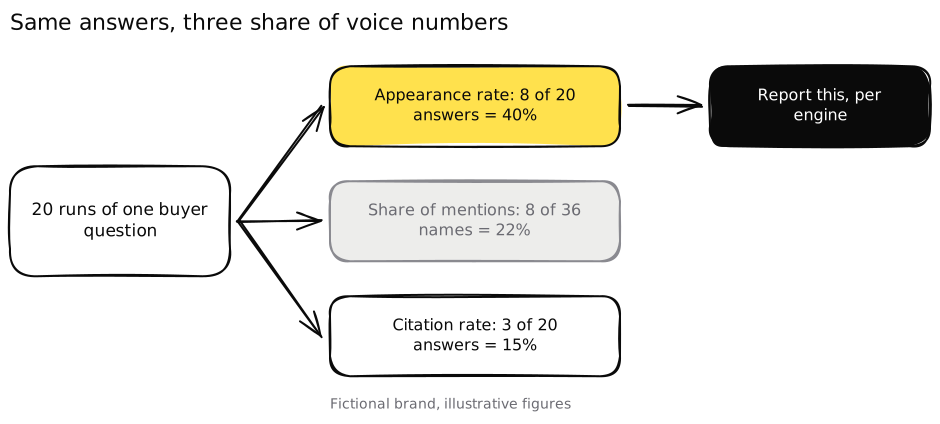 Same answers, three numbers. Write the formula on the report and keep it fixed.
Which formula to report
Report appearance rate as the headline, per engine, next to the same rate for three named competitors. We use this framing with clients and call it share of answers. It’s the number that matches the buyer’s experience. Out of every 10 people who ask this question, how many hear your name?
Notice that appearance rates add past 100% across brands (40% plus 70% plus 50% plus 20% in the example). That’s correct, because one answer names several brands. Some tools present this as a fault, or quietly switch to share of mentions so the pie chart sums neatly. Share of mentions has a real flaw, though. If engines start naming fewer brands per answer, your share of mentions can rise while you appear in fewer answers. It measures your slice of the conversation and hides how often you’re left out of it.
Keep citation rate as a second line. It’s the core of AI citation tracking, and it tells you which of your pages engines trust as sources. But a brand can be recommended without its site being cited (the engine leans on a review site or a forum thread instead) and cited without being recommended. Position weighted scores are best left out, for the reason SparkToro gave. The order almost never repeats.
How many runs make a share of voice number trustworthy
This is the gap in most guides. “Run each prompt more than once” is true, but how many times?
A share of voice reading is a sample, so it carries a margin of error you can estimate with the standard formula for a proportion. The table below uses the usual 95% approximation. Treat it as a rough guide, not a precise statistical claim, since repeated runs of the same engine aren’t perfectly independent.
| Runs per question | Margin of error at 50% appearance | At 20% appearance |
|---|---|---|
| 1 | Meaningless | Meaningless |
| 10 | About ±31 points | About ±25 points |
| 30 | About ±18 points | About ±14 points |
| 100 | About ±10 points | About ±8 points |
| 400 | About ±5 points | About ±4 points |
Read the 10 run row again. A brand “at 50%” after 10 runs could plausibly sit anywhere from about 20% to 80%. That’s not a measurement. It’s a range wide enough to support any story.
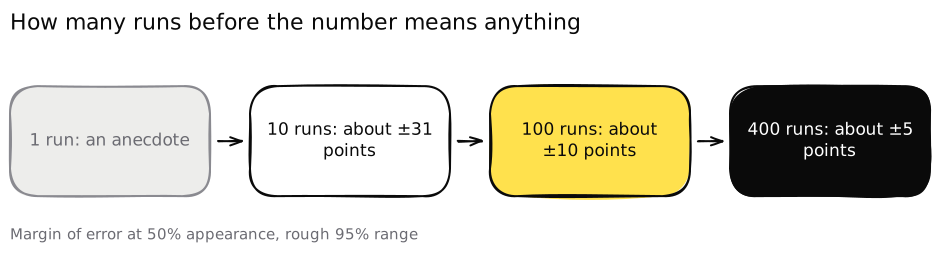 More runs, narrower range. A single run tells you almost nothing.
Two practical consequences follow.
Pool for the headline, sample deep where it matters. Your headline share of voice pools every run across the whole question set, so 50 questions run 10 times each gives 500 answers per engine and a much tighter number. But for the handful of questions that drive most revenue, run each one many times on its own. Those are the ones sales will ask about.
A change has to beat the noise. Comparing two months adds the uncertainty of both readings, so the margin on the change is wider than the margin on either month. With 30 runs per month, moving from 30% to 40% is well inside the noise. With 200 runs per month, it starts to mean something. If your report says “up 6 points”, it should also say whether 6 points is larger than the margin.
Step 1: Build the question list from buyers, not from a keyword tool
Share of voice is only as good as the questions underneath it. Change the questions and you change the number, which is why the list has to be fixed and signed off before anything is measured.
- Write questions the way buyers ask them. Use sales call notes, support tickets and the language in your positioning. SparkToro’s study found that when 142 people wrote their own prompt for the same need, the prompts had an average semantic similarity of just 0.081. Buyers phrase things very differently, so cover several phrasings of each need.
- Mostly unprompted questions. The share that matters is on questions that don’t name you (“best payroll tool for a 60 person team”, “what’s a good alternative to X”). You’ll win questions that contain your brand name. That’s not the point.
- Keep only questions that have an answer worth being in. Run each candidate live once before it joins the list. If the engine gives no recommendation at all, it isn’t a share of voice question.
- Separate validation questions. “Is X legit?” or “X reviews” measure trust, not findability. Track them, but report them on their own line.
- Get sales to sign off. A list chosen by whoever runs the tracking will drift toward questions that flatter the dashboard. We have clients approve the list before a single answer is measured, and the same rule protects an in-house team.
Our guide on what an AI visibility audit should show you covers how to build and approve this list in more depth.
Step 2: Run the questions natively in each engine
Run each question where buyers ask it, inside ChatGPT, Perplexity, Gemini, Claude and Google, rather than only through an API. API answers aren’t what a buyer sees in the app, and in our experience most tracking tools query through APIs because it’s cheaper at scale.
That doesn’t make tools useless. They’re good at counting at volume. The rule we follow is to use a tool as the record, then check it every month against a native run done by hand. When they disagree, trust the live run, because that’s the answer your buyer actually read.
Step 3: Score every answer three ways
For each answer, record three things.
- Appearance. Is your brand named? Which competitors are named?
- Position when present. First mention or fifth? Useful context for one answer, but don’t average it into a rank.
- Description. How does the engine describe you? Being named as “a basic option for beginners” or with a pricing tier you dropped last year is a different problem from being missing. Our guide to AI reputation management covers what to do when the description is wrong.
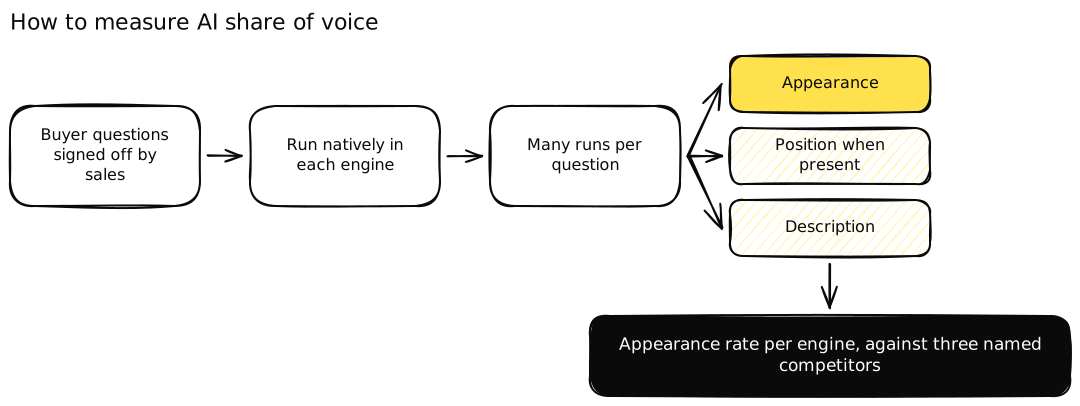 Appearance rate is the headline. Position and description are context, never a rank.
Step 4: Calculate share of voice per engine, never blended
Calculate the appearance rate separately for each engine, and for each named competitor. Then stop. Don’t average the engines into one number, because they behave too differently for an average to describe any real buyer’s experience.
The data on this is clear. Ahrefs compared Google’s AI Overviews and AI Mode on the same queries and found that only 13.7% of their citations overlapped, even though the two agreed on the substance of the answer about 86% of the time. AI Mode named 3.3 entities per answer on average against 1.3 for AI Overviews, and 59.41% of AI Overview responses named no brand at all (Ahrefs, December 2025). Those are two features from the same company.
Across companies the sources diverge further. Profound’s analysis of 680 million citations found Wikipedia made up 47.9% of ChatGPT’s ten most cited sources, while a single discussion forum made up 46.7% of Perplexity’s top ten and 21.0% of Google AI Overviews’ (Profound).
So expect your share to vary engine by engine, sometimes a lot. The variation is the useful part. An engine where you’re strong points to sources that already work for you. An engine where you’re weak tells you which sources to go after, because each engine has its own favourites. A blended score hides both.
Step 5: Report it monthly, with the formula on the page
A share of voice report that holds up over time has five features.
- The formula is written on it, and it doesn’t change between quarters. Tool vendors do sometimes change their method or recalculate history, which breaks quarter on quarter comparisons. Keep your own export.
- One line per engine, with three named competitors beside you.
- Unprompted questions only in the headline. Branded questions go in a separate line, if at all.
- A margin or a run count, so readers can tell a real move from noise.
- Re-measured more often than it’s reported. We re-run the questions twice a month and report monthly, so each monthly number rests on more than one reading.
In our experience the questions that matter most to leadership are the ones that don’t name the brand, and whether the brand shows up when an executive checks for themselves. A report built this way answers both. For connecting share of voice to traffic, signups and pipeline, see our guide to AI search analytics.
Using a share of voice calculator
The classic share of voice calculator, built for ads and organic search, divides your measure (impressions, clicks, mentions) by the market total. That arithmetic works for AI too. The hard part is the inputs, not the division.
A calculator can’t fix a question list chosen by the person being measured, a sample of three runs, or answers taken from an API that buyers never see. Before you trust any calculator’s output, ask four questions. Which questions went in? How many runs per question? Which engines, and were they queried natively? Is the result an appearance rate or a share of mentions?
If you want a starting point, our free AI visibility tools page has the AI visibility audit, which shows your share of AI answers against each competitor on your buyers’ questions. An AI share of voice calculator that estimates what moving from a low share to a higher one is worth in pipeline is listed there as coming soon.
AI share of voice for B2B vs B2C
The method stays the same. The questions and the engines that matter change.
B2B. Questions are shortlist and comparison questions (“best X for mid-market teams”, “X vs Y for agencies”) asked by several people on a buying committee. Competitors are usually easy to name. Description weighs heavily, because one stale claim about pricing or security can surface in a procurement call. Comparison questions are usually won on your own site, so the citation rate of your comparison pages is a useful second line.
B2C. Questions are “best X for Y”, “is X worth it” and first-person experience questions, which engines often answer from community threads and reviews. The competitor set is wider, so name the three that actually take your customers. Validation questions (“is X legit?”) deserve their own line, because a trust problem hits conversion fast.
Common AI share of voice mistakes
- Reporting a rank. “We’re number 2 in ChatGPT” isn’t a stable fact. “Named in 6 of 10 runs” is.
- Measuring on branded questions. It inflates the number and measures nothing you need to know.
- Blending engines. One number across ChatGPT, Perplexity and Google describes no buyer.
- Changing the formula or the question list mid-year. The trend line stops meaning anything.
- Celebrating noise. A 5 point move on 20 runs is a coin landing differently.
- Counting mentions and ignoring descriptions. A brand named in every answer as the wrong kind of product has a high share of voice and a real problem.
- Treating share of voice as the goal. It’s a leading indicator. Whether it turns into branded search, signups and pipeline is what makes it worth tracking.
AI share of voice is worth measuring because it’s the closest thing AI search has to market share. It’s also easy to measure badly. Fix the questions, run them many times where buyers ask them, report appearance rate per engine against named competitors, and keep the formula on the page. A number built that way will match what an executive sees when they check for themselves, more often than not.
Get a personalised case study
Pick your industry and we'll email you the case closest to your business, numbers included.
Frequently asked questions
What is AI share of voice?
AI share of voice measures how often AI assistants such as ChatGPT, Perplexity, Gemini, Claude and Google's AI features name your brand when buyers ask about your category, compared with the same measure for named competitors. It's calculated on a fixed list of buyer questions, run many times per engine, and reported per engine rather than as one blended score.
How do you calculate AI share of voice?
Run each buyer question many times in each engine and record which brands every answer names. Your appearance rate is the number of answers that name you divided by the number of answers, times 100. Calculate the same rate for each competitor and report them side by side, per engine, on questions that don't mention your brand.
How many times should I run a prompt to measure AI share of voice?
More than you'd think. With 10 runs, a 50% appearance rate carries a margin of error of roughly 31 points either way. With 100 runs it's about 10 points. Run your priority questions dozens of times per engine, and pool results across the whole question set for the headline number, so a monthly change is bigger than the noise.
Why does AI share of voice add up to more than 100%?
Because one answer can name several brands. If you report appearance rates, your brand might appear in 40% of answers and a competitor in 70%, which already passes 100%. That's correct, not a bug. Share of mentions divides by total brand mentions instead, so it always sums to 100%, but it hides how often you're missing entirely.
What is the difference between AI share of voice and AI citation tracking?
Share of voice counts whether the answer names your brand in its text. Citation tracking counts whether the answer links to your pages as a source. They often diverge. An engine can recommend you while citing a review site or a forum thread, or cite your page without naming you. Track both, but report brand appearance as the headline.
Is there a free AI share of voice calculator?
Earleads lists free AI visibility tools on its tools page. The AI visibility audit, which shows your share of AI answers against each competitor on your buyers' questions, is live now, and an AI share of voice calculator that estimates what a higher share is worth in pipeline is listed there as coming soon.