How to Get Cited by AI: What Gets Cited and Why

Othmane Khadri · Founder, Earleads

Summary
To get cited by AI, let the AI crawlers read your pages, then write short passages that each answer one buyer question with named sources, quotes and numbers. Keep those pages current, and get your brand onto the third party pages that ChatGPT, Gemini and Perplexity already cite for your questions. Then check those questions every month.
On this page
- What does it mean to get cited by AI?
- How AI engines choose what to cite
- What the research says gets cited
- How to rank in AI Overviews, in Google’s own words
- Step 1: Find which pages AI cites for your buyer questions
- Step 2: Let every engine read your pages
- Step 3: Write passages that answer one question each
- Step 4: Add named sources, quotes and numbers
- Step 5: Keep the pages that matter fresh
- Step 6: Get onto the pages AI already cites
- What changes for B2B and B2C brands
- What doesn’t work
- How to measure AI citations
What does it mean to get cited by AI?
Getting cited by AI means an assistant like ChatGPT, Gemini or Perplexity, or Google’s AI Overviews, shows a link to your page as a source for its answer. The engine searches the web, reads a handful of pages, and builds its answer from the passages it trusts. The links it shows are the citations.
A citation isn’t the same as a mention. A mention is your brand named in the answer. A citation is your page listed as evidence. Both matter, and they often travel together, because an engine that reads your page is more likely to repeat what it says about you.
The good news is that nobody has to approve you. There’s no submission form and no paid placement inside the answer. Engines cite what they can find, read and trust for a specific question. That’s something you can work on.
How AI engines choose what to cite
Every major engine works roughly the same way when it searches. It takes the question, breaks it into smaller searches, pulls pages, then picks the passages that answer each part.
Google describes this openly. Its AI features documentation says AI Overviews and AI Mode “may use a ‘query fan-out’ technique, issuing multiple related searches across subtopics and data sources to develop a response.” When it launched AI Mode, Google said the technique means “breaking down your question into subtopics and issuing a multitude of queries simultaneously on your behalf,” and that both AI Mode and AI Overviews in the US run on “a custom version of Gemini 2.5.”
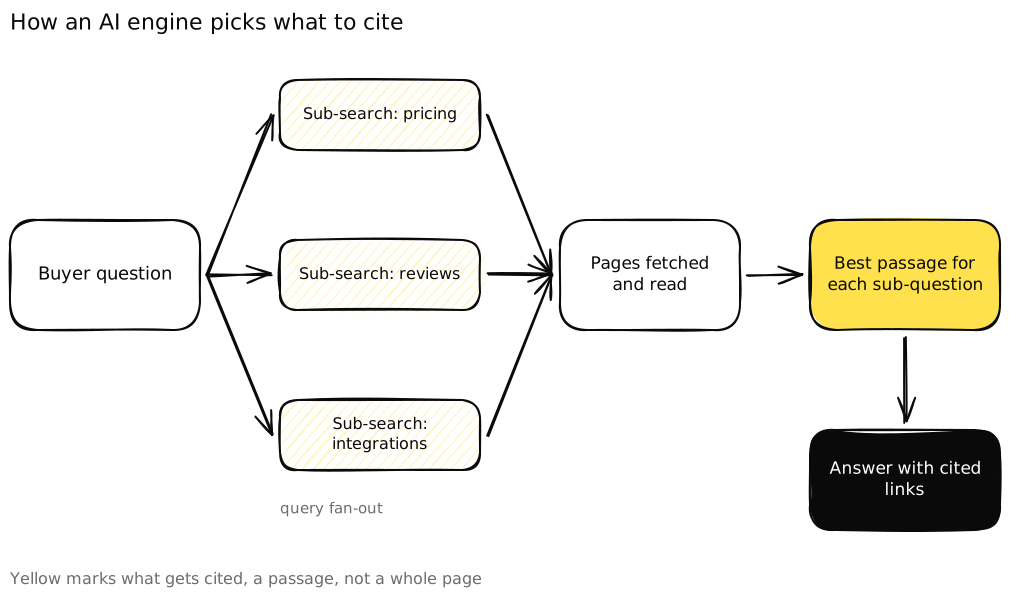 Engines cite passages, not whole pages, so one sharp paragraph can earn the link.
This has a practical consequence. A buyer asking “what’s the best payroll tool for a 30 person company in Germany” doesn’t trigger one search. It triggers several, about pricing, compliance, integrations and reviews. Each sub-search is another chance for your page to be read, and another chance for a competitor’s page to answer it better.
The engines also need permission to read you. ChatGPT uses OpenAI’s OAI-SearchBot, which OpenAI says “is used to surface websites in search results in ChatGPT’s search features.” Perplexity uses PerplexityBot, which Perplexity says “is designed to surface and link websites in search results on Perplexity” and “is not used to crawl content for AI foundation models.” Google’s AI features use the same Googlebot crawl as regular search.
| Engine | What it needs to cite you | Where the rule is written |
|---|---|---|
| Google AI Overviews and AI Mode | Page indexed and eligible to show with a snippet | Google Search Central, AI features page |
| ChatGPT search | OAI-SearchBot allowed in robots.txt | OpenAI crawler docs |
| Perplexity | PerplexityBot allowed in robots.txt | Perplexity crawler docs |
What the research says gets cited
The most useful study on this is still the GEO paper from researchers at Princeton University and IIT Delhi, published at KDD 2024. They built a benchmark of 10,000 queries, rewrote source pages with nine different techniques, and measured how much of each rewritten page ended up in the generated answer.
The headline is that the right edits “boost visibility by up to 40%.” The detail is more useful than the headline.
| Technique tested | What the paper found |
|---|---|
| Keyword stuffing | Didn’t perform well against the unedited baseline |
| Adding quotations from credible sources | One of the two best methods, which beat the baseline by up to 41% on one metric and 28% on another |
| Adding statistics | The other best method, strongest in law, government, debate and opinion topics |
| Citing sources | Lifted sources ranked fifth by 115.1%, while top ranked sources lost 30.3% on average |
| Better fluency and easier wording | A 15 to 30% visibility gain |
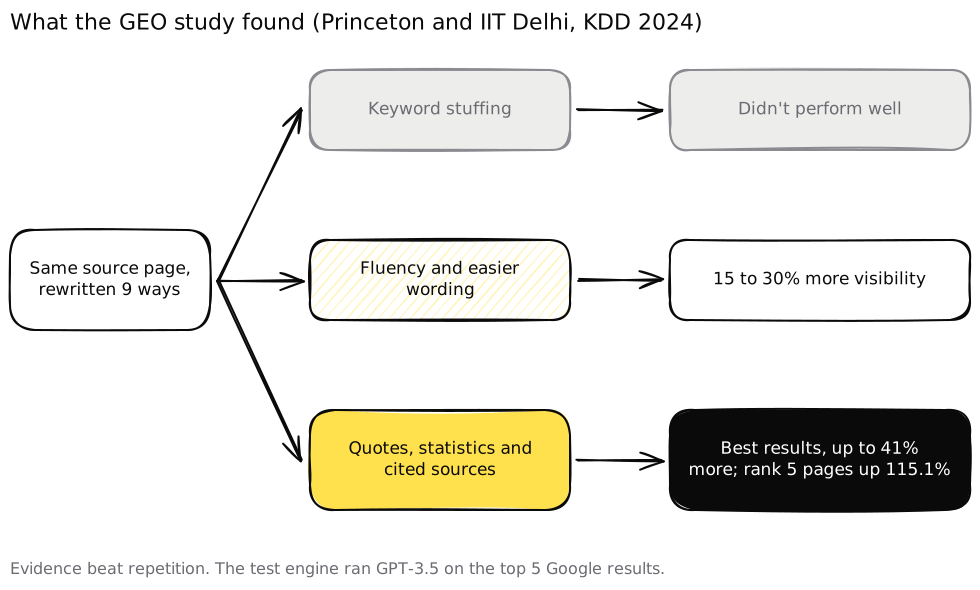 In the GEO study, evidence beat repetition. Quotes, numbers and named sources moved visibility, keywords didn’t.
Two findings matter for most businesses. First, evidence wins over keywords. Engines prefer passages that carry their own proof. Second, the effect was biggest for lower ranked pages. The authors wrote that this shows GEO’s “potential as a tool to democratize the digital space,” since smaller sites can compete on the quality of a passage, not only on links.
Read it with its limits in mind. The test engine was built on GPT-3.5 turbo and fed the top five Google results for each query. The team also ran the methods on Perplexity and saw “visibility improvements up to 37%.” Today’s engines are larger and search more widely, so treat the paper as a direction, not a formula.
Two newer studies from Ahrefs add the outside view. One analyzed 17 million citations across seven platforms and found that pages cited by AI assistants were “25.7% fresher” on average than pages in organic results, with ChatGPT the most likely to cite newer pages. The other studied 75,000 brands and found that brand web mentions correlated with AI Overview visibility at 0.664, against 0.218 for backlinks. Ahrefs itself points out that correlation isn’t causation, but the pattern is consistent with the GEO paper. Engines trust what’s well evidenced, current and corroborated elsewhere.
How to rank in AI Overviews, in Google’s own words
Most advice on how to rank in AI Overviews overcomplicates what Google has written down plainly. Its AI features page, last updated December 10, 2025, says “there are no additional requirements to appear in AI Overviews or AI Mode, nor other special optimizations necessary.”
To show as a supporting link, Google says “a page must be indexed and eligible to be shown in Google Search with a snippet.” It adds that “you don’t need to create new machine readable files, AI text files, or markup” and that “there’s also no special schema.org structured data that you need to add.”
What Google does recommend is ordinary, and easy to skip. Allow crawling, use internal links, keep important content in text, make structured data match the visible page, and keep Merchant Center and Business Profile information current. In a May 2025 post, Google told site owners to focus on “unique, non-commodity content,” and said clicks from results with AI Overviews “are higher quality, where users are more likely to spend more time on the site.”
Two consequences follow. If a page carries a nosnippet tag, or a max-snippet limit too tight to quote, it limits what Google can show from it. And because AI Overviews and AI Mode traffic is counted inside the “Web” search type in Search Console, you won’t find a separate AI report there. You measure it with your own question list.
Step 1: Find which pages AI cites for your buyer questions
Start with what’s being cited today, not with writing. Every question already has winners, and they tell you what the engine wants.
- List 20 to 40 buyer questions. Use the words your customers use with sales or support. Mix “best X for Y,” “X vs Y,” “how much does X cost” and “is X worth it.”
- Run each one in four places. ChatGPT with search on, Perplexity, Gemini and Google with an AI Overview or AI Mode. Use a logged out or fresh session.
- Copy every cited URL into a sheet. One row per question per engine.
- Tag each URL. Is it your page, a competitor’s page, or a third party page like a review site, a publisher roundup, a forum thread or a marketplace listing?
- Read the cited passage. Find the exact paragraph the engine used. That’s the bar you have to clear.
Answers vary between runs, so run each question two or three times and keep the URLs that show up more than once. This sheet is your citation gap. Our guide to what an AI visibility audit should show you walks through the same citation map in more detail.
Step 2: Let every engine read your pages
No passage gets cited if the crawler can’t fetch it. Check your robots.txt for OAI-SearchBot, PerplexityBot and Googlebot. OpenAI says sites opted out of OAI-SearchBot “will not be shown in ChatGPT search answers,” and both OpenAI and Perplexity say changes can take about 24 hours to apply.
Then check the page itself. Is the answer in the HTML, or does it load only after JavaScript runs? Is it hidden in a tab or a PDF? Does a CDN or bot protection setting block AI crawlers without anyone deciding to? Firewall rules catch a lot of sites by accident. If you sell online, our checklist on whether your store is visible to AI shopping agents covers the same checks for product pages.
For ChatGPT specifically, the difference between OAI-SearchBot and GPTBot matters. We cover it in how to get ChatGPT to recommend your business.
Step 3: Write passages that answer one question each
Engines lift passages, so write pages that are easy to lift from. Four habits do most of the work.
- Put the answer in the first 40 to 60 words of the section. Then explain. A section titled “How much does a payroll tool cost for a small team?” should state a range or the factors that set it in its first two sentences.
- Make each section stand alone. Name the thing you’re talking about instead of writing “it” or “this tool.” A passage pulled out of context should still make sense.
- Use the question as the heading. Fan-out searches look like questions, so headings that match them are easier to match.
- Cover the neighbouring questions on the same page. If buyers ask about price, they’ll also ask about contracts, setup time and alternatives. Fan-out means the engine will search for those too.
Short passages aren’t the goal on their own. The goal is a passage that answers one sub-question better than anything else the engine found. That’s what the GEO paper measured, and it’s why a fifth ranked page can take the citation.
Step 4: Add named sources, quotes and numbers
This is where the GEO paper’s strongest findings turn into edits. Quotations from credible sources, statistics and cited sources were the techniques that moved visibility most. Keyword stuffing didn’t.
In practice, that means replacing vague claims with checkable ones.
- “Fast onboarding” becomes the real median setup time from your own rollouts, with the team size it applies to.
- “Trusted by customers” becomes a named review platform and its rating, linked.
- “Industry experts agree” becomes one named expert, quoted, with a link.
- “Prices vary” becomes a published range, or the three factors that set the price.
Use your own data where you have it. Original numbers are exactly the “unique, non-commodity content” Google asks for, and they give engines something they can’t get from a competitor. Never invent a statistic. A number an engine can’t trace back to a source is a liability, and a false one can be repeated in answers for months.
Step 5: Keep the pages that matter fresh
The Ahrefs data says assistants lean toward newer pages, and it also found that ChatGPT and Perplexity order their in-text references from newest to oldest. So a fresher page may also get a better slot in the list of sources.
Fresh doesn’t mean changing the date. It means the facts on the page are current. Review your most cited and most wanted pages every quarter, update prices, screenshots, figures and examples, and show a visible “updated” date when the content really changed. Pages about fast moving topics like software, pricing, regulations and product ranges need it most.
Step 6: Get onto the pages AI already cites
Your Step 1 sheet will show that many citations go to pages you don’t own. Review sites, publisher roundups, comparison posts, community threads and marketplaces. That’s the third party corroboration engines lean on, and it lines up with the Ahrefs finding that brand mentions track AI visibility far more closely than backlinks.
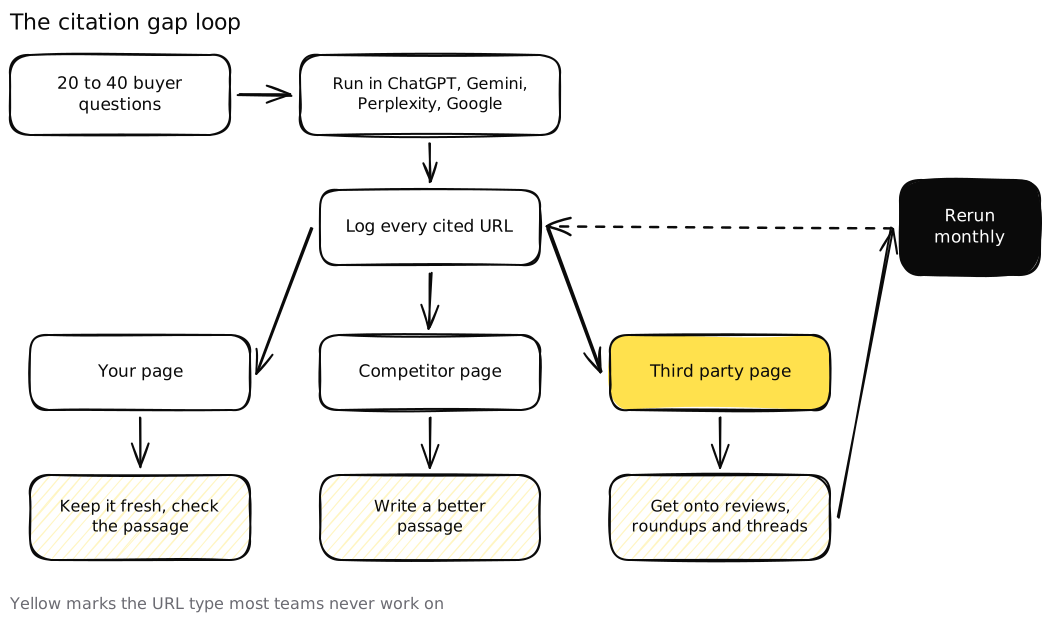 Each cited URL type needs a different move. Third party pages are the one most teams skip.
Each URL type gets its own action.
- Your page is cited. Protect it. Keep it fresh and make sure the cited passage says what you want it to say.
- A competitor’s page is cited. Write a better passage on your own page for that exact sub-question, with stronger evidence.
- A third party page is cited. Get onto it. Pitch the author of a roundup with a useful, verifiable reason to include you. Ask customers for reviews on the platform the engine reads. Answer the community thread honestly, from a named account, without a sales pitch.
This is slower than editing your own site, because someone else controls the page. It’s also the move with the biggest upside, since the engine has already decided it trusts that page.
What changes for B2B and B2C brands
The steps don’t change. The pages that get cited do.
B2C and local businesses. Google tells site owners to keep Merchant Center and Business Profile information up to date for its AI features. For shops, restaurants, clinics, gyms and trades, accurate hours, prices, stock and reviews on the platforms buyers use are often what’s cited. Consumer questions like “best running shoes for flat feet under $150” lean heavily on review sites, publisher roundups and forums, so Step 6 carries more weight.
B2B. Buyers ask for shortlists, comparisons and prices. Cited pages tend to be comparison posts, software review platforms, documentation and analyst style roundups. If your pricing, integrations and security details hide behind a demo form, the engine can’t quote them. Publish them, or at least the factors that set them, in plain text.
What doesn’t work
- Keyword stuffing. The GEO paper found it doesn’t perform well. Engines want answers, not repetition.
- Special AI files for Google. Google says you don’t need new machine readable files, AI text files or special schema for AI Overviews or AI Mode.
- Invented or recycled statistics. If you can’t link the source, cut the number.
- Blocking AI crawlers by accident. Check robots.txt and your CDN before writing anything new.
- Promises of guaranteed citations. No one outside the engines controls what they cite. A good partner improves the inputs and shows you the question list moving. If you’re comparing options, our guide on how to choose a GEO agency lists the questions to ask.
How to measure AI citations
Measure on a fixed question list, the same one from Step 1, every month. For each question and engine, record four things. Were you cited, were you mentioned by name, which position were you in, and which URLs were cited instead of you.
Add your analytics on top. Google counts AI Overviews and AI Mode clicks inside the “Web” search type in Search Console. OpenAI tags ChatGPT referrals with utm_source=chatgpt.com. Clicks undercount the effect, since many people read the answer and then search for you by name, so watch branded search too.
Read trends over a quarter, not week to week. If you’d like an outside view of where you stand today, our free AI visibility audit runs your buyer questions across the major assistants and shows which cited pages to go after first. It’s the core of what we do at Earleads for B2B and B2C brands.
Frequently asked questions
Do I need to rank on page one of Google to get cited by AI?
It helps, but it isn't the whole story. Google says a page must be indexed and eligible to show with a snippet to appear as a supporting link in AI Overviews. In the Princeton GEO study, adding cited sources to a page lifted visibility for sources ranked fifth by 115.1%, while the top ranked source lost 30.3% on average. Strong passages can beat position.
Does llms.txt help you get cited by AI?
Not for Google. Its AI features page says you don't need to create new machine readable files, AI text files, or markup to appear in AI Overviews or AI Mode, and that there's no special schema.org structured data to add. Other engines haven't published a rule that rewards it either. Spend the time on crawler access and better passages first.
How long does it take to get cited by AI?
It depends on what you change. OpenAI and Perplexity say robots.txt changes take up to about 24 hours to register. A rewritten passage can show up in answers once the page is recrawled. Getting onto third party pages takes longest, because someone else has to update them. Track a fixed question list monthly and judge progress over a quarter.
How do I see which pages AI cites for my keywords?
Run your buyer questions in ChatGPT with search on, Perplexity, Gemini and Google with AI Overviews or AI Mode, and copy every cited URL into a sheet. Note whether each link is your page, a competitor's page or a third party page. Run each question two or three times, because answers vary between runs.
Are AI citations the same as brand mentions?
No. A citation is a link to a source page shown with the answer. A mention is your brand named in the answer text. You can be cited without being named, and named without being linked. Track both, because a buyer who reads your name in the answer may search for you directly instead of clicking.
Does getting cited by AI work for B2C brands too?
Yes. Google tells site owners to keep Merchant Center and Business Profile information up to date for its AI features, which matters most for shops, restaurants, clinics and other local or consumer businesses. B2B brands win citations with comparison pages, pricing pages and documentation. The six steps are the same for both.