Comparison Pages That Win AI Answers: Vs and Alternatives

Othmane Khadri · Founder, Earleads

Summary
Comparison pages win AI answers when your brand is one of the two names, a plain comparison table comes first, a 40 to 60 word verdict says who each option suits (including who you're not for), and honest weaknesses follow. An alternatives hub owns the head term, and spokes cover qualifiers like cheaper or for agencies.
On this page
- What comparison pages are, and why AI answers lean on them
- Only compare where you’re one of the names
- Hub and spokes: how to structure an alternatives cluster
- How to build comparison pages that win AI answers
- Step 1: Pick comparisons from exit intent, not volume
- Step 2: Put the comparison table first
- Step 3: Write a 40 to 60 word verdict, including who you’re not for
- Step 4: Write the honest weaknesses section
- Step 5: Verify every competitor claim on their live pages, and date it
- Step 6: Link the cluster and keep it current
- Why comparison pages win on craft, not links
- The “best of” trap: don’t rank yourself first in your own list
- Comparison pages for B2B vs B2C
- Common comparison page mistakes
What comparison pages are, and why AI answers lean on them
A comparison page sets your product next to a competitor so a buyer can choose. There are two formats worth building. The vs page compares your brand with one named rival (“YourBrand vs Rival”). The alternatives page speaks to people leaving a competitor (“Rival alternatives”). Both catch a buyer at the point where the shortlist is already short.
That moment now happens in AI answers as often as on Google. A finance lead asks ChatGPT whether to pick one expense tool or another. A parent asks Perplexity for an alternative to a meal kit that got too expensive. The engine reads what it can find and writes a verdict. If you haven’t published your side, the verdict is assembled from your competitor’s comparison page, affiliate roundups and the automated “X vs Y” pages that software directories generate.
Comparison content is also what engines reach for on shortlist questions in general. Ahrefs analysed ChatGPT responses to 750 top-of-funnel prompts across software, products and agencies and found that “best X” blog lists made up 43.8% of all page types cited. Buyers ask engines to compare, so engines quote pages that compare.
This guide covers how we build comparison pages at Earleads for AI visibility. Which comparisons to build, how to structure a cluster, how the page itself should be ordered, and why these pages win on craft rather than links. It applies to B2B and B2C brands alike, and it sits alongside the wider playbook in how to get ChatGPT to recommend your business.
Only compare where you’re one of the names
The first decision is the one most teams get wrong, and it’s made in a keyword tool. A big-volume “Rival A vs Rival B” query looks like an opportunity. It isn’t. The person typing it is choosing between two products that aren’t yours, and they aren’t shopping for a third. You’d pay the same to earn that traffic as traffic that converts, and it rarely does.
So we only build comparisons where the client is one of the two names. Then we rank the candidates by whether a click can become a customer, and only after that by volume.
| Comparison query | Who’s searching | Build it? |
|---|---|---|
| YourBrand vs Rival | A buyer with you already on the shortlist | Yes, these come first |
| Rival alternatives | A buyer leaving a competitor, open to options | Yes, as the hub |
| Rival alternatives for [segment], cheaper Rival alternatives | A buyer leaving with a specific need | Yes, as spokes |
| Rival A vs Rival B | A buyer choosing between two other products | No, whatever the volume |
| Best [category] tools, on your own site | Early research, often with you ranked first | Rarely, and never ranked first |
The rule follows the way we assign buyer questions to surfaces. First-person experience questions (“did switching work for you”) belong in community threads, which we cover in forum marketing for B2B. Named comparisons belong on your own site, where you control the facts and can date them.
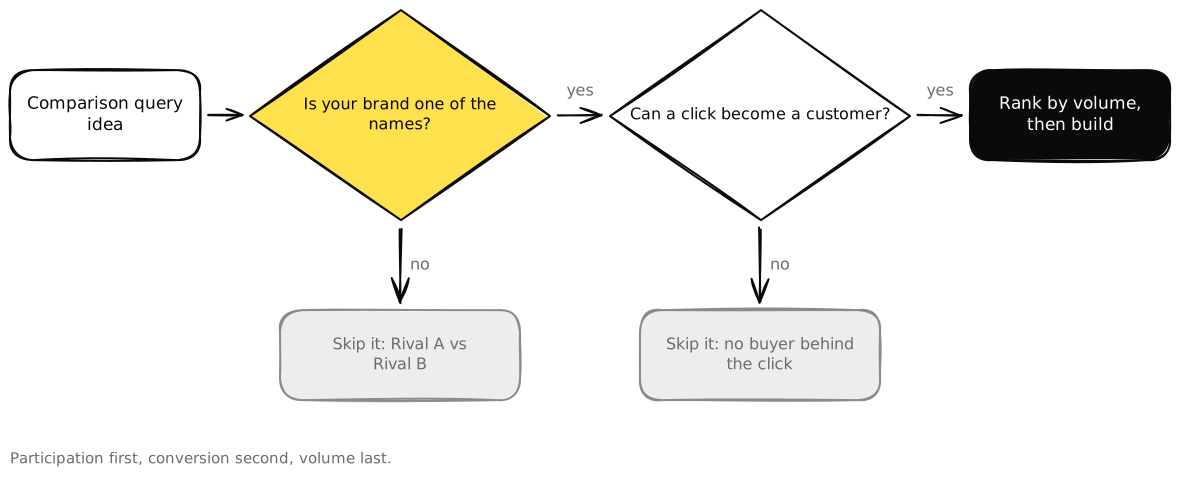 Participation first, conversion second, volume last. Most “A vs B” ideas drop out at the first gate.
Hub and spokes: how to structure an alternatives cluster
Once you know which competitors matter, give each one a small cluster instead of a single page.
The hub owns the head term. “Rival alternatives” is the page for anyone leaving that competitor. It lists the realistic options, yours included, with who each suits. It’s not a page where you’re the only answer.
The spokes own qualifiers. Each spoke answers a narrower version of the same exit question, where the answer changes and the buyer could act on it. “Rival alternatives for agencies.” “Cheaper alternatives to Rival.” “Migrating from Rival.” A spoke only earns its place if its answer is different from the hub’s. If it would say the same thing with a new heading, it’s a section, not a page.
The vs page sits beside the hub. “YourBrand vs Rival” is for the buyer who already has you on the list and wants the head-to-head.
This mirrors how engines break questions apart. Google describes its AI features as using “a ‘query fan-out’ technique, issuing multiple related searches across subtopics and data sources”. A buyer’s “best alternative to Rival for a small agency” becomes several searches, and a cluster gives each one a page that answers it directly. Our guide to query fan-out covers the same hub and spoke logic for other topics.
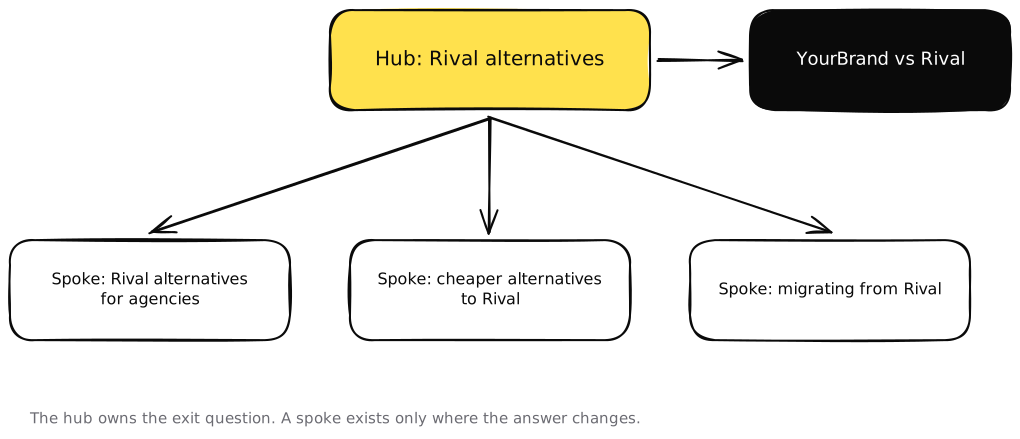 The hub owns the exit question. Spokes exist only where the answer changes.
How to build comparison pages that win AI answers
The six steps below follow the order of the work, from choosing the comparison to keeping it current. The order of the page itself matters as much as its content, so Steps 2 to 4 are written in the order a reader (and an engine) meets them.
Step 1: Pick comparisons from exit intent, not volume
Start with the comparisons your sales team already hears. If buyers keep asking how you differ from one incumbent, that vs page is overdue, whatever a keyword tool says about it. Then list the competitors your customers most often leave, because each one is a candidate hub.
For each candidate, ask two questions. Is your brand one of the names in the query? Could someone who clicks become a customer? Only then sort by volume. Qualifier queries (“alternatives for [segment]”, “cheaper”, “migrating from”) are long and specific, much like the prompts buyers type into AI assistants, and they describe a real need a page can meet.
Before writing, run each comparison as a question in ChatGPT, Perplexity and Google, and note which pages the answers cite. If an engine already cites your competitor’s comparison page, you know the bar. If it cites a directory’s automated page, the bar is usually lower than it looks.
Step 2: Put the comparison table first
The table goes at the top, right under a one-line intro. It’s the part AI Overviews and Perplexity tend to extract, and it’s the part a busy buyer reads before deciding whether to scroll.
- Use a plain HTML table. Not an image, not a tabbed widget that loads its rows with JavaScript. If a crawler can’t read the rows in the raw HTML, engines can’t quote them. Our checklist on blocking AI crawlers by accident covers how to test that.
- Pick rows on buyer criteria. Price model, starting price, key integrations, setup time, limits, support, contract terms. Include rows where the competitor wins. A table where you win every row tells the reader, and the engine, that the table was written by marketing.
- Write cells as facts, not ticks. “SSO on the Business plan and above” beats a green check. Engines can repeat a fact. They can’t repeat a tick.
- Date it. A visible “last checked” date under the table tells a reader the prices are current, and gives you a review trigger.
Step 3: Write a 40 to 60 word verdict, including who you’re not for
Directly under the table, write the verdict. Forty to sixty words, plain language, and it must say who each option is for. Including who you’re not for.
That last part is what makes the verdict quotable. An engine answering “which should a 10 person team pick” needs a “best for” statement it can trust, and a verdict that admits a limit reads as one. A verdict that says “YourBrand is the best choice for everyone” gives it nothing.
Two illustrative verdicts follow, one B2B and one B2C.
Verdict. Pick Rival if you’re a US-only team that wants the lowest per seat price and doesn’t need SSO. Pick YourBrand if you pay people in several countries or need SSO and audit logs from day one. If you have fewer than five employees, Rival’s free plan is probably enough.
Verdict. Pick Rival if you cook for one or two and want the widest recipe choice. Pick YourBrand if you’re feeding a family of four on a budget and want meals ready in under 20 minutes. If you need certified gluten-free meals, neither is the right fit.
Google’s guidance on reviews asks for the same thing in its own words. It tells writers to “cover comparable things to consider, or explain which might be best for certain uses or circumstances”, and to “explain what sets something apart from its competitors”. A verdict that sorts buyers by situation does both.
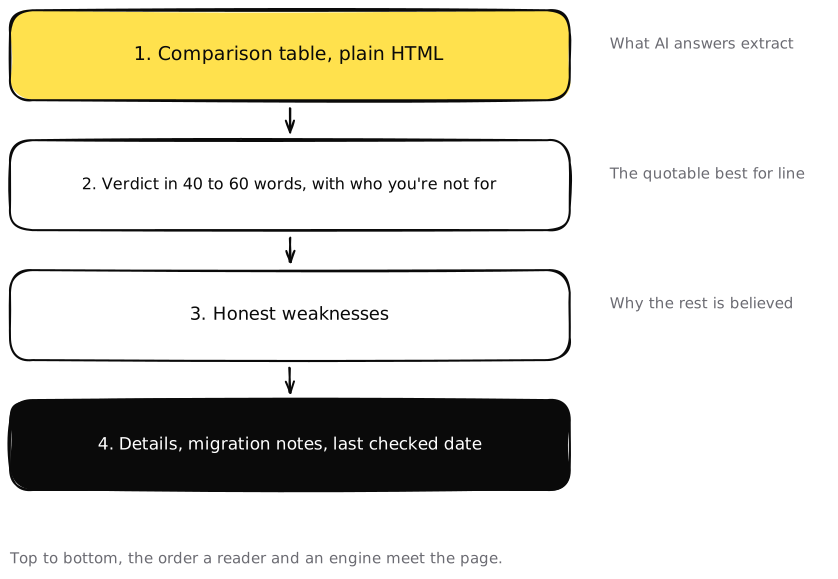 Table first, verdict second, weaknesses third. The order is what makes the page quotable.
Step 4: Write the honest weaknesses section
After the verdict, list where your product falls short against this competitor. Not a token weakness dressed as a strength (“we’re almost too thorough”). Real ones a buyer would find in a trial.
- Features the competitor has that you don’t.
- Segments where the competitor is the better pick, by size, budget, region or use case.
- Trade-offs in your pricing or packaging that some buyers won’t like.
Google’s reviews guidance asks writers to “discuss the benefits and drawbacks of something, based on your own original research”. A comparison page is a review with a conflict of interest, which is exactly why the drawbacks have to be on it. Readers know who wrote the page. Admitting a weakness is how you earn the rest of the table’s credibility.
There’s a sales reason too. A buyer who picks you after reading your weaknesses arrives with accurate expectations. A buyer who picks you from a page that hid them finds out in onboarding.
Step 5: Verify every competitor claim on their live pages, and date it
Every claim about a competitor gets checked on the competitor’s own live pages. Their pricing page, their docs, their changelog. Not a review site, not last year’s sales deck, not what an AI assistant says about them. If you can’t confirm a claim on their page, leave it out or mark it unconfirmed.
Naming competitors is allowed in most markets, with conditions. In the US, the FTC’s policy statement on comparative advertising “encourages the naming of, or reference to competitors, but requires clarity, and, if necessary, disclosure to avoid deception of the consumer”. In the EU, Directive 2006/114/EC permits comparative advertising when, among other conditions, it “objectively compares one or more material, relevant, verifiable and representative features of those goods and services, which may include price” and doesn’t discredit or denigrate the competitor. None of this is legal advice. In regulated categories, follow the stricter process in GEO for regulated industries, where balanced comparisons are part of the brief.
Then date the page and keep the date honest. A stale comparison page can feed a wrong AI answer, with an old price or a retired feature repeated to every buyer who asks. Our guide to knowledge graph optimization covers how those errors spread and how to correct them at the source.
Step 6: Link the cluster and keep it current
Link the hub to every spoke and every spoke back to the hub. Link the vs page from the hub, and from your pricing page if buyers compare on price. Use the competitor’s name in the anchor text, because that’s the question the page answers.
Set a review cycle per competitor. Recheck the table whenever they change pricing or ship something big, and on a fixed schedule otherwise. When a competitor retires a plan or renames a product, update the page the same week and say what changed.
Then measure what the pages earn. Run each comparison question in the engines and record whether your page is cited, how you’re described, and which competitor pages appear next to it. Our guide to AI share of voice covers the maths, and the citation rate of your comparison pages is a useful second line under it.
Why comparison pages win on craft, not links
Most SEO advice treats a competitive keyword as a link-building problem. Comparison pages are an exception. In the competitor comparison pages we’ve studied, the ones winning in search often rank on very few referring domains. What they have is structure. The query is precise, the table answers it, the verdict settles it, and nothing on the page fights the reader.
That fits what larger studies find about AI visibility. Ahrefs studied 75,000 brands and found branded web mentions correlated with AI Overview visibility at 0.664, against 0.218 for backlinks. Correlation isn’t causation, but it points the same way. Being named clearly, in the right context, matters more than raw link counts.
So the investment goes into the page, not the outreach. Real research on the competitor, a table with rows that cost you something, a verdict a sceptical buyer would accept. Our wider review of AI search ranking factors puts comparison pages in the same group as other pages that get extracted on craft.
The “best of” trap: don’t rank yourself first in your own list
There’s a tempting shortcut next to comparison pages. Publish “The 10 best [category] tools”, put yourself at number one, and let the engines pick it up. Ahrefs’ data says it still shows up in ChatGPT answers, and that it’s everywhere on Google.
The study found that a self-promotional blog list “still showed up in more than a third of ChatGPT responses in the software category when its publisher was recommended”. Across 250 “best X software” Google results, 169 (67.6%) featured a list where the company writing it ranked itself number one. Not everyone quoted in that study agreed with the tactic. Agency owner Wil Reynolds put it plainly: “Any marketer worth a damn knows listing yourself at the top of a list hosted on your site doesn’t build trust with buyers.”
Then the Google picture shifted. In February 2026, Lily Ray documented ranking volatility in January 2026, a couple of weeks after the December 2025 core update, with several SaaS and B2B brands losing between 29% and 49% of their organic visibility. Their blogs carried many self-promotional listicles, which she called “a major likely culprit”. Her reading is hedged, and Google hasn’t confirmed a cause, but the pattern is hard to ignore.
Our rule is simple. We never rank a client first in its own “best of” page. And when a client appears in someone else’s list, we remember that a listicle spot isn’t a recommendation. Answers often name two of the ten, so the entry needs concrete detail, such as pricing, integrations and limits, for an engine to have a reason to pick it. Honest vs and alternatives pages do the job the self-ranked list pretends to do, without the risk.
Comparison pages for B2B vs B2C
B2B: the page is read by a committee. One person finds it, and several people use it to defend a shortlist. Rows that matter are security, integrations, contract terms, implementation time and pricing model. Procurement will check your claims, so the dates and sources matter more than the design. SaaS comparison pages also go stale fastest, because packaging changes every few quarters. Our guide to GEO for B2B covers the other pages a committee checks.
B2C: the page answers a personal situation. “Is it worth switching for a family of four” is answered by price per serving, delivery areas, cancellation terms and who the product isn’t for. Alternatives pages matter more than vs pages here, because consumers leave a brand over one bad experience and ask for options. Keep the table short and the verdict concrete, and remember that engines answering shopping questions lean on product data and reviews as much as on your page.
Common comparison page mistakes
Comparing two products that aren’t yours. Volume without participation is traffic that doesn’t convert.
Winning every row. A table with no losses reads as an ad, to buyers and to engines.
Hiding the table. Tables in images, tabs or scripts can’t be extracted. Plain HTML, at the top.
A verdict that suits everyone. If it doesn’t say who you’re not for, it isn’t a verdict.
Unchecked competitor claims. Every claim checked on the competitor’s live pages, every page dated.
Spokes that repeat the hub. A qualifier page needs a different answer, not a different heading.
Ranking yourself first in your own list. Honest comparisons earn trust. Self-ranked lists borrow it. An AI visibility audit shows which comparison pages engines already cite on your buyer questions, and you can request one here.
Get a personalised case study
Pick your industry and we'll email you the case closest to your business, numbers included.
Frequently asked questions
What is a comparison page?
A comparison page is a page on your own site that sets your product next to a named competitor, or next to several alternatives, so a buyer can choose. The two common formats are the vs page (your brand vs one rival) and the alternatives page (options for people leaving a competitor). Done honestly, it says who each option suits, including when the other product is the better pick.
Should I build a vs page for two competitors that aren't me?
Usually not. Someone searching for two other products is choosing between products that aren't yours, and they're rarely shopping for a third. The traffic costs the same to earn as traffic that converts, and it rarely does. Rank comparison ideas by whether a click can become a customer first, and by search volume second. Build pages where your brand is one of the names.
Do AI engines cite comparison pages?
They cite comparison content heavily on shortlist questions. Ahrefs found that across 750 top-of-funnel prompts, 'best X' blog lists were 43.8% of all page types ChatGPT cited. On named comparisons, engines look for a clear table and a clear statement of who each option suits, so a page built that way gives them something specific to repeat. A one-sided page gives them a reason to look elsewhere.
Is it legal to name competitors on a comparison page?
In the US, the FTC's policy statement on comparative advertising encourages naming competitors, as long as the comparison is clear and not deceptive. In the EU, Directive 2006/114/EC allows comparative advertising that objectively compares material, relevant and verifiable features and doesn't denigrate the competitor. Check every claim on the competitor's live pages, date the page, and take legal advice for your market.
Should I rank my own product first in a best tools list on my site?
We don't. Ahrefs found self-promotional lists still appear in ChatGPT answers, but in February 2026 Lily Ray linked large Google visibility drops at several SaaS and B2B brands to self-promotional listicles, calling them a likely culprit. A list where the author always wins also reads as an ad to buyers. Write honest vs and alternatives pages instead, where your position is explained, not assumed.
How often should comparison pages be updated?
Whenever a competitor changes pricing, packaging or a key feature, and at least on a set review cycle. Put a visible 'last checked' date on the page and recheck every competitor claim against their live pricing and docs. A stale comparison is worse than none, because AI answers can repeat an old price or a retired feature to every buyer who asks.