
GEO for Financial Services, Healthcare and HR

Othmane Khadri · Founder, Earleads

Summary
GEO for financial services, healthcare and HR works when compliance comes first, not last. Agree in writing which claims can be made publicly, have the compliance owner sign off anything naming the brand, publish regulatory content from the brand's named account, take compliance content out from behind forms, and keep the directories regulated buyers trust accurate.
On this page
- Why regulated brands go missing from AI answers
- AI search compliance: the rules that shape GEO in each sector
- Step 1: Write down what you may claim before anyone writes
- Step 2: Agree who signs off, and when
- Step 3: Publish regulatory content from the brand’s named account
- Step 4: Ungate the compliance content engines need to read
- Step 5: Fix the directories and listings AI leans on
- Step 6: Check what engines already say about you
- GEO for financial services and fintech
- GEO for healthcare
- GEO for HR and employment
- B2B and B2C: same workflow, different sources
- What not to do
Why regulated brands go missing from AI answers
Regulated brands go missing from AI answers for a reason that has little to do with the engines. Their best material is either never published, published too late, or published somewhere engines can’t read. A bank’s clearest explanation of a product sits in a PDF behind a form. A health brand’s careful guide waits three months in review. An HR vendor’s country-by-country employment guide is “available on request”.
Meanwhile the questions don’t stop. Buyers ask ChatGPT, Perplexity, Gemini, Claude and Google’s AI features which account to open, which provider to trust, which payroll tool handles a new country. The engines answer with whatever they can read and cite, and in regulated categories that’s often an aggregator, a forum thread or a competitor that published first.
Google is open about the bar for these topics. It calls them “Your Money or Your Life” topics, ones that “could significantly impact the health, financial stability, or safety of people, or the welfare or well-being of society”, and says its systems “give even more weight to content that aligns with strong E-E-A-T” for them (Google). That’s good news for a careful brand. The rules that slow you down are the same signals that make a source worth citing.
So GEO for financial services, healthcare and HR isn’t a lighter version of GEO elsewhere. It’s the same work, with the compliance process moved to the front instead of bolted on at the end. This article covers that process. It isn’t legal advice, and your own compliance owner has the final word on every rule mentioned here.
AI search compliance: the rules that shape GEO in each sector
Every regulated sector has its own rulebook, but three questions decide most of the GEO work. What may you claim, who has to approve it, and does content you didn’t write still count as yours?
| Sector | Example rule | What it means for GEO |
|---|---|---|
| US broker-dealers | FINRA Rule 2210 requires a registered principal to approve each retail communication “before the earlier of its use or filing” (FINRA) | Pages and posts that reach more than 25 retail investors in 30 days go through principal approval. Plan the review into the calendar. |
| US broker-dealers, third-party sites | FINRA treats content as the firm’s own if it “paid for or been involved in the preparation of the content” or endorsed it (FINRA) | Paying for or shaping a third-party post, or sharing it, can make it your communication. Placement and community work need the same review. |
| UK financial promotions | A firm “must ensure that a communication or a financial promotion is fair, clear and not misleading” (FCA) | Comparisons, rates and risk wording have to be balanced in every source you control, including listings. |
| US health products | The FTC says randomized controlled trials “are generally the type of substantiation that experts would require for health benefit claims” (FTC) | Don’t publish outcome claims you can’t substantiate. Explain, don’t promise. |
| Any sector, employee posts | The FTC says employees “should disclose your relationship to the company”, and “listing your employer on your profile page isn’t enough” (FTC) | Staff answering questions in communities disclose who they work for, in the post itself. |
| HR and employment | Employment law differs by country and often by region | Every statement about a rule is tied to a jurisdiction, dated, and linked to its primary source. |
FINRA also spells out the content standard itself. Communications “must be fair and balanced”, may not make “any false, exaggerated, unwarranted, promissory or misleading statement or claim”, and generally “may not predict or project performance” (FINRA). Read those lines next to what makes a page citable, plain facts, sourced statements and honest comparisons, and they point in the same direction.
Step 1: Write down what you may claim before anyone writes
In a regulated market, product truth belongs to the client, in writing. Before a word is drafted, list the claims the brand wants to make and ask which of them can be restated publicly. Internal sales decks are full of statements that are true, approved for a pitch, and still not approved for a public page.
Keep the answers in a claims register. It’s a short document, one row per claim, with four columns.
- The claim, worded exactly as it may appear.
- The status. Approved for public use, approved with conditions, or not for public use.
- The source. The primary document that backs it, whether a regulation, a filing, a study or a product spec.
- The condition. A required disclaimer, a jurisdiction, a date after which it has to be rechecked.
When we worked on employment-law content across several EU countries, nothing was written until the client confirmed what could be said in each one.
The register also sets the policy lines that never move. Our own are simple. No health or medical claims, no promises of financial returns, no legal advice, and any statement about a regulation links to its primary source. Write yours down, and share them with every writer before they start.
Step 2: Agree who signs off, and when
The fastest regulated programmes aren’t the ones with the lightest review. They’re the ones where everyone knows in advance what goes to review and what doesn’t.
Split the work into two lanes.
- Anything that names the brand. Site pages, brand posts, listing descriptions, comparison entries, replies that mention the product. The client’s compliance owner signs these off. Nothing publishes without that approval.
- Practitioner content that doesn’t name the brand. A writer with lived experience answering a question about how a process works, with no product mention. The client approves the communities you may post in and names the ones that are off-limits. Agree with compliance up front whether these answers need a pass one by one or a standing approval of the guidelines they follow.
Either way, nothing publishes without the client’s approval. What changes is how much review each piece needs, and that’s decided once, in writing, before posting starts.
Batch the first lane. One approval pass per batch, on a fixed day, is easier for a compliance team than a stream of single requests. Brand phrasing gets approved once and then reused word for word, which also helps engines, since consistent wording across sources is easier to recognise.
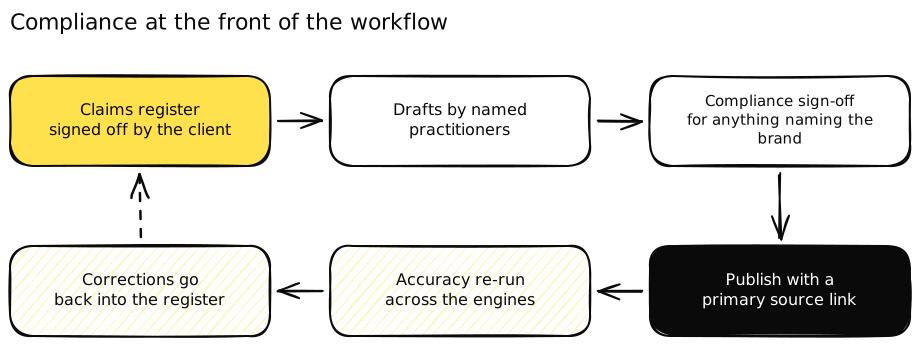 Compliance sits at the front of the workflow, not the end. The claims register decides what can be written before anyone writes it.
Step 3: Publish regulatory content from the brand’s named account
Community content matters in regulated categories, because buyers ask peers the questions they won’t ask a sales rep. Is this provider legit? Did anyone get their claim paid? How did you handle payroll when you hired in a new country? Engines cite those threads.
The question is who speaks. Our rule is that when the brand is the authority, the brand speaks under its own name. Regulatory analysis, product updates, an explanation of what a rule change means for customers, all of it posts from the brand’s named account, signed off like any other brand communication. That keeps the disclosure obvious, which is what the FTC asks of employees, and it keeps the content inside the review process, which is where FINRA’s adoption and entanglement guidance puts anything a firm shapes or pays for (FINRA).
Everything else follows our public forum standard, which matters even more here.
- A human submits every post. Nothing is auto-posted.
- Writers use a practitioner voice, not marketing copy, and have real history in the community.
- The brand is never the only option, appears once, and only where it answers the question.
- The client approves brand phrasing and names the communities that are off-limits.
- Some communities remove any vendor mention. Knowing which ones, and leaving them alone, is most of the skill.
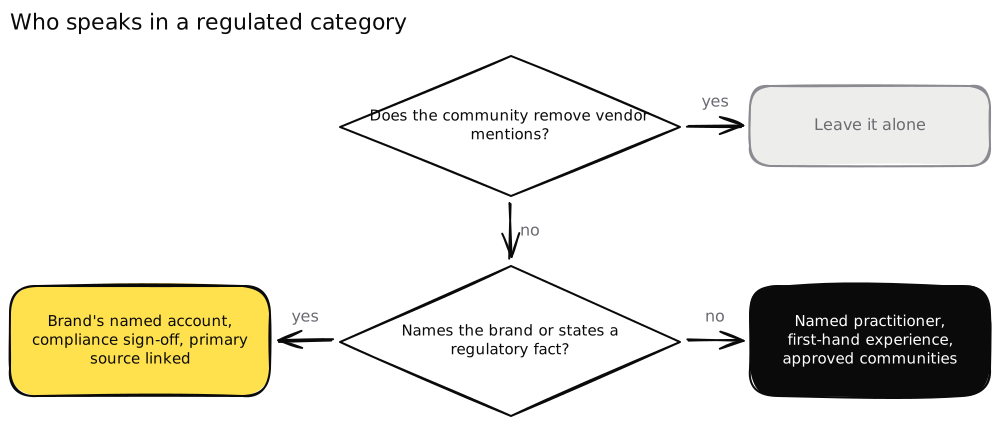 Who speaks depends on what’s said. Regulatory statements come from the brand, signed off, with the source linked.
We cover what makes a thread worth citing in the first place in how to get cited by AI.
Step 4: Ungate the compliance content engines need to read
Compliance content behind a form is invisible to AI. It’s also one of the simplest gaps to close.
Regulated brands gate their best material for good reasons. Lead capture, version control, a wish to know who downloads a regulatory guide. But crawlers don’t fill forms. Google notes that “some pages may not be accessible without logging in to the site” (Google), and to appear as a supporting link in AI Overviews or AI Mode, “a page must be indexed and eligible to be shown in Google Search with a snippet” (Google). ChatGPT’s search features rely on OAI-SearchBot to “surface websites in search results” (OpenAI). A PDF behind a form reaches none of them.
You don’t have to give up the leads. Split the asset.
- A public summary page. The key facts in plain HTML text. What the rule is, who it applies to, the dates, what it means in practice, each statement linked to its primary source, with a visible “last reviewed” date.
- The full guide, still gated. Templates, checklists, the detailed country tables. The page sells the download, and engines can cite the page.
Then check the page is actually readable. A guide published through a theme that renders text with JavaScript, or a CDN that blocks AI bots by default, is gated in practice even without a form. OpenAI notes that each of its crawler settings “is independent of the others” (OpenAI), so a rule meant to block training can be set without blocking search. We go through the usual traps in do you block AI crawlers by accident.
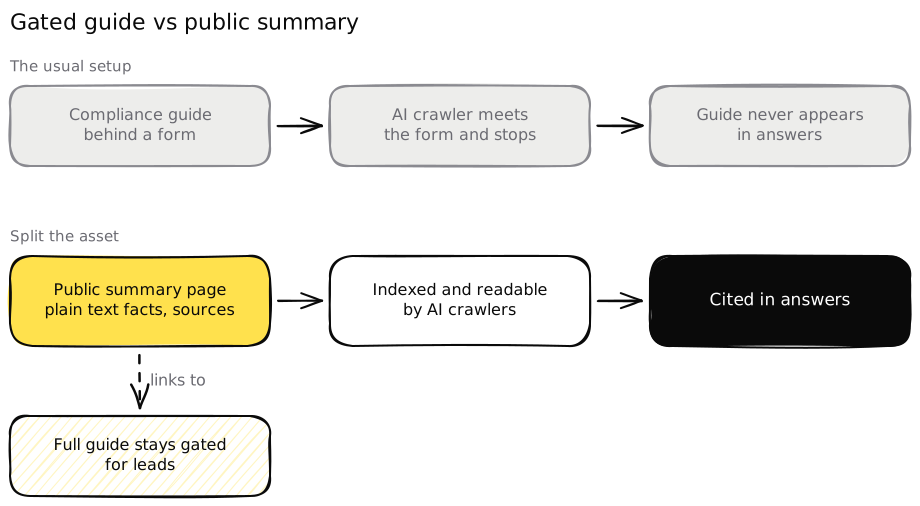 Keep the full guide gated if you need the leads. Publish the facts on a public page engines can read and cite.
Step 5: Fix the directories and listings AI leans on
Regulated buyers lean on curated directories. They check a provider’s listing, its licence, its reviews, before they check its website. Engines do something similar, which is why accurate listings are part of the work and not an afterthought.
The sources differ sharply by sector. BrightEdge found that for the week of 23 August 2026, ChatGPT’s five most cited healthcare domains were nih.gov at 43%, medlineplus.gov at 33%, mayoclinic.org at 27%, cdc.gov at 18% and clevelandclinic.org at 17%, and that “ChatGPT’s healthcare top five is entirely government and hospital domains” (BrightEdge). A health brand won’t edit those pages. It can make sure its own pages cite them, and that the provider and product directories it does control are accurate.
Finance and HR software look different. Comparison publishers, review sites, software directories and professional bodies show up far more often. Don’t guess which ones matter. Run your buyer questions, open the citations and list the directories that appear, then work down that list.
For each listing, check four things. The legal name and licence or registration details, the products and the markets you actually serve, any rates, fees or eligibility rules (stale numbers are a compliance problem, not only a marketing one), and the description, which should use the same approved wording as your site.
Mentions matter more than links here. Ahrefs studied 75,000 brands and found branded web mentions correlated with AI Overview visibility at 0.664, against 0.218 for backlinks (Ahrefs). One line we never cross, in any sector. We don’t pay for reviews, testimonials or a ranking position in someone else’s list, and in regulated markets it’s often a legal line too.
Step 6: Check what engines already say about you
In a regulated category, a wrong AI answer isn’t only a lost mention. It can be a compliance problem you didn’t create. An engine that quotes a rate you withdrew, describes a product as available in a country where you aren’t licensed, or attributes a health benefit you never claimed is putting words in your mouth.
So every audit we run includes an accuracy check. We list each factual claim the engines make about the brand, covering pricing, product, positioning and leadership, mark what’s wrong or stale, and record the source each answer leans on. In a regulated market, add eligibility, licensing and the markets you serve to that list. Ask sales and support to log any AI claim a prospect or customer repeats, because the most dangerous wrong answer is the one sales hears first.
The fix is the same as for any inaccurate answer. Find the source in the citations, correct it there, publish the correct version on pages engines already read, and re-run until the description holds. In regulated markets, feed each correction back into the claims register, so the next writer starts from the corrected fact. We describe the loop in detail in AI reputation management, and the tracking side in AI brand tracking.
GEO for financial services and fintech
Banks, insurers, wealth managers, lenders and payments companies share one pressure. Buyers ask AI to compare providers, and comparison is exactly where promotion rules bite.
A few practices make the difference.
- Facts over adjectives. “Fees from X per month, no minimum balance, FDIC insured through partner bank Y” is citable and reviewable. “The best account for freelancers” is neither.
- Balanced comparisons. If you publish a comparison page, include who you’re not for. It’s what fair and balanced looks like in practice, and engines quote honest verdicts.
- No performance promises. No projected returns, no implied guarantees, anywhere you control. That includes listing descriptions and community replies.
- Dated rates. Every rate, fee and limit carries the date it was checked. Stale numbers are where AI answers and compliance problems overlap.
GEO for fintech adds a wrinkle. Many fintechs sit on a partner bank’s licence, and engines often blur the two, or describe the fintech as a bank. State the relationship in one plain sentence on your site and in every listing, using the wording your partner bank and your compliance owner have approved.
GEO for healthcare
Health brands, from digital health and telehealth to medical devices, pharmacies and health insurers, face the highest bar and the clearest opportunity. Engines lean on institutional sources for health questions, so a brand earns citations by explaining well and pointing to those sources, not by competing with them.
- Explain, don’t promise. Conditions, eligibility, coverage, how the service works, what happens at each step. Leave outcome claims out unless they meet the substantiation standard the FTC describes.
- Name the reviewer. Content reviewed by a named clinician, with credentials and a review date, is what readers and raters look for on these topics.
- Cite primary sources. Link to the guideline, the agency page or the study, not to a blog summarising it.
- Keep patient stories inside the rules. Health data and testimonials carry their own privacy and consent rules in most markets. Your compliance owner decides what can be used, and where.
GEO for HR and employment
HR software, payroll, employer of record and benefits providers sell into a category built on law that changes by country, by state and by year. Buyers ask AI how a rule works before they ask which vendor handles it, and engines cite whoever explains the rule clearly.
That makes the claims register even more important. Every statement about an employment rule names its jurisdiction, links to the primary legal source, and carries a review date. When a rule changes, the pages that explain it change first, and the community answers that mention it get updated or followed up.
Write as a practitioner, not as a vendor. An answer that explains how a probation period or a notice requirement works in a given country, and mentions the product only where it genuinely helps, is the kind engines cite and moderators leave up. Never present an explanation as legal advice, and say so on the page.
B2B and B2C: same workflow, different sources
B2B. Buying committees in regulated categories include risk, legal and compliance people, and they ask their own questions. “Is this vendor SOC 2 certified?” “Is this payroll provider licensed in Germany?” Make the answers public, plain and dated on a trust or compliance page, because a security questionnaire answered by an engine from a stale source can stall a deal. We cover how AI shortlists vendors in GEO for B2B.
B2C. Consumers asking which savings account, insurance plan or telehealth service to choose check fewer sources and act faster. Consumer promotion rules are often stricter, and review sites, app store listings and comparison publishers carry more weight. Keep those listings accurate first, and keep the same approved wording on every one of them.
What not to do
No one controls what an AI engine says, so be wary of anyone who guarantees ChatGPT will recommend your bank, clinic or HR platform. In a regulated market, that promise is also a red flag about how the rest of the work will be done.
A few other mistakes come up again and again. Publishing first and asking compliance later. Letting staff post about the product from personal accounts without disclosure. Paying for placements that nobody reviewed. Leaving the clearest explanation of a rule behind a form. And measuring success by reach instead of by whether engines describe you accurately on the questions that don’t name you.
An Earleads audit starts with whether AI crawlers can read your site, then measures the buyer questions your team signs off, and includes the accuracy check described above. You can request an audit, read what an AI visibility audit should show you, or see how large teams organise the work in GEO strategy for enterprises.
Get a personalised case study
Pick your industry and we'll email you the case closest to your business, numbers included.
Frequently asked questions
Is GEO allowed for financial services firms?
Yes. Nothing in the rules forbids being cited by AI. What the rules govern is what you publish and where. In the US, FINRA Rule 2210 requires a registered principal to approve retail communications before use, and FINRA treats third-party content you paid for or endorsed as your own. Build GEO inside that process and it's ordinary marketing, reviewed the ordinary way.
Can healthcare brands get cited by ChatGPT without making medical claims?
Yes, and that's usually the better route. Engines cite plain, sourced explanations, which is what a compliance team wants anyway. Explain conditions, eligibility, coverage and how the product works, link each statement to its primary source, and leave outcome claims out unless they're substantiated to the standard the FTC expects. In health, that generally means randomized controlled trials.
Should compliance review every forum reply?
Anything that names the brand or states a regulatory fact needs the compliance owner's sign-off, every time. For practitioner answers that don't mention the brand, agree with compliance whether each one is reviewed or whether a standing approval of the guidelines and communities covers them. Decide it in writing before posting starts, so writers never guess and reviewers never get surprised.
Why don't AI engines cite our compliance guides?
Usually because they can't read them. A guide behind a form, a login or a PDF download wall isn't indexed, and Google says a page must be indexed and eligible for a snippet to appear as a supporting link in AI Overviews or AI Mode. Publish a public summary page with the key facts in plain text and keep the full guide gated if you need the leads.
Which directories matter most in regulated categories?
The ones engines cite on your buyer questions, which you find by reading the citations. In health, ChatGPT leans heavily on government and hospital sources. In finance and HR software, review sites, comparison publishers and professional directories show up more. Check the listings that appear in your own answers, then correct them at the source, starting with the most cited.
Does this apply to consumer finance and health brands as well as B2B?
Yes. A consumer asking which savings account, telehealth service or insurance plan to choose gets an AI answer the same way a benefits buyer does. Consumer brands face stricter promotion rules in many markets, and their buyers check fewer sources before acting, so an inaccurate or missing answer costs more. The workflow is the same, only the sources differ.