GEO Strategy: How Enterprises Win Their Niche in AI Search

Othmane Khadri · Founder, Earleads

Summary
A GEO strategy for a niche starts with your won deals, not with keywords. Take the words buyers used when they picked you, turn them into the painful questions they ask Google, ChatGPT and Perplexity, run each one 100+ times to map who gets cited, find out when the winner started winning and why, then go after the exact sources the answers read.
On this page
- How do you win in AI search when you’re better on a niche?
- The 6-step GEO strategy at a glance
- Step 1: Analyze the deals you want to win
- Step 2: Compare which competitors show up today
- Step 3: Derive the painful queries buyers actually type
- Step 4: Monitor every prompt 100+ times and build the citation map
- Step 5: Check since when they win and what they did
- Step 6: Build the exact plan to go after them
- Why enterprises lose niches they should own
- How Earleads runs this for enterprise teams
How do you win in AI search when you’re better on a niche?
You win by being the obvious answer to a narrow question, not the loudest brand on a broad one. Most enterprises we talk to have the same problem. They know they beat competitors on a few use cases. Sales can name the deals. But when a buyer asks ChatGPT or Perplexity about exactly that use case, a bigger or louder competitor gets named instead.
That gap matters more every quarter. G2 surveyed 1,076 B2B software buyers in March 2026. Half of them (51%) now start research in an AI chatbot more often than in Google, up from 29% a year earlier. And 69% said they picked a different vendor than planned because of what a chatbot recommended (G2, April 2026). Forrester counts 13 internal stakeholders and 9 external influencers in a typical buying decision (Forrester, January 2026). That’s a lot of people asking a lot of different questions.
Consumer brands face the same thing with a different buyer. A shopper asking for “the best stroller for a small apartment with stairs” is a niche question too. The method below works for both.
A quick note on who’s writing this. Earleads runs this work for companies, so we have a stake in it. We don’t name clients or quote their results here, and nothing below promises a ranking. It’s the method, step by step.
The 6-step GEO strategy at a glance
- Mine your won deals for the words buyers used and the reasons they gave for picking you.
- Map the competitors that show up for those use cases today.
- Derive the painful queries buyers type into Google, ChatGPT and Perplexity.
- Run each prompt 100+ times and build a citation map of who gets named and which pages get cited.
- Find out since when the winner wins and what they did to get there.
- Build the attack plan from what you found. Backlinks, third-party citations, Reddit, LinkedIn, Substack and technical fixes, in the order the map tells you.
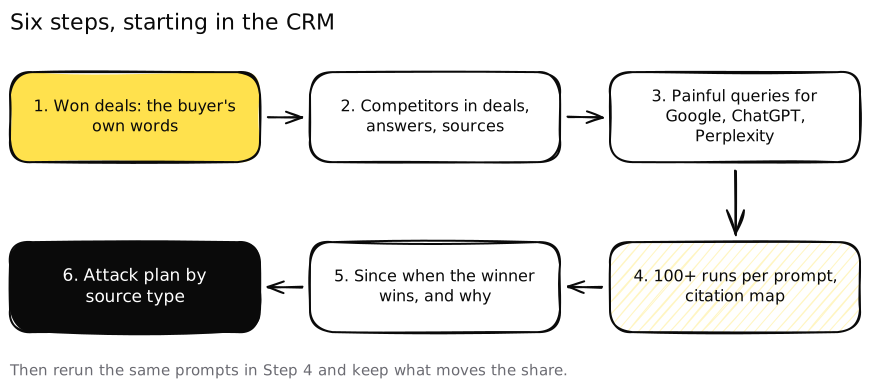 The strategy starts in your CRM, not in a keyword tool. Everything after Step 1 inherits its words.
Step 1: Analyze the deals you want to win
Every GEO page we’ve read starts prompt research by brainstorming or asking the AI. That gives you generic prompts. Your won deals give you the real ones.
Pull the last 20 to 40 deals you won in the niche you want to own. Then pull the evidence of how the buyer talked. That means call recordings and transcripts, the first inbound message or form fill, RFP language, the business case the champion wrote internally, and any reasons logged at closed-won. Lost deals in the same niche help too, because they show which competitor you lost to and how the buyer framed it.
Look for three things.
The problem in their words. Buyers rarely say “we need a [category] platform.” They say things like “our audit trail breaks every time we add a new region” or “we can’t get carrier rates for oversized freight in under a day.” Write down the exact phrases, including the awkward ones.
How they described you as better. This is the part most teams skip. Did they say you were the only option that handled a specific regulation? Faster on a specific workflow? The one that worked with their existing system? Those sentences are your positioning, written by the people you need to convince.
What triggered the search. A new regulation, a failed audit, a merger, a price change at the incumbent. Triggers become the “why now” part of the prompts in Step 3.
This matters because buyers word the same need very differently. In SparkToro’s study with Gumshoe, 142 people each wrote their own prompt for the same need, and the average semantic similarity between their prompts was 0.081 (SparkToro, January 2026). The authors compared it to the gap between “Kung Pao Chicken and Peanut Butter.” If you guess the prompts, you’ll track the wrong ones.
Step 2: Compare which competitors show up today
You already know who you compete with in deals. AI answers may disagree. Start a working list with three groups.
- Deal competitors. The vendors that appear in your won and lost deal notes for this niche.
- Answer competitors. The brands AI names when you ask a handful of your niche questions by hand. Expect surprises here, including adjacent tools, open source projects and companies you’ve never met in a deal.
- Source competitors. Publishers, review sites, consultancies and creators that get cited instead of any vendor. Sometimes the thing beating you is a comparison article, not a company.
For each one, note what the answer says about them. Is it a feature claim, a customer quote, a price point, a “best for” label? That phrasing tells you which source the answer is leaning on, which is what Step 4 measures properly.
A table like this is enough at this stage.
| Competitor | Type | Named for which use case | How the answer describes them | You beat them in deals? |
|---|---|---|---|---|
| Competitor A | Deal + answer | Multi-region compliance | “Industry leader, widely adopted” | Yes, on audit trail |
| Competitor B | Answer only | Same | “Popular open source option” | Never met in a deal |
| Analyst blog | Source | Same | Cited as the comparison | n/a |
Step 3: Derive the painful queries buyers actually type
Now turn the deal language into queries. You need two versions of each, because people search and prompt differently.
Google queries are short and keyword shaped. “multi region audit trail software”, “oversized freight rate quote api”. Check search volume and difficulty for these, but don’t drop a query because volume looks small. Niche, high-intent queries often show tiny numbers and still decide six figure deals.
AI prompts are longer, carry context and often name a competitor or a constraint. Some patterns we use:
- The problem plus the trigger. “We just failed an audit because our logs don’t cover our EU entities. What tools handle this?”
- The comparison. “Is Competitor A good for multi-region audit trails or is there something better?”
- The constraint. “Best option for X that works with SAP and doesn’t need a 6 month rollout.”
- The skeptic. “What are the downsides of Competitor A for X?”
- Each committee member’s angle. Security asks about certifications, finance about cost, the end user about the workflow.
Google’s own documentation explains why the related questions matter. AI Overviews and AI Mode “may use a ‘query fan-out’ technique,” running several related searches behind a single question (Google Search Central). Winning the main question means having good answers on the sub-questions the engine generates around it.
Aim for 15 to 30 prompts per niche. More than that and you’ll spread the work too thin. Fewer and you’ll miss how differently people ask.
Step 4: Monitor every prompt 100+ times and build the citation map
This is where most AI visibility tracking goes wrong. People run a prompt once, see their brand or don’t, and draw conclusions. AI answers aren’t stable enough for that.
SparkToro and Gumshoe ran 12 prompts between 60 and 100 times each, 2,961 runs in total across ChatGPT, Claude and Google AI. They found less than a 1 in 100 chance that ChatGPT or Google AI returns the same brand list twice in 100 responses, and about 1 in 1,000 for the same list in the same order (SparkToro). Their conclusion was that visibility percentage across many prompts run many times “is a reasonable metric,” while rank position isn’t.
So we run each priority prompt at least 100 times per engine. That’s a sampling choice, not a magic number. At 100 runs, a brand that shows up in about half the answers is measured within roughly 10 points either way, which is tight enough to see a real change from one month to the next. At 10 runs, the same measurement could be off by 30 points.
For every run, record:
- Which brands are named, and in what words.
- Which URLs are cited, and their domains.
- The engine, the date and whether the answer used web search.
Aggregate that into a citation map. For each prompt and engine, you get how often each brand appears and which pages keep getting cited. The pages matter more than the brands, because they’re what you can act on.
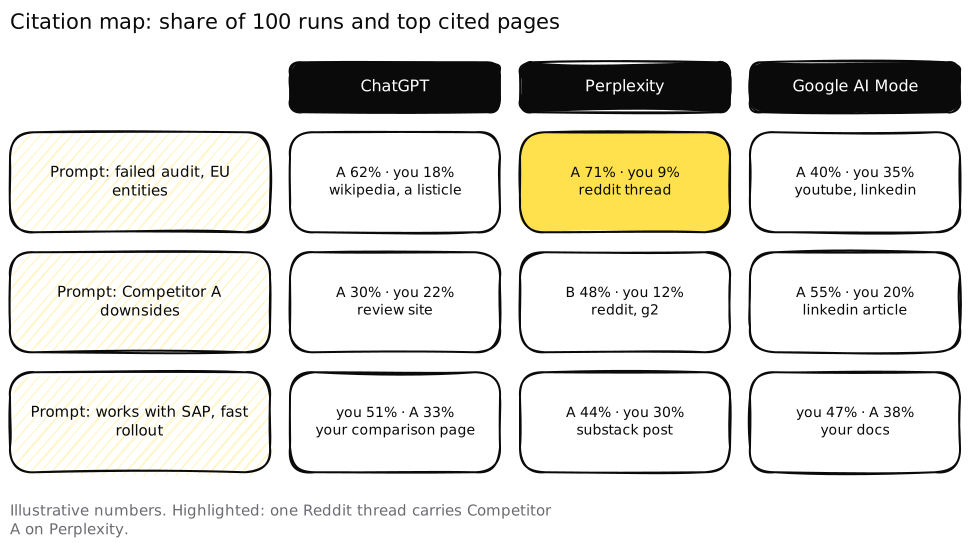 Run the same prompt 100 times per engine. The share of runs and the cited pages are the signal, not one answer.
Map engine by engine, because they read different sources. Peec AI’s analysis of 30 million cited sources in the US found Reddit, YouTube, LinkedIn and Wikipedia at the top overall, but the order shifts by engine. ChatGPT leaned on Wikipedia and Reddit, AI Overviews and AI Mode on YouTube and Reddit, and Perplexity on Reddit and YouTube (Peec AI, March 2026).
And keep the map running. Semrush tracked over 230,000 prompts weekly for 13 weeks and watched ChatGPT cite Reddit in close to 60% of responses in early August 2025, then around 10% by mid September (Semrush, November 2025). A one-off audit can be out of date within weeks.
Step 5: Check since when they win and what they did
The citation map tells you who wins. This step tells you how they got there and how long it took. It’s the step we see skipped most often, and it’s the one that turns a report into a plan.
Take the five to ten pages cited most often for the competitor that wins your niche. For each page, find out:
When it appeared. Publication dates on articles and LinkedIn posts, the date on Reddit threads, the first Wayback Machine snapshot of a comparison page, and when review counts on directories started climbing.
Who published it. The competitor, a customer, an employee posting as an individual, a paid placement, an analyst, a creator. A Reddit thread started by an account that only ever mentions one vendor tells a different story than a thread full of independent practitioners.
What triggered it. Line those dates up against the competitor’s own activity. A product launch, a funding round, a conference talk, a new partner program, a push for reviews, a series of customer case studies. Patterns show up fast once the dates sit side by side.
Then check their link and mention profile over the same period in a backlink tool. A burst of new referring domains or brand mentions around the time they started showing up in answers usually means a deliberate campaign, and you can usually see its shape.
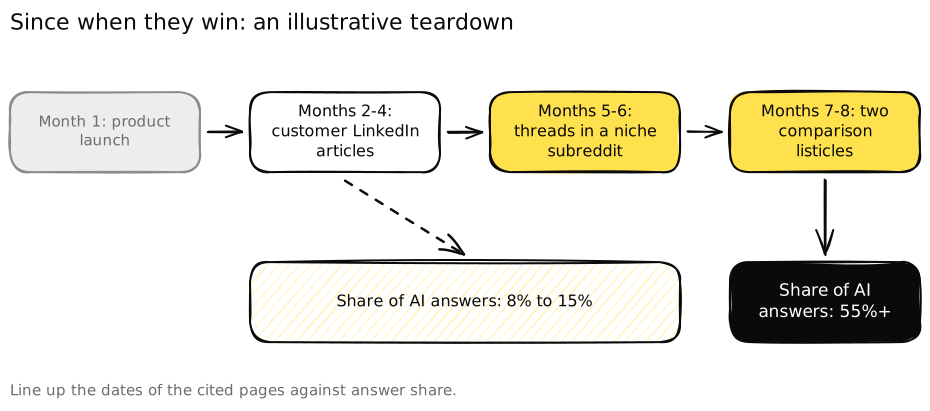 An illustrative teardown. Lining up dates against answer share shows which activations moved the needle.
Two things come out of this step. First, a list of the activation types that worked in your niche, so you aren’t guessing. Second, a rough sense of the effort involved. If the winner built their position over 18 months of steady customer content, you know a single press release won’t flip it.
Step 6: Build the exact plan to go after them
Now you have the map and the history. The plan follows from them, source type by source type. Don’t do everything. Do what the map says the answers read in your niche.
Third-party citations and mentions. Ahrefs studied 75,000 brands and found branded web mentions correlated with AI Overview visibility at 0.664, against 0.218 for the number of backlinks (Ahrefs, May 2025). A follow-up across ChatGPT, AI Mode and AI Overviews found YouTube mentions had the strongest correlation, at about 0.737 (Ahrefs, December 2025). Correlation isn’t causation, as the author says, but the direction is clear. Get named on the comparison articles, review directories, analyst notes and videos the citation map flagged. Bring them the proof from Step 1, in the buyer’s words.
Backlinks. They still help, mostly as a supporting signal and because they help the cited pages rank in the first place. Prioritize links from the pages and publishers that already appear in the answers, not generic link volume.
Reddit. If threads show up in your map, join the communities where they live. Write honest, specific posts and comments from people who actually do the work, clearly say who they work for, and follow each subreddit’s rules. Talk about the niche problem, the tradeoffs and where your product isn’t the right fit. A thread that reads like an ad gets downvoted and ignored, by people and by answers. Google has had access to Reddit’s Data API since 2024 for exactly this kind of real-time content (Google, February 2024), and OpenAI announced its own Reddit partnership the same year.
Customer testimonials on LinkedIn. Semrush and LinkedIn analyzed 325,000 prompts and found LinkedIn was the second most cited site, appearing in 11% of AI answers on average and 14.3% on ChatGPT Search. Articles made up 50 to 66% of the LinkedIn content cited, and individual members accounted for 59% of LinkedIn citations on ChatGPT and AI Mode (Semrush, March 2026). So ask the customers from Step 1 to write a 500 to 2,000 word LinkedIn article under their own name about the problem and how they solved it. Authors with small followings got cited as often as big ones in that study.
Substack and niche newsletters. Practitioners in narrow fields often read and write in newsletters, and those posts can turn up in AI citations. Check whether newsletters appear in your map. If they do, offer the authors data, a customer to interview or an honest guest post on the niche problem, not a sponsored mention.
Technical fixes on your own site. These are the cheapest wins and the ones most often blocked by accident.
- Let the search crawlers in. OpenAI’s OAI-SearchBot surfaces sites in ChatGPT search, and sites that block it won’t appear in those answers (OpenAI). Perplexity’s PerplexityBot does the same job for Perplexity (Perplexity). Both say changes take about a day.
- Make sure niche pages are indexed and snippet eligible, with no stray nosnippet tags. That’s Google’s stated requirement for appearing as a supporting link in AI features.
- Publish a page per niche use case that uses the buyer’s own words from Step 1, states the proof in plain text and includes an honest comparison with the competitors from Step 2.
- Keep those pages current. Ahrefs found pages cited by AI assistants were on average 25.7% fresher than pages in regular Google results, with ChatGPT leaning hardest toward fresh content (Ahrefs, July 2025).
Our guide on how to get cited by AI goes deeper on the on-page side, and what an AI visibility audit should show you covers what a good tracking report looks like.
Then go back to Step 4. Rerun the same prompts on the same schedule and watch which activations move your share of runs on which engines. Drop what doesn’t move anything. Do more of what does.
Why enterprises lose niches they should own
The pattern repeats across the teams we work with. It’s rarely that the product is worse. It’s usually one of these.
- Positioning written for the category, not the niche. The homepage says “the leading platform for X,” so answers have nothing specific to cite for the narrow question.
- Proof locked in sales decks. The best customer stories live in PDFs and calls, not on pages and third-party sites AI can read.
- Tracking the brand name. Prompts that include your name tell you nothing about whether a buyer who doesn’t know you yet will find you.
- One-off audits. A snapshot taken once, in an environment where cited sources shift within weeks.
- Spreading too wide. Chasing 300 generic prompts instead of owning the 20 that map to won deals.
How Earleads runs this for enterprise teams
This is how we run the six steps in practice, without client details.
We start with access to won and lost deal notes for the niche the client wants to own, and build the prompt set from buyer language the client approves. We run each prompt at least 100 times per engine across ChatGPT, Perplexity and Google’s AI features, and build the citation map at page level. We do the since-when teardown on the winner’s top cited sources. The attack plan is then carried out by a team, with a GTM engineer running the tracking and data, writers producing the pages and articles, and people earning mentions on Reddit, LinkedIn and newsletters in an honest, disclosed way. AI agents handle the repeated runs and the monitoring, and people make the calls.
The tracking keeps running after the first round, so every activation is measured against the same prompts. If you’re comparing partners for this, our guide on how to choose a GEO agency lists the questions to ask any of them, us included. For the B2B pipeline side of the same work, see GEO for B2B.
If you want to see where you stand on your own niche first, our free AI visibility audit maps the conversion queries your competitors are winning, shows who wins each one on every engine, and lists the pages and threads the answers read.
Frequently asked questions
What is a GEO strategy?
A GEO strategy is a plan for getting your brand named and cited when buyers ask AI assistants like ChatGPT, Perplexity, Gemini or Google's AI Mode for recommendations. It covers which questions you need to win, who wins them today, which sources the answers read, and what you'll publish, earn and fix to change that. For enterprises the useful version is narrow. It targets the use cases you actually win in deals.
How do you beat a bigger competitor in ChatGPT answers?
Don't fight them on generic prompts like 'best CRM'. Pick the niche use cases where you win deals, use the exact words those buyers used, and track those prompts over many runs. Then look at which pages the answers cite for the winner, when those pages appeared, and go after the same types of source with better proof. Specific, verifiable claims beat brand size on narrow questions.
How many times should you run a prompt to measure AI visibility?
Enough to measure a frequency, not a single answer. SparkToro and Gumshoe found less than a 1 in 100 chance that ChatGPT or Google AI returns the same brand list twice across 100 runs. We run each priority prompt at least 100 times per engine. At that sample size a brand that shows up half the time is measured within roughly 10 points either way, which is enough to see real movement.
What is AI share of voice?
AI share of voice is the share of AI answers, across a set of prompts and repeated runs, that mention your brand compared with competitors. A useful version is split by engine and by prompt, because ChatGPT, Perplexity and Google's AI features cite different sources. Pair it with citation tracking, which records which pages the answers link to, so you know what's driving the number.
How long does a GEO strategy take to show results?
It depends on what the winner built and how long it took them. Technical fixes such as unblocking AI crawlers can take effect within about a day, according to OpenAI and Perplexity. Earning mentions on the threads, articles and directories the answers read takes longer. That's why Step 5 matters. Knowing when your competitor started winning tells you roughly how much ground you have to cover.
Do enterprises need a GEO agency to run this?
Not always. You need someone with access to won deal notes, someone who can run and read prompt tracking at volume, and people who can earn honest mentions on Reddit, LinkedIn, newsletters and directories without spamming them. Large teams often have the pieces but no single owner. An agency helps when the off-site work needs more hands, or when you want the method set up and handed over.