
How to Choose a Generative Engine Optimization Agency
The short answer
Choose a generative engine optimization agency by how it picks the questions it tracks, which sources it works on beyond your site, and whether it can show what AI visibility did for pipeline. Good agencies baseline before they promise anything, track the questions buyers really ask, and never guarantee a spot in ChatGPT or AI Overviews.

What does a GEO agency actually do?
A generative engine optimization agency gets your brand named and linked in the answers ChatGPT, Claude, Gemini, Perplexity and Google AI Overviews give when buyers ask about your category. A GEO agency, also sold as an AEO agency, an LLM SEO agency or an AI search optimization agency, does that by working on the pages and sources those engines read, then measuring which questions you win.
A word on who’s writing this. Earleads is a GEO agency, so we sell the thing this guide helps you buy. We don’t rank anyone here. Read it as a rubric, and hold us to it as hard as anyone else on your shortlist.
Two facts from Google frame the job. Google says “there are no additional requirements to appear in AI Overviews or AI Mode, nor other special optimizations necessary,” and that a supporting link must be “indexed and eligible to be shown in Google Search with a snippet” (Google Search Central, AI features). The same page says AI Overviews and AI Mode “may use a ‘query fan-out’ technique, issuing multiple related searches across subtopics and data sources.” So a GEO agency’s work starts with ordinary search foundations, then widens to every source a fan-out can land on.
In practice, AI answers draw on five kinds of sources, and a serious agency will tell you which of the five it touches. We wrote up how AI agents pick what to recommend separately. For choosing an agency, the map below is enough.
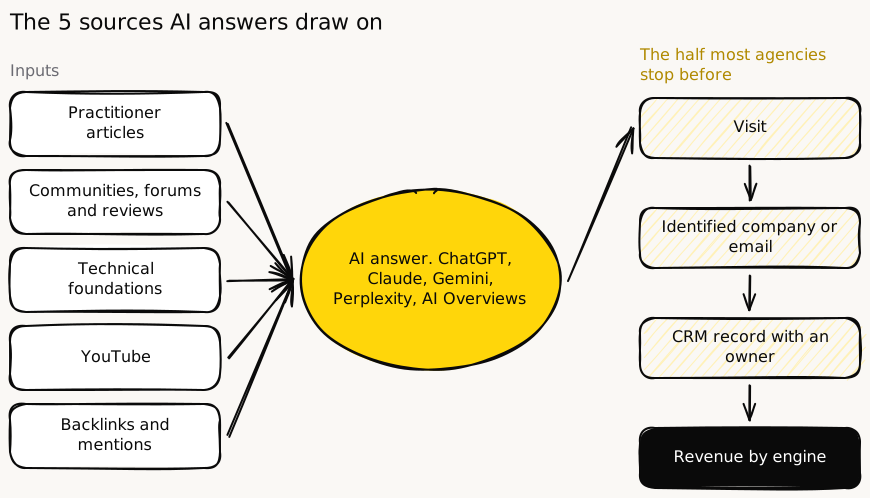 Five sources feed the answer. Most agencies stop at the answer, before the visit ever reaches your CRM.
The bottom half of that picture is where buyers get burned. A citation is a line in a chat window. It isn’t revenue until someone clicks, gets identified, lands in your CRM with an owner, and buys.
Before you talk to a GEO agency, write down 3 things
If you show up to the first call empty-handed, you’ll leave with the agency’s prompt list, success metric and timeline. Three short notes flip that.
The 10 to 20 questions your buyers ask before they buy
Pull them from sales call notes, support tickets, review sites, and the threads where buyers compare options. A B2B payroll vendor might write “best payroll software for a 50 person team.” A skincare brand might write “fragrance free moisturizer for sensitive skin.” None of them should contain your brand name. This list is yours, and every agency you talk to should be measured against it, not against a list it wrote.
The 2 or 3 numbers that would make this worth it
Pick numbers you already track. For a sales-led B2B company that’s often AI-referred demo requests and meetings. For a B2C app or store it’s accounts created or orders. Write today’s value next to each one, even if it’s zero. An agency that can’t say how its work would move one of those numbers is selling you a dashboard.
Who on your side approves content fast
Every good GEO engagement stalls on approvals at some point. Name one person who can say yes to a draft within a few days. If nobody can, fix that before you sign with any generative engine optimization agency, because the fee keeps running while drafts wait.
If you’d rather not build the baseline alone, our free AI visibility audit maps 5 conversion queries in 7 days, shows who wins each one on every engine, and lists the pages and threads the engines read. Bring it to every agency call, ours included.
12 questions to ask a GEO agency (and what good and bad answers sound like)
Every guide on how to choose a GEO agency lists questions. Few tell you what a good answer sounds like, which is the only part that helps on a live call. Google’s own page on hiring an SEO is a good template. It suggests asking for past work, asking “What results and timeframe should I expect, and how do you measure success?”, and asking whether every change will be communicated with reasoning. We’ve adapted that to AI answers.
1. Which questions will you track, and who approves the list?
- A good answer sounds like “We’ll draft the list from your sales calls, reviews, community threads and search data, then you approve every question before we measure anything.”
- A red flag answer sounds like “We use our standard prompt set,” or a sample list where half the prompts include your brand name.
2. What is our baseline today, by engine?
- A good answer sounds like “Here’s a citation map per question and per engine, built before we sent the proposal.”
- A red flag answer sounds like a single AI visibility score with no questions behind it.
3. Which engines do you measure, and how often do you rerun the checks?
- A good answer sounds like “ChatGPT, Gemini, Claude, Perplexity and AI Overviews, rerun on a fixed schedule, because answers change week to week.”
- A red flag answer sounds like one engine, or one screenshot from last month.
4. Which sources outside our site will you work on?
- A good answer sounds like a named list of the practitioner sites, communities, videos and pages the engines already read for your questions.
- A red flag answer sounds like “We’ll publish more blog posts.”
5. What will you change on our site first, and why?
- A good answer sounds like “Crawler access and indexing first, then the few pages closest to buying questions.”
- A red flag answer sounds like a site-wide rewrite, or “schema everywhere” as the whole plan.
6. Who writes the content, and who checks it?
- A good answer sounds like named writers with domain knowledge, and you approve every piece before it goes live.
- A red flag answer sounds like a volume promise with unnamed writers and AI-only drafts.
7. How do you connect a citation to pipeline or sales?
- A good answer sounds like “Tagged AI referrals, identified visits, CRM records with an owner, and revenue reported by engine.”
- A red flag answer sounds like “Citations are the KPI.”
8. What can you promise, and what can’t you?
- A good answer sounds like “We promise the work, the cadence and the reporting. Nobody can guarantee placement in an AI answer.”
- A red flag answer sounds like guaranteed citations, guaranteed rankings or “position 1 in ChatGPT.”
9. What would make you change the plan?
- A good answer sounds like a stated rule, for example “If a question hasn’t moved after a set number of weeks, we switch to a different source.”
- A red flag answer sounds like “Trust the process.”
10. Show me one case. What changed, when, and what else happened at the same time?
- A good answer sounds like dated changes, before and after per question, and honest caveats about what else moved.
- A red flag answer sounds like a percentage with no baseline and no timeframe.
11. What do you need from us each week?
- A good answer sounds like a named approver, a short weekly review, and access to analytics and the CRM.
- A red flag answer sounds like “Nothing, we handle it all.”
12. What do we keep if we stop?
- A good answer sounds like “The audit, the question list, the content and the tracking setup are yours.”
- A red flag answer sounds like everything living inside their tool and disappearing with the contract.
Questions 1, 7 and 12 do the most work. If a GEO agency answers those three well, the rest of the call is usually detail. If it fumbles question 1, stop there, because every number it reports afterward depends on that list.
Red flags that should end the call with a GEO agency
Google’s guidance for hiring an SEO is blunt. “No one can guarantee a #1 ranking on Google,” and its warning signs include refusing to explain methods and keeping changes secret (Google Search Central). Even agencies that publish rankings agree. Digital Elevator writes that “no agency can guarantee that a brand will appear in a specific AI answer, because the platforms control their own models and citation logic and change them frequently” (Digital Elevator).
End the call, or at least stop taking it seriously, when you hear any of these:
- Guaranteed citations, rankings or “position 1 in ChatGPT”
- No baseline before the proposal
- They chose the prompts and won’t show them, or the prompts contain your brand name
- One engine only
- Reporting that ends at mentions or a visibility score
- A method they can’t explain in plain words, or changes they won’t name in advance
- Tactics only on your own site, nothing on the sources answers are built from
- Pricing with no deliverables attached
- Results promised inside 30 days
- No exit, with your data and content locked in their platform
One more, quieter flag. Watch for a GEO agency that has one playbook for every market. The KDD 2024 GEO paper from Princeton and IIT researchers found GEO methods “can boost visibility by up to 40% in generative engine responses,” and in the same abstract that “the efficacy of these strategies varies across domains, underscoring the need for domain-specific optimization methods” (Aggarwal et al., KDD 2024). The 40% is a research ceiling, not a promise anyone can sell you. The second sentence is the useful one. What works for developer tools won’t automatically work for pet food.
Vanity prompts vs buyer prompts
A vanity prompt is one written so the dashboard looks good. “Is [Brand] a good tool?” “What does [Brand] do?” “[Brand] reviews.” An engine asked about you by name will usually talk about you, so a report built on those prompts shows high visibility from week one. It also predicts nothing, because buyers who already know your name aren’t the ones you’re trying to reach.
A buyer prompt is the question someone asks before they know you exist. “Best payroll tool for a 50 person team.” “Alternative to [incumbent] for ecommerce.” “Is [category] worth it for a small team?” Your share of answers on those questions is low at first and hard to move. That’s exactly why it’s the number worth paying for.
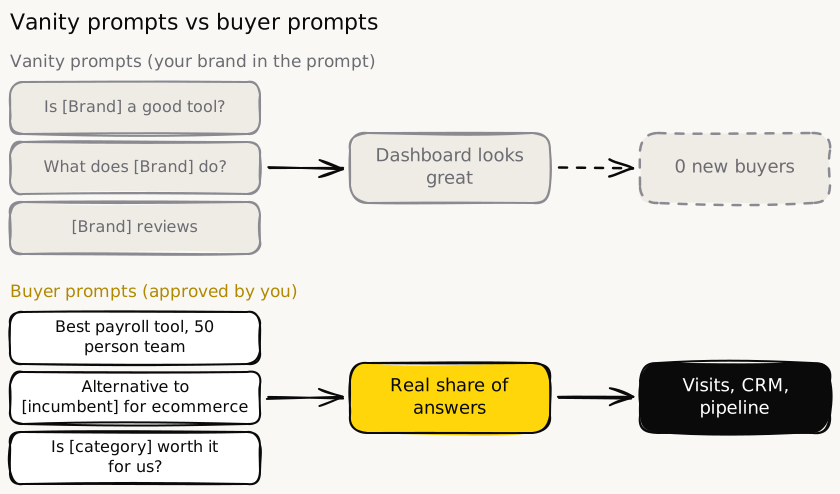 If your brand name is in the prompt, the test is rigged.
The test takes two minutes. Ask every finalist for the exact prompt list they’d track, then count how many contain your brand name. Our rule is simple. Branded prompts belong in a separate reputation check, and they shouldn’t count toward any visibility number an AI SEO agency reports to you.
How much does a GEO agency cost?
Published ranges for GEO agency pricing run from about $1,500 a month for small companies to $10,000 a month for most mid-market teams, with enterprise retainers well above that. Three agencies publish numbers on their own pages:
- WebFX’s GEO pricing guide gives $1,500 to $5,000 a month for small businesses, $5,000 to $25,000 and up for mid-size companies, and $25,000 to $50,000 and up for enterprise. It says its own AI Search Optimization service starts at $3,000 a month.
- Direct Online Marketing publishes GEO tiers at $3,500 a month, from $6,500 and from $9,500, with working media included in the upper two.
- Digital Elevator states that most credible mid-market GEO retainers land between $2,000 and $10,000 a month.
Five things move the price inside those ranges. How many engines get tracked. How much content gets written, and by whom. Whether community and video work is included or left to you. How much technical fixing your site needs. And whether attribution to your CRM is part of the scope or an extra.
Compare fees only after you normalize them. Put each proposal’s deliverables side by side, add the hours your own team will spend approving and supplying input, and divide. A cheaper retainer that eats several hours a week of your head of marketing can cost more than a pricier one that runs on a short weekly review. If a proposal lists a price without deliverables, you can’t run that math at all, which is why it’s on the red flag list.
What a good GEO engagement looks like over 6 months
A good GEO engagement has a diagnosis you keep, a short sprint against numbers baselined on day one, and a renewal decision made on evidence. Use the timeline below as a buyer’s checklist. It’s also how we run our own engagements, so judge us by it too.
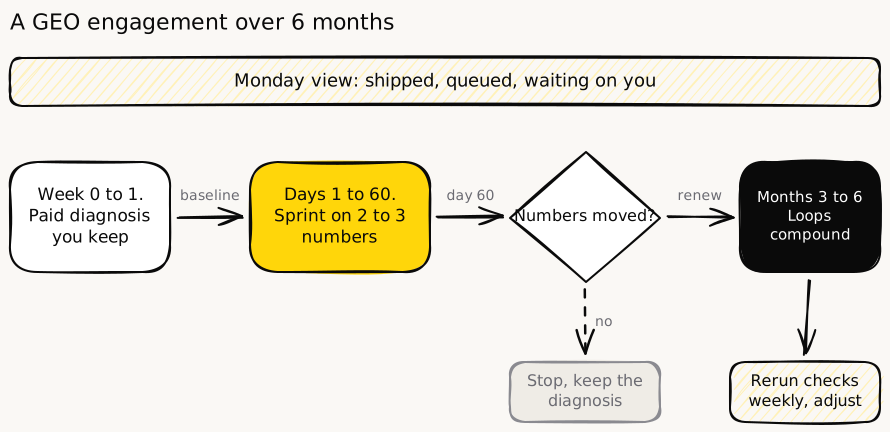 Diagnose, sprint on 2 or 3 numbers, decide at day 60, then let the loops compound.
Week 0 to 1, a diagnosis you keep
The citation map, the sources the engines read for each question, and the question list for your approval. At Earleads this is a paid audit, and you own it whether or not you hire us. Whoever runs it, insist the diagnosis is yours.
Days 1 to 60, a sprint on 2 or 3 baselined numbers
Not a long list of goals. Two or three, each with a day-one value. A sprint that short forces the agency to pick the few pages, threads and fixes most likely to move them, and it gives you a clean decision point at day 60.
Months 3 to 6, loops compound
Checks get rerun every week and the plan adjusts. Our own term is six months, renewable, because month three is the earliest the loops start compounding. A contract much longer than that, with no evidence checkpoint, asks you to pay for faith.
A weekly view you’ll actually open
One page, every Monday. What shipped, what’s queued, what’s waiting on you. Ours is put together by a GTM engineer, a copywriter and AI agents working the account together, and it’s the same page the client sees.
B2B vs B2C, what changes when you hire
Search results for this topic split into B2B SaaS lists and ecommerce lists. The questions to ask a GEO agency are the same for both, but the prompts, the sources and the success metric aren’t.
B2B, committees and comparisons
B2B buyers ask committee questions and comparison questions. “Alternative to [incumbent] for a mid-size sales team.” “Does [category] integrate with Salesforce?” A good B2B GEO agency works the practitioner articles and communities where those comparisons happen, and it measures success in pipeline and meetings, not traffic. Ask it to show you how an AI-referred visit becomes a named account in your CRM.
B2C and ecommerce, products and reviews
B2C buyers ask product, review and “best for me” questions. “Best running shoes for flat feet.” “Is [brand] worth it?” Communities and video carry more weight here, and so does product feed readiness. A good GEO agency for ecommerce reports accounts created and orders, and it can talk about your product data, not just your blog.
GEO agency, SEO agency or in-house?
Pick on two things. Who already owns your search foundations, and whether anyone on your side can work off-site sources and attribution every week. Google’s point that AI features run on the same foundations as search means a strong SEO setup isn’t wasted. It’s the floor, not the whole job.
| Option | Pick it when | Watch for |
|---|---|---|
| GEO agency | You need multi-engine tracking, off-site source work and attribution, and nobody in-house has time for all three | Vanity prompts, reporting that stops at citations, no exit terms |
| SEO agency adding GEO | Your SEO agency already performs and will commit to buyer questions and multi-engine reporting in writing | GEO as a relabeled SEO retainer with an AI visibility score bolted on |
| In-house team | You have a writer with domain depth, someone who can participate in communities, and analytics access | Nobody owning the reruns, so measurement quietly stops after a few months |
Whichever you choose, the technical floor is the same. OpenAI says “OAI-SearchBot is used to surface websites in search results in ChatGPT’s search features” and that “sites that are opted out of OAI-SearchBot will not be shown in ChatGPT search answers” (OpenAI, bots). GPTBot, the training crawler, is separate. Perplexity says PerplexityBot “is designed to surface and link websites in search results on Perplexity” and isn’t used to train foundation models (Perplexity, bots). Check your robots.txt for both before you pay anyone.
Measurement has a floor too. ChatGPT adds utm_source=chatgpt.com to the links it sends from search results, according to OpenAI’s publishers and developers FAQ, so ChatGPT referrals are easy to separate in your analytics. Google is different. Sites in AI features “are included in the overall search traffic in Search Console,” inside the normal Web report (Google Search Central). So when an agency shows you “AI Overview traffic from Search Console,” ask how it was separated out, because Google doesn’t split it for you.
Should you trust “best GEO agency” lists?
Use them to build a longlist, not to decide. Most ranked lists of the best GEO agencies on page one are published by an agency, and the publisher usually sits in first place. Some of those lists are well researched, but a ranking written by a vendor can’t tell you which generative engine optimization agency fits your buyers.
The 12 questions and the scorecard below work better, because they apply the same test to every agency, including whoever wrote the list you found them on. Fill one column per finalist after each call.
| What to compare | Strong answer | Weak answer | Agency A | Agency B |
|---|---|---|---|---|
| Prompt selection | Drafted from your buyers, approved by you | Their standard set, or branded prompts | ||
| Baseline | Citation map per question and engine before the proposal | A single visibility score | ||
| Engines | ChatGPT, Gemini, Claude, Perplexity, AI Overviews | One engine | ||
| Off-site sources | Named communities, sites and videos | “More blog posts” | ||
| Content team | Named writers, you approve | Unnamed writers, AI-only drafts | ||
| Attribution to CRM | AI referrals traced to records and revenue by engine | Citations as the KPI | ||
| Reporting cadence | Weekly, one page | Monthly deck, or on request | ||
| What you keep | Audit, question list, content, tracking | Everything stays in their tool | ||
| Published price | Price tied to deliverables | Price with no scope | ||
| Guarantee language | Promises work and reporting only | Guarantees citations or rankings |
An agency that wins most rows on the strong side is worth a second call. An agency that lands on the weak side for prompt selection or guarantee language isn’t, whatever it scores elsewhere.
Frequently asked questions
How much does a GEO agency cost?
Published ranges start around $1,500 a month for small companies and reach $25,000 to $50,000 and up for enterprise, according to WebFX's own GEO pricing guide. Digital Elevator puts most credible mid-market retainers between $2,000 and $10,000 a month. The fee alone tells you little, so ask each agency what every tier delivers and how much of your team's time it needs.
Can a GEO agency guarantee I get cited in ChatGPT?
No. OpenAI, Google, Perplexity and Anthropic decide what their engines cite, and they change how they do it. Google's own advice on hiring an SEO says no one can guarantee a #1 ranking, and the same logic applies to AI answers. A good GEO agency promises the work, the cadence and the reporting, never a placement.
How long until a GEO agency shows results?
Ask for a baseline on day one and 2 or 3 numbers to move within the first 60 days. That's enough time to see whether the work is landing on the questions you picked. Compounding usually takes months, because off-site sources and new pages take time to be read and reused, so treat any promise of results inside 30 days with caution.
Is a GEO agency different from an SEO agency?
Partly. Google says its AI features rely on the same foundations as search, with no special optimization required, so solid SEO still matters. A GEO agency adds three things most SEO agencies don't run by default. It tracks buyer questions across several AI engines, works on the off-site sources answers draw from, and reports on citations and AI referral traffic.
What should a GEO agency deliver?
A GEO agency should deliver a baseline citation map per question and engine, a question list you approve, technical fixes so crawlers like OAI-SearchBot and PerplexityBot can read your pages, content and off-site work on the sources answers draw on, and a weekly report that ties AI referrals to visits, CRM records and pipeline.
What is the best GEO agency for B2B SaaS or ecommerce?
The best GEO agency for B2B SaaS or ecommerce is the one that tracks your buyers' real questions and can show dated results on similar ones. Most ranked lists of GEO agencies are written by an agency that places itself first. Run every finalist through the same 12 questions and the scorecard instead, including the agency that wrote the list.