
GEO Pricing: What Enterprise GEO Costs and What Drives It

Othmane Khadri · Founder, Earleads

Summary
GEO pricing runs from about $1,500 a month for a small programme to $25,000 to $50,000 or more for enterprise, according to WebFX's own guide. Published agency price lists cluster between $3,000 and $10,000 a month, and tracking tools add $29 to about $500. Scope sets the price, so compare what each quote pays for before you compare totals.
On this page
- How much does GEO cost?
- Published GEO prices, from the sellers’ own pages
- What drives the price of enterprise GEO
- The five GEO pricing models, and what each one rewards
- What AI visibility tools cost for a real question set
- How to build an enterprise GEO budget
- Step 1: Count the questions and engines
- Step 2: Count markets and languages
- Step 3: Size the community work
- Step 4: Decide who ships site changes
- Step 5: Set the placement line and the day 90 test
- Enterprise, mid-market, B2B and B2C: how the price scales
- When GEO isn’t worth paying for
- Red flags in a GEO quote
How much does GEO cost?
GEO pricing in 2026 runs from about $1,500 a month for a small programme to $25,000 to $50,000 or more for enterprise. That’s the range WebFX gives on its own GEO pricing guide, with $5,000 to $25,000 and up for mid-size companies in between. Tracking software sits on top or inside those fees, from $29 a month to custom enterprise contracts.
Those ranges are useful as a frame and useless as a quote. SEYBOLD, an agency that publishes its own GEO prices, collected the figures that market comparison sites publish for generative engine optimization pricing and found that “between the lowest and highest figure lies a factor of thirty” (SEYBOLD, July 2026). A spread that wide doesn’t mean some agencies overcharge by thirty times. It means “GEO” covers anything from a monthly dashboard to a multi-market programme with native writers, site engineering and community work.
So this guide does three things. It puts the price lists sellers publish on their own pages side by side. It separates the five pricing models, because the model decides what the agency is paid to do. And it lists what should move an enterprise quote, and what shouldn’t.
A word on who’s writing. Earleads is a GEO agency, so we sell what this guide prices. We don’t publish our own price here, and we don’t rank anyone. Every number below comes from the seller’s own page, checked on 15 October 2026.
Published GEO prices, from the sellers’ own pages
The most honest data on GEO agency pricing is what agencies and tools publish about themselves. Most ranges you’ll see quoted in roundups are a vendor’s estimate of the market. A price list is a commitment.
| Seller | Offer | Published price | Model |
|---|---|---|---|
| WebFX | AI search optimization service | From $3,000 a month | Retainer |
| Direct Online Marketing | Foundational, Growth, Acceleration | $3,500, from $6,500, from $9,500 a month | Retainer, working media included in the upper two |
| Tenten | GEO Audit | From $1,299 one time, credited toward a plan | Audit then retainer |
| Tenten | Content Engine + Tracking | From $4,999 a month, month to month, 90 day proof period | Retainer with a proof period |
| SEYBOLD | Measurement only, Visibility Growth, Visibility Dominance | From €149, €2,500 and €6,000 a month, ex VAT | Tiered retainer |
| SEYBOLD | AI visibility workshop, 2.5 hours | €1,500 one time | Project |
A few agencies also publish what they think the wider market charges. WebFX gives project work at $5,000 to $50,000 and hourly consulting at $50 to $300. Gripped, a UK agency working with B2B SaaS companies, says most SaaS companies spend £1,500 to £6,000 a month, standalone audits run £3,000 to £8,000, and the first three months “typically cost more than steady-state,” so it suggests budgeting 20 to 30% higher at the start (Gripped, July 2026).
Read the table for its shape, not its averages. Entry retainers start around $3,000 a month. The named upper tiers stop near $10,000. Above that, almost everyone says “custom,” which is where enterprise GEO lives. That’s why the cost drivers matter more for an enterprise buyer than any published band.
What drives the price of enterprise GEO
Five things move an enterprise GEO quote. When we scope work, these are the only lines that change the price, and they’re a fair test for any proposal you receive.
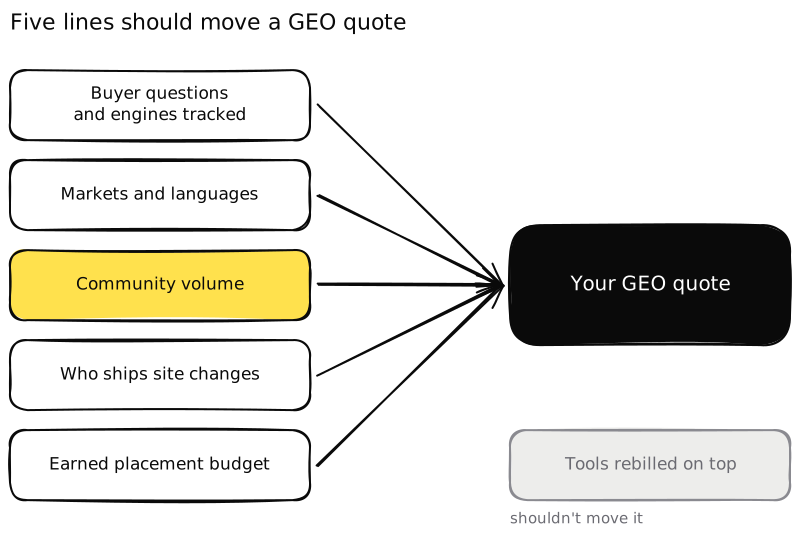 Five lines should move a GEO quote. Tools rebilled on top of the fee shouldn’t be one of them.
1. How many buyer questions and engines get tracked. Every question has to be written, run, re-run and read on every engine you care about. Fifty questions on five engines is a different job from fifteen on one. We track 50 to 60 buyer questions per client across ChatGPT, Perplexity, Gemini, Claude and Google’s AI features, built from positioning and sales language rather than a keyword tool.
2. How many markets and languages. Each market needs its own questions, its own sources and writers who know it. For a foreign-language market, that means someone who has lived there for years, not a translation pass. A two-market programme isn’t twice the price of one, but it’s never the same price.
3. Community volume. Answers lean heavily on discussion forums and online communities, so off-site work is often the biggest line. Our rule of thumb is about half the monthly mentions of the category leader, spread across the communities where buyers ask. A category with a loud leader costs more to enter than a quiet one.
4. Who ships site changes. If your developers ship fixes in a day, the agency writes tickets. If they can’t, someone has to take the website work on, and that’s real engineering time. What slows most programmes down isn’t access, it’s site fixes sitting in a backlog.
5. The earned placement budget. Getting named on pages that answers already cite sometimes involves a placement fee. Mentions matter here. Ahrefs found branded web mentions correlate with AI Overview visibility at 0.664, against 0.218 for backlinks, across 75,000 brands (Ahrefs, May 2025). Placement fees should come out of an approved budget line, never get added on top of it.
What shouldn’t move the price is tools. Subscriptions, crawlers and data tools are our cost, and we never rebill them. Some agencies do rebill, which is a legitimate choice as long as the quote says so. WebFX’s own guide lists three budget models, software only, service with software included, and service plus separate software (WebFX). Ask which one you’re being sold before you compare totals.
The five GEO pricing models, and what each one rewards
The pricing model tells you what an agency is paid to do, which is often a better predictor of the work than the fee. Gigabit, a growth agency, lists three models on its own page. A monthly retainer, “the most common, because GEO is continuous work,” fixed project fees for audits, and performance-based pricing “priced against an outcome like citation rate” (Gigabit, July 2026). In practice we see five.
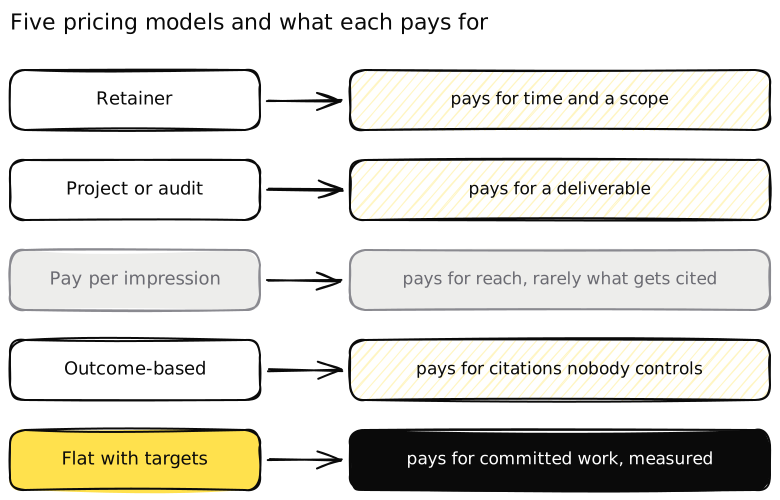 The model decides what the agency is paid to chase. Reach is easy to sell and rarely what gets cited.
Retainer: pays for time and a scope
A monthly fee for a defined scope. It’s the default for good reasons, because GEO doesn’t finish. The risk is a retainer with no scope attached, which pays for effort and lets the deliverables drift. A retainer is only as good as the list of what it buys each month.
Project or audit: pays for a deliverable
A fixed fee for a defined output, usually an audit or a content overhaul. It’s the cleanest way to test an agency before a retainer. Tenten credits its audit fee toward any plan that follows (Tenten), which is one way to lower the cost of finding out. Check what you keep. Our own audit is paid, takes 10 working days, and is the client’s whether or not they hire us. A good AI visibility audit should be useful to any team that reads it.
Pay per impression or per placement: pays for reach
The fee follows views, posts or placements. It’s easy to report and easy to inflate. We dropped pay per impression for one reason. It rewards reach, and reach isn’t what gets cited. In one programme, the high-reach threads earned no citations while far smaller threads written around a literal buyer question earned them all. A model that pays for reach pushes the work toward the part that doesn’t compound.
Outcome-based: pays for what nobody controls
The fee is tied to citation rate, mention rate or share of answers. GenOptima, for example, describes its model as “Results-as-a-Service” (GenOptima). It looks like the safest deal for the buyer. The catch is that the engines decide what they cite, and they aren’t consistent. SparkToro’s research across 2,961 runs found “a <1 in 100 chance” that ChatGPT or Google’s AI gives the same list of brands in any two responses (SparkToro, January 2026). If you go this way, read exactly how the outcome is measured, on which questions, and who picked them.
Flat with written targets: pays for committed work
A flat fee for volumes the agency controls, such as pages shipped, threads posted and fixes made, with targets for what the engines decide written into the same contract and reported every month. This is how we price. The targets keep both sides honest, and the commitments are the only thing anyone guarantees. Google’s advice on hiring an SEO applies word for word. “No one can guarantee a #1 ranking on Google” (Google Search Central). Nobody can guarantee a spot in ChatGPT either. Our guide to GEO services shows how to split the two lists in a contract.
Most good engagements combine two models. A paid audit first, then a flat sprint of 60 or 90 days against two or three numbers baselined on day one. Tenten’s 90 day proof period is a version of the same idea. It gives you a decision point before you commit to a year.
What AI visibility tools cost for a real question set
Every GEO budget includes tracking, either inside the agency’s fee or on your own card. Tool prices look small next to a retainer, but they depend entirely on how many questions and engines you track. Here’s what the public plans say, on monthly billing.
| Tool | Entry plan | Mid plan | Upper plan | Engines |
|---|---|---|---|---|
| Otterly | $29, 15 prompts | $189, 100 prompts | $489, 400 prompts | ChatGPT, AI Overviews, Perplexity, Copilot included. AI Mode, Gemini and Claude are add-ons |
| Peec | €85, 50 prompts | €205, 150 prompts | €425, 350 prompts | Choose 3 models. Enterprise covers up to 13 |
| Semrush AI Visibility Toolkit | $99, 25 tracked prompts | +50 prompts for $60 | Extra domain $99 | Not listed on the toolkit page |
| Profound | Free 7 day trial, 50 prompts | Custom | Custom enterprise, up to 9 engines | ChatGPT, Gemini, AI Overviews on trial |
Now run the maths on a realistic enterprise set of 60 buyer questions on five engines. On Otterly, the Standard plan covers the prompt count and four engines. Adding Gemini at $59 and Claude at $109 brings it to $357 a month, before you add AI Mode at another $59. On Peec, the Pro plan covers 150 prompts but three models, so five engines means talking to sales. On Semrush, the toolkit plus one prompt add-on gives 75 tracked prompts for $159 a month.
Two things follow. First, the tool line for a serious programme is a few hundred dollars a month, so a quote that rebills tools at thousands is padding. Second, the tool is the cheap part. The expensive part is deciding which questions to track and what to do about the answers. Tools are good at counting and bad at deciding.
Our advice is to buy the cheapest tool that covers your engines, track questions your sales team has signed off, and check it once a month against a live run in each engine, logged out. Ask whether your tool queries engines through an API or the live interface, because API answers aren’t always what buyers see. When the tool and the live run disagree, trust the live run. Our AI search analytics guide covers what to measure beyond the tool.
How to build an enterprise GEO budget
You can estimate your own GEO budget before you speak to an agency. Work through the five drivers in order, and you’ll know which quotes are priced on scope and which are priced on a guess.
Step 1: Count the questions and engines
List the questions your buyers ask before they talk to sales, in their words, not yours. Keep only the ones where an answer exists and you’re missing from its sources. For most enterprise categories that’s 50 to 60 questions. Pick engines by where your buyers are, not by what’s fashionable. Then price tracking on the tool table above. If you need help writing the list, our enterprise GEO strategy guide shows how.
Step 2: Count markets and languages
Each market is its own question set and its own set of sources. Budget native writers for each one, and ask any agency who will write in each language. Get the name. If the answer is “our team” with no names, the work will be translated, and translated threads read like it.
Step 3: Size the community work
Look at how often the category leader gets mentioned in the forums your buyers read each month. Half of that is a sensible target volume. Ask every agency how it decides which threads to work on. The right answer is by how often engines cite a thread, not by upvotes or views.
Step 4: Decide who ships site changes
Count the developer time you can give. One developer hour in week one and fast tickets after that is enough if your team ships. If fixes wait in a backlog, budget for the agency to take the website work on, or the programme will stall at the most basic step, crawler access.
Step 5: Set the placement line and the day 90 test
Set an earned placement budget the agency spends line by line with your approval. Then agree the test you’ll run at day 90. What does a citation cost, against what a customer is worth? That one comparison tells you whether to renew, cut back or stop.
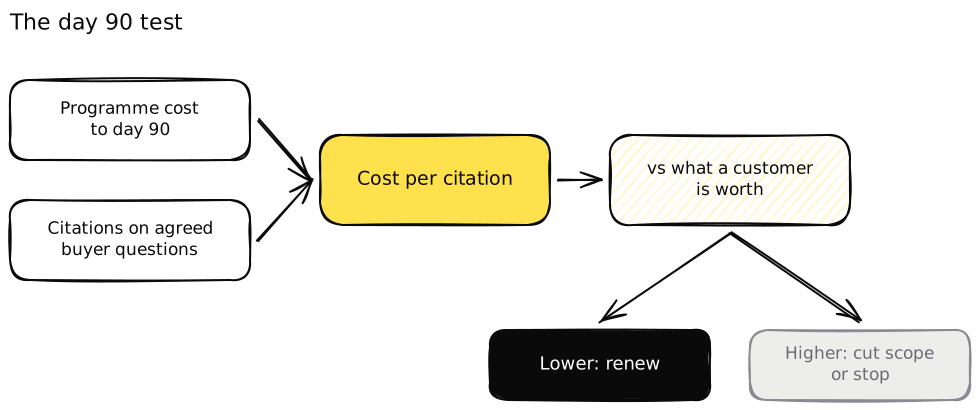 Price the programme against what a customer is worth, not against the fee.
Don’t run the test too early. Reach moves in the first month. Citations compound in months two and three, and month three is the earliest we’ve seen Google rankings move. Killing a programme at week six measures the part that hasn’t had time to work.
Enterprise, mid-market, B2B and B2C: how the price scales
Enterprise GEO costs more for structural reasons, not because the logo is bigger. There are more products, so more questions. More markets, so more writers. More stakeholders, so more approvals. And more risk in a regulated claim, so slower publishing. WebFX’s enterprise band of $25,000 to $50,000 and up reflects that multi-market, multi-team scope.
The split between B2B and B2C changes where the money goes more than the total. A B2B budget leans toward comparison pages, practitioner communities, review directories and tying identified companies to pipeline. Our GEO for B2B guide covers that side. A B2C or ecommerce budget leans toward product data, reviews, video and consumer forums, and measures orders and promo codes against what was published. Same five drivers, different weights.
When GEO isn’t worth paying for
Sometimes the right budget is zero. We say so when it’s true, because a programme that can’t pay back hurts the next one too.
- The category is small. Run the opportunity maths first. If the honest total of buyers asking these questions is small, a retainer won’t change that.
- You need results inside 30 days. GEO compounds over months. Anyone promising otherwise is selling reach.
- Volume is the brief. If the goal is a number of posts or a reach figure, you’ll get it, and it won’t get you cited.
- You’re buying on price alone. The cheapest quote usually tracks the questions you already win.
- There’s no traffic yet. Don’t pay for attribution before there’s something to attribute.
You can also run it in-house. It works with three people, one who ships pages fast, one with real standing in your buyers’ communities and one who owns the CRM and routing. Then you need a method, not an agency. Large teams still use outside specialists, usually with one internal owner. Our guide to choosing a GEO agency has the questions to ask if you go that way.
Red flags in a GEO quote
Put every proposal through the same checks before comparing totals.
- A price with no deliverables. You can’t compare what you can’t count.
- Guaranteed citations or rankings. Nobody controls the engines.
- Tools rebilled at a markup. Public plans put serious tracking at a few hundred dollars a month.
- Placement fees on top of the fee. They belong inside an approved budget line.
- Reach as the main KPI. Views and mentions are easy to count and rarely what gets cited.
- Prompts chosen by the agency alone. If your brand name is in half the questions, the dashboard will look great and mean nothing.
- No exit point. A year’s commitment with no audit, proof period or day 90 review means you’re paying to find out.
If a citation ends up costing more than a customer is worth, a good agency tells you, even when it’s their fee on the line.
Get a personalised case study
Pick your industry and we'll email you the case closest to your business, numbers included.
Frequently asked questions
How much does GEO cost per month?
WebFX's own pricing guide gives $1,500 to $5,000 a month for small businesses, $5,000 to $25,000 and up for mid-size companies and $25,000 to $50,000 and up for enterprise. Agencies that publish their own service tiers mostly start around $3,000 to $5,000 a month. Tracking tools alone cost $29 to about $500 a month on their public plans.
How much does a GEO audit cost?
Published audit prices vary a lot. Tenten lists a GEO audit from $1,299, credited toward any plan that follows. Gripped puts standalone audits for UK SaaS at £3,000 to £8,000. Ask what the audit hands you, whether you keep it if you don't hire the agency, and whether it measures the questions your buyers really ask.
Is performance-based GEO pricing a good idea?
It sounds safe, but nobody controls what ChatGPT, Gemini or Perplexity cite, and SparkToro found answers vary so much that two runs rarely give the same brand list. A fee tied to citations pays for something the agency can't fully deliver. A flat fee with written targets, reported every month, keeps incentives honest without pretending to control the engines.
Why do GEO prices vary so much?
Because the scope varies. The number of buyer questions and engines tracked, the number of markets and languages, the volume of community work, who ships site changes and the earned placement budget all move the price. SEYBOLD found published market figures for GEO that differed by a factor of thirty, which is a scope problem more than a pricing one.
Should tool subscriptions appear on a GEO agency invoice?
Ask before you sign. Some agencies rebill tracking tools, crawlers and data subscriptions on top of the fee, which makes two quotes hard to compare. Our policy is that tools are part of the agency's cost and never rebilled. Whatever an agency does, the quote should say plainly which tools you pay for and which they do.
Can I run GEO in-house instead of paying an agency?
Yes, if you have three people. One who ships pages fast, one with real standing in your buyers' communities, and one who owns the CRM and routing. Add a tracking tool covering your engines, from about $100 to $500 a month on public plans, and a method. Large teams often add outside specialists with one internal owner.