
Generative Engine Optimization Services for Enterprise

Othmane Khadri · Founder, Earleads

Summary
Generative engine optimization services get your brand named and cited in ChatGPT, Perplexity, Gemini, Claude and Google's AI features. An enterprise engagement should hand over a crawler check, a buyer question list you sign off, an audit you keep, a 60 to 90 day sprint on two or three baselined numbers, off-site community work and reporting that ties results to the actions that earned them.
On this page
- What do generative engine optimization services include?
- The deliverables an enterprise GEO engagement should hand over
- A realistic timeline, from audit to day 90
- The team behind the work: a buyer checklist
- What the agency should need from you to start
- Off-site work: how forum and community work should be scoped
- What moves the price of GEO services
- The GEO RFP checklist you can copy
- How to score the responses
- What changes for B2B and B2C buyers
What do generative engine optimization services include?
Generative engine optimization services get your brand named and cited when buyers ask ChatGPT, Perplexity, Gemini, Claude or Google’s AI features about your category. An enterprise engagement should cover five things. Crawler access, a buyer question list you approve, fixes and content on your site, work on the off-site sources answers read, and reporting that ties results to actions.
The labels on GEO proposals aren’t standard. One agency says “AI search optimization services,” another “LLM visibility.” Pepper’s guide to GEO services advises getting the deliverables named in writing before you compare proposals. This article is the list we’d want named.
It’s written for whoever runs the selection, a CMO, a head of growth or a procurement lead. The stakes have gone up. G2 surveyed 1,076 B2B software buyers in March 2026 and found 51% now start research in an AI chatbot more often than in Google, up from 29% in its previous report, and 69% picked a different vendor than they’d planned because of what a chatbot recommended (G2, April 2026). Consumer brands feel the same shift with shoppers asking for “the best” anything.
A word on who’s writing. Earleads sells GEO services, so we have a stake in how you buy them. Where we describe our own method we say so, and you should hold us to the same checklist as everyone else on your shortlist. If you’re still at the stage of building that shortlist, start with how to choose a GEO agency. This guide picks up where it ends, at the proposal and the RFP.
The deliverables an enterprise GEO engagement should hand over
“Strategy, content, monitoring” is nothing you can hold anyone to. A good proposal names each deliverable, the day it arrives and what it looks like. Here’s the set an enterprise buyer should expect, in order.
| Deliverable | When it should land | What good looks like |
|---|---|---|
| AI crawler access check | First days | A yes or no per engine, sent the same day, with the fix if it’s a no |
| Buyer question list | Before any measurement | Drafted from your positioning and sales language, signed off by you |
| Baseline | Before the sprint starts | Two or three numbers with a day-one value each |
| Audit you keep | End of the diagnosis | Hosted page, PDF, a spreadsheet of every question and answer, and a plan any team could run |
| Site fix tickets | Week 1 onward | Each one small enough for a developer to ship in under a day, ordered by revenue |
| Off-site plan | Weeks 2 to 4 | Threads and sources ordered by how often engines cite them |
| Re-measurement | Mid-sprint | Same questions, same engines, one root cause named per page |
| Reconciliation | End of the sprint | Every result joined to the action that earned it |
| Economics | Day 90 | What a citation costs against what a customer is worth |
Two lines in that table carry most of the weight.
The signed-off question list. If the agency chooses the questions, it can choose ones it already wins. Google’s AI features may run a “query fan-out,” issuing several related searches across subtopics behind a single question (Google Search Central), so the list has to reflect how your buyers really ask, not how a keyword tool groups terms. We cover how to build that list from won deals in our enterprise GEO strategy guide.
The reconciliation. Without a dated log of every page, fix and thread, you can’t tell a result from a coincidence. Ask to see a sample reconciliation before you sign. If the agency doesn’t keep one, its monthly report is a list of things that happened near each other.
One thing to leave off the list is anything sold as a special AI format. Google says “there are no additional requirements to appear in AI Overviews or AI Mode, nor other special optimizations necessary,” and that a supporting link has to be indexed and eligible to show with a snippet (Google Search Central). Crawlability, indexing and clear pages come first. Anything billed as a secret format should get a hard question.
A realistic timeline, from audit to day 90
Here’s how we run the timeline at Earleads. Use it as a yardstick for any proposal, ours included.
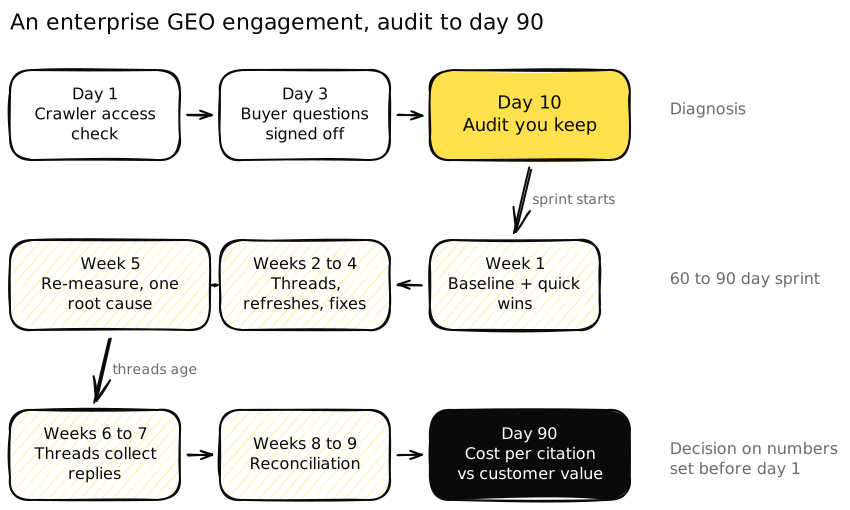 A short diagnosis you keep, then a sprint judged on numbers set before it started.
Days 1 to 10: an audit you keep
Every engagement starts with a paid audit the client keeps whether or not they hire us, over 10 working days. On day 1 we check whether AI crawlers can reach the site and send the result the same day. If they can’t, nothing else measured is worth much. OpenAI, for one, says sites opted out of OAI-SearchBot “will not be shown in ChatGPT search answers,” and that robots.txt changes take about 24 hours to apply (OpenAI).
On day 3 the client signs off the buyer questions we’ll track, before any answer is measured. That’s on purpose. Nobody, us included, should pick prompts that flatter a dashboard. On day 10 the client gets a hosted audit page, a PDF, a spreadsheet of every question and answer, and a plan written so any team could run it without us. Our guide to what an AI visibility audit should show you covers what belongs inside.
Week 1: access, baseline and quick wins
Then a 60 or 90 day sprint on two or three numbers baselined on day one. Week 1 is access, the baseline and quick wins on the pages that convert, not the pages with the most traffic.
Weeks 2 to 5: threads, refreshes and the first re-measurement
Weeks 2 to 4 cover community threads ordered by how often engines cite them, refreshes of pages sitting in positions 8 to 20, and crawler fixes. Week 5 is the first re-measurement, with one root cause named per page.
Weeks 6 to 9: threads mature, results get reconciled
By weeks 6 and 7, the earlier threads have aged enough to collect replies, which is when engines start treating them as consensus. Weeks 8 and 9 produce the reconciliation, joining every result to the action that earned it.
Day 90: the economics
On day 90 we put what a citation costs next to what a customer is worth. If the first number is bigger, the honest move is to say so. Across the whole sprint, the client’s own time is about three hours a month.
Whatever timeline an agency proposes, the checkpoints should have dates and the renewal should rest on numbers set before the work started.
The team behind the work: a buyer checklist
Proposals describe teams in adjectives. Ask for roles and names instead. Here’s the shape we use, and the question each part should raise in your RFP.
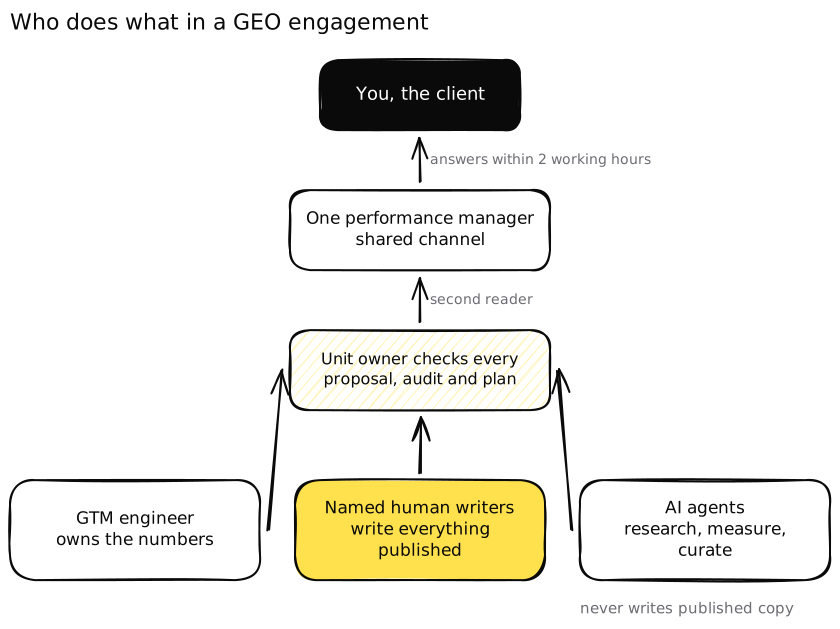 One person to talk to, named humans on every published word, and a second pair of eyes before anything reaches you.
- Who owns the numbers? At Earleads it’s a GTM engineer, who runs tracking, attribution, site fixes and the plan. Ask any agency who that person is on your account.
- Who writes the copy published in your name? Ours are named writers with lived context in the topic, and the client gets their name and background before they write a line. For a foreign-language market, that’s someone who has lived there for years. Ask any agency who writes your copy, and get the name.
- What do the AI agents do? Ours do research, measurement and curation. They don’t write published copy. Ask every agency the same question and write the answer into the contract.
- Who checks the work before you see it? A unit owner checks every proposal, audit and plan for deliverability before it reaches the client. Ask who your agency’s second reader is.
- Who do you talk to? One performance manager, in a shared Slack channel. Ask how many people you’ll need to chase.
- What are the service standards, in writing? Ours are an answer within 2 working hours (or a time when you’ll get one), a slipping KPI flagged mid-month rather than at month end, every report checked by a second person and never on the day it’s sent, and each writer covering one or two clients at most. Ask for the agency’s version on paper.
That last question sorts agencies fast. An agency with written standards hands them over. One without them will describe its “culture.”
What the agency should need from you to start
A good proposal is specific about inputs, because GEO stalls on the client side more often than on the agency side. Here’s our list, and a fair benchmark for anyone’s.
- Search Console read access. We get added as a user. An agency should never create its own property on your domain.
- Analytics read access. Enough to see landing pages and conversions.
- One developer hour in week 1. For the crawler and rendering fixes that block everything else.
- One person who approves fast. They own product truth (what we may claim), do one approval pass per batch, and name the communities that are off limits.
What slows a start is rarely access. It’s implementation, site fixes sitting in a backlog for weeks. That’s why every fix should arrive as a ticket a developer can ship in under a day, ordered by revenue. If your team can’t ship, ask whether the agency will take the website work on. We do.
Also tell the agency upfront whether reviewers will see a deck, a wireframe or a live page. With 13 internal stakeholders in a typical buying decision, by Forrester’s count (Forrester, January 2026), that mismatch costs enterprise teams weeks.
Off-site work: how forum and community work should be scoped
Much of what moves AI answers happens off your site. Ahrefs studied 75,000 brands and found branded web mentions correlated with AI Overview visibility at 0.664, against 0.218 for backlinks (Ahrefs, May 2025). Correlation isn’t causation, but it tells you where to look. Forums and online communities are a big part of that, and they’re where a careless agency can hurt your brand. Below is our public standard. Ask any agency for theirs in the same detail.
Map before posting. We start with 30 to 40 buyer questions and 40+ communities across nine categories (category, role, stage, regional, rant and more), at least a fifth of them non-obvious. Each community is tagged by its self-promotion rules.
One play per thread. Every thread gets exactly one of three treatments.
- Comment. The thread is open, so add a genuinely useful answer.
- Recreate. The thread is locked or thin, so publish a better one against the same question.
- Leave alone. The community removes any vendor mention. Knowing which ones those are is most of the skill.
Order by citations, not upvotes. Work is ordered by how often engines cite a thread. Volume is set at about half the monthly mentions of the category leader, spread across communities.
The rules. A human submits every post and nothing is auto-posted. The brand is never the only option and appears once, only where it answers the question. The client approves brand phrasing and off-limits communities. Everything is written by a named human with real history in that community.
If an agency’s answer on community work is a number of posts per month and nothing else, that’s the answer to worry about.
What moves the price of GEO services
Published price ranges are wide. WebFX’s GEO pricing guide gives $5,000 to $25,000 or more a month for mid-size companies and $25,000 to $50,000 or more for enterprise. The range is that wide because the scope is. When we scope work, five things move it.
- How many buyer questions and engines get tracked.
- How many markets and languages. Each one needs native writers.
- Community volume. Our rule of thumb is about half the monthly mentions of the category leader.
- Who ships the site changes. Your developers, or the agency.
- The earned placement budget. Placement fees come out of that line, never on top of it.
What shouldn’t move it is tools. Subscriptions, crawlers and data tools are ours, and we never rebill them. Ask every agency whether its tool stack shows up on your invoice.
Pricing models matter too. We dropped pay-per-impression because it rewards reach, and reach isn’t what gets cited. We price flat with written targets, and we keep two lists apart in every contract.
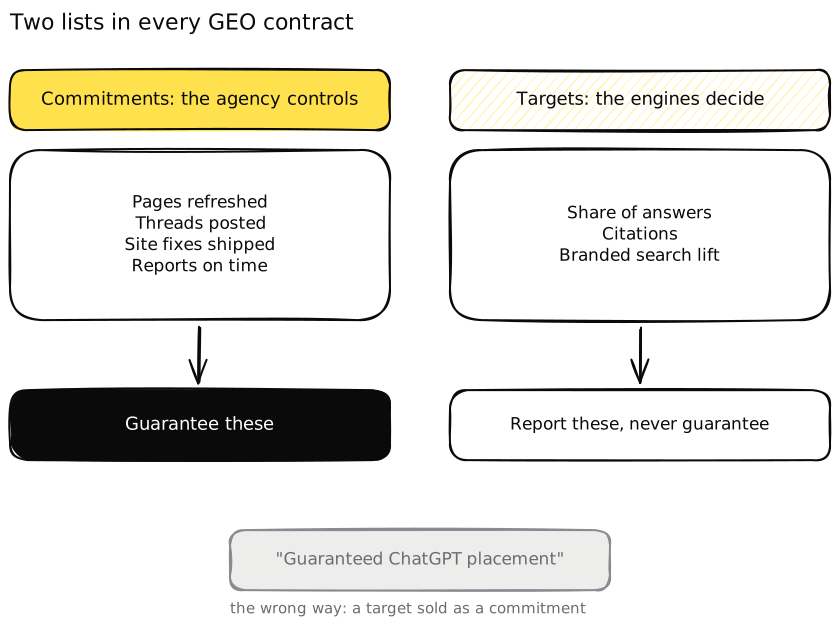 Commitments are volumes the agency controls. Targets are what the engines decide. Only the first can be guaranteed.
A contract that blurs commitments and targets lets an agency claim credit for good months and blame the engines for bad ones, and it invites guarantees nobody can keep. Google’s own guidance on hiring an SEO is plain about it. “No one can guarantee a #1 ranking on Google” (Google Search Central). The same goes for a spot in ChatGPT.
The GEO RFP checklist you can copy
Seer Interactive published a solid list of 27 GEO RFP questions focused on philosophy, prompts and measurement. The list below adds the parts most RFPs skip, the dated deliverables, the team, your inputs and the contract. Paste it into your RFP as it is, or cut it down to the sections that matter to you.
Scope and deliverables
- List every deliverable in the first 90 days, with the day each one arrives.
- When do you check AI crawler access, and how do you report the result?
- Who drafts the buyer question list, from what sources, and who signs it off before measurement?
- Which engines do you track, and do you run questions natively in each engine or through an API?
- Which two or three numbers would you baseline on day one for us, and why those?
- Send a sample audit, redacted. What do we keep if we don’t continue?
Measurement and reporting
- How do you report visibility when answers change from run to run? Do you report appearance rate or rank?
- How do you join each result to the action that earned it? Send a sample reconciliation.
- When would you tell us a citation costs more than a customer is worth?
- What does a monthly report look like? Send one, redacted.
Team
- Who owns the numbers on our account? Name and role.
- Who writes the copy published in our name? Names, backgrounds and how many other clients each writer covers.
- What do AI agents do in your process, and do they write anything published?
- Who checks proposals, audits and reports before they reach us?
- What are your written service standards for response time and escalation?
Off-site and community work
- How do you map communities before posting, and how do you decide which threads to leave alone?
- Who submits posts? Is anything auto-posted?
- How do you handle disclosure, brand phrasing approval and off-limits communities?
- Do you pay for placements? Do you ever pay for reviews, testimonials or a ranking position in someone else’s list?
Our inputs
- Exactly what access do you need, and from whom?
- How much of our team’s time does the engagement take each month?
- What happens when our developers can’t ship your fixes?
Commercials and exit
- Which items are commitments you control, and which are targets?
- What drives your price, and do tool subscriptions appear on our invoice?
- What would you guarantee, and what won’t you?
- What do we own if we stop, and for how long does it stay accessible?
Questions 3, 12 and 23 do the most work. An agency that won’t let you sign off the questions, won’t name the writers, or won’t separate commitments from targets has told you what you need to know.
How to score the responses
Put every proposal through the same table. Weight it however your team likes, but don’t skip rows.
| What to score | Strong response | Weak response |
|---|---|---|
| Deliverables | Named, dated, with samples | “Strategy, content, monitoring” |
| Question list | Drafted from your sales language, signed off by you | Their standard prompt set |
| Measurement | Appearance rate across many runs, per engine | One visibility score, or a “rank in ChatGPT” |
| Team | Names and roles, writers covering few clients | Adjectives, unnamed writers |
| AI in the process | Research and measurement, humans write | AI drafts published under your name |
| Community work | Mapped, one play per thread, human submitted | Posts per month, nothing else |
| Contract | Commitments separate from targets | Guaranteed citations or rankings |
| Exit | Audit, plan and content are yours | Everything lives in their tool |
The measurement row isn’t a matter of taste. Across 2,961 runs, SparkToro and Gumshoe found less than a 1 in 100 chance that ChatGPT or Google’s AI returns the same brand list twice in 100 runs, and concluded visibility percentage across many runs “is a reasonable metric” while a ranking position in AI isn’t (SparkToro, January 2026).
What changes for B2B and B2C buyers
The deliverables, team and RFP above work for both. The questions, sources and numbers change.
B2B. Buyers ask committee and comparison questions, like “alternative to [incumbent] for a mid-size finance team.” Answers lean on practitioner articles, comparison pages, directories and professional communities. Report demos, meetings and pipeline. Our GEO for B2B guide covers how AI-referred visits become CRM records.
B2C and ecommerce. Shoppers ask product and “best for me” questions, like “best running shoes for flat feet.” Consumer communities, reviews and video carry more weight. Report accounts, orders or units sold against what was published.
Either way, ask the agency which two or three numbers it would baseline for you. A generic answer usually means a generic programme. If you’d like a starting point before the RFP goes out, our free AI visibility report shows which answers name your competitors instead of you, which you can hand to every agency you invite to bid.
Get a personalised case study
Pick your industry and we'll email you the case closest to your business, numbers included.
Frequently asked questions
What do generative engine optimization services include?
A full engagement covers five kinds of work. A check that AI crawlers can read your site, a list of buyer questions measured across several engines, fixes and content on your own pages, work on the off-site sources the answers read (forums, articles, directories, video), and reporting that links each result to the action that earned it. Ask for each one by name in the proposal.
How long does an enterprise GEO engagement take?
Plan for a short diagnosis, then a 60 or 90 day sprint against two or three numbers measured on day one. Site fixes can show up within weeks. Off-site work compounds more slowly, because threads and articles need time to collect replies and be picked up by the engines. Judge the first month on what shipped, not on share of answers.
How much do GEO services cost for an enterprise?
WebFX's published GEO pricing guide puts enterprise programmes at $25,000 to $50,000 or more a month, and mid-size companies at $5,000 to $25,000 or more. What moves the price is scope. That means how many questions and engines get tracked, how many markets and languages, how much community work, and who ships the site changes.
What should a GEO RFP ask?
Ask how the agency builds and approves the question list, what it delivers on which day, who writes the copy published in your name, what it needs from your team, which numbers it commits to versus targets, how it links results to actions, and what you keep if you stop. Ask for names, dates and sample reports, not adjectives.
Can a GEO agency guarantee ChatGPT will recommend us?
No. The engines decide what they cite and they change how they do it. Google's own guidance on hiring an SEO says no one can guarantee a number one ranking, and the same logic holds for AI answers. A credible agency commits to the work it controls, like volumes, dates and reporting, and treats share of answers as a written target.
Do B2C brands need different GEO services than B2B companies?
The deliverables are the same. The questions, sources and success numbers change. B2B programmes track committee and comparison questions and report demos and pipeline. B2C and ecommerce programmes track product and review questions, lean harder on communities and video, and report accounts, orders or units sold against what was published.