AI Brand Tracking: Tools vs a Managed Service

Othmane Khadri · Founder, Earleads
Summary
AI brand tracking measures how often ChatGPT, Gemini, Perplexity, Claude and Google's AI features name your brand, how they describe you and which sources they lean on. Tools start at $29 to $250 a month on their own pricing pages. They count well and decide badly, so check any dashboard against a live run once a month.
On this page
- What is AI brand tracking?
- AI visibility tools compared: prices from the vendors’ own pages
- What AI brand monitoring tools do well
- Five blind spots no pricing page mentions
- Why we stopped scraping AI answers
- Profound alternatives: pick by the job, not the logo
- How to check an AI visibility dashboard against a live run
- Step 1: Pick ten questions that matter to revenue
- Step 2: Run each one natively, logged out
- Step 3: Score the answers the way the tool does
- Step 4: Compare and look for patterns, not single misses
- Step 5: Trust the live run and write the gap down
- Tool, managed service or both
- AI brand tracking for B2B vs B2C
- A buyer checklist for AI brand tracking
What is AI brand tracking?
AI brand tracking is running a fixed set of buyer questions through AI assistants, again and again, and recording what comes back. Is your brand named? Where does it appear in the answer? How is it described? Which sources did the engine read before it answered? Tools that do this are usually sold as AI visibility tools or AI brand monitoring software.
The term gets confused with two older things, so it’s worth being precise. Classic brand tracking surveys people about awareness and perception. Social listening counts mentions of your brand on social networks, news and review sites, and many of those tools now use AI to sort sentiment. Neither tells you what ChatGPT says when a buyer asks it for a shortlist. That’s the gap AI brand tracking fills, for B2B software and for consumer brands alike.
This guide compares the tracking tools on prices taken from each vendor’s own pricing page, lists the blind spots none of them put on the pricing page, and shows how to check any dashboard against a live run. A word on who’s writing. Earleads runs AI visibility programmes for clients, so we use these tools and we also sell the judgment around them. We don’t rank the tools, and we have no affiliate deal with any of them.
AI visibility tools compared: prices from the vendors’ own pages
Every price below comes from the vendor’s own pricing page, checked on 19 October 2026, on monthly billing. Prices change and some pages show local currency, so treat this as a snapshot and check the page before you buy.
| Tool | Entry price | What the entry plan includes | Engines on the entry plan | Above entry |
|---|---|---|---|---|
| Otterly | $29 a month | 15 prompts | ChatGPT, AI Overviews, Perplexity, Copilot | $189 for 100 prompts, $489 for 400. Claude, AI Mode and Gemini are paid add-ons |
| Semrush AI Visibility Toolkit | $99 a month | 25 tracked prompts, updated daily | Not fully listed on the toolkit page, which names ChatGPT and Google AI Mode | 50 more prompts for $60 a month |
| Ahrefs Brand Radar | From $50 a month | Custom prompts, checked daily | Priced per platform | $699 a month for all models. AI Visibility Index $199 a month |
| Peec | €85 a month | 50 prompts, daily tracking, unlimited users | Choose 3 models | €205 for 150 prompts, €425 for 350. Enterprise tracks up to 13 models |
| Scrunch | $250 a month | 125 prompts, 5,000 responses a month | ChatGPT, Perplexity, AI Overviews, Copilot | Enterprise is custom, with 9 models |
| Profound | Free 7 day trial | 50 prompts, run daily | ChatGPT, Gemini, AI Overviews | Enterprise is custom, with nine engines including Claude, Copilot and DeepSeek |
Three things stand out once the table is in front of you.
Engine coverage is where the price climbs. Entry plans are cheap because they cover three or four engines. On Otterly’s Standard plan, adding Claude costs $109 a month, which is more than half the plan price again. Peec’s self-serve plans let you pick three models. If your buyers use Claude or Gemini, price those engines first, not the headline plan.
Prompts are the unit, and a real question set is bigger than an entry plan. Fifteen or 25 prompts is enough to test a tool. A buyer question set for a company with a few products and several competitors runs to dozens. Our GEO pricing guide works through what a 60 question set costs on these plans.
Two kinds of product hide under one label. Most tools track prompts you write. Ahrefs also sells an index built from its own keyword data, “492 million+ search-backed prompts,” and says it’s “best once your brand already appears in AI search” (Ahrefs). An index shows the market. Your own prompts show your buyers. They answer different questions.
What AI brand monitoring tools do well
Tools are good at counting, and counting is worth paying for. A tool runs the same questions on a schedule you’d never keep by hand. It stores every answer, so you can go back and see what ChatGPT said about you in May. It lines you up against named competitors on the same questions. And it pulls out the cited sources, which is where most of the useful work starts, because the sources tell you which pages and threads the engines trust.
That record has real value when someone asks “are we better or worse than last quarter?” Without a stored history, the answer is a guess. We use clients’ existing tools as the record when they already own one. A tool you already pay for doesn’t need replacing.
What tools don’t do is decide. They can’t tell you which questions matter to your pipeline, whether “a beginner app” is a worse description than not being named at all, or what to publish next. That’s where the blind spots begin.
Five blind spots no pricing page mentions
None of these make a tool useless. They make it a tool you need to check.
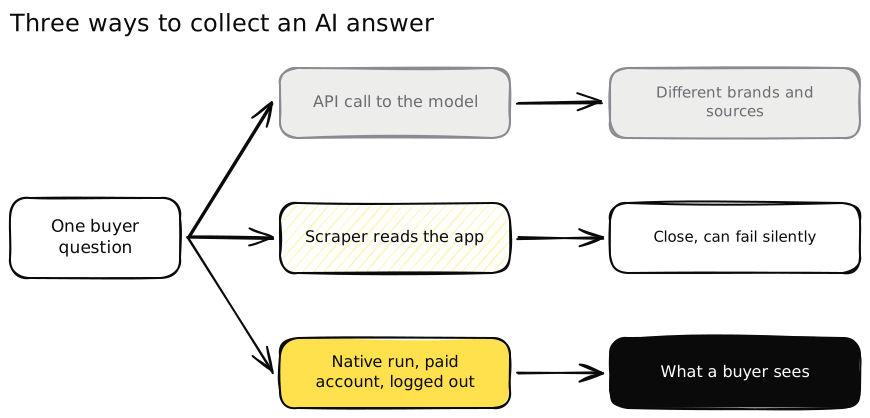 How an answer is collected changes the answer. The native run is the reference the other two should be checked against.
1. It only tracks the questions you give it
A tool measures the prompt list, not your market. If the list is written by marketing from a keyword tool, or worse, includes your brand name in half the questions, the dashboard will look healthy and mean very little. The fix isn’t a better tool. It’s a question list written from sales language and signed off by the people who hear buyers every day.
2. Many tools query an API, not the app buyers use
An API call to a model isn’t the same as a buyer typing into ChatGPT. The app adds its own instructions, search behaviour and interface logic. Surfer ran 1,000 prompts across five AI products both ways and collected 13,779 answers. Brand lists overlapped by only 15.5% to 23.8%, and 21.3% to 31.6% after cleaning up brand names. “The API names more brands than the scraped interface across all five products,” and ChatGPT’s cited domains overlapped by just 4.8% (Surfer, October 2026). Surfer sells its own tracker and notes it took one sample per prompt, so read it as a strong signal rather than a final number. Even inside one app, settings move the sources. Semrush found that “only 25.6% of cited domains overlap between minimal and high reasoning for the same prompts” in ChatGPT (Semrush, June 2026).
3. One run is one draw from a distribution
AI answers vary from run to run. SparkToro’s research across 2,961 runs found “a <1 in 100 chance” that ChatGPT or Google’s AI gives the same list of brands in any two responses (SparkToro, January 2026). A tool that runs each prompt once a day and shows you a rank is showing you noise with a line through it. Appearance rate across many runs is the honest number. Our AI share of voice guide covers how many runs make it trustworthy.
4. Methods change underneath you
Vendors improve their methods, and sometimes the improvement breaks your history. We’ve seen share of voice figures that add up past 100% by design, and volume recalculations that made quarter over quarter comparisons meaningless. Neither is dishonest. Both will embarrass you in a board meeting if nobody noticed. Ask every vendor how it announces method changes, and note the date in your own log when one happens.
5. A mention isn’t a description
Most dashboards count whether you’re named. Fewer show how you’re described, and that’s often the bigger problem. “A good option for beginners” is a different problem from being invisible, and a stale pricing claim repeated to a prospect costs more than a missing mention. Read the answers, not just the counts. Our AI reputation management guide shows how to trace a wrong description to its source.
Why we stopped scraping AI answers
We tried to automate this ourselves before settling on our current method, and the failures taught us more than the tools did. When we scraped AI answers, ChatGPT sat behind a JavaScript wall, so results came back flagged as low confidence. Perplexity citations came back partial. And the flag meant to show whether a Google AI Overview appeared fired on every query, which made it worthless.
None of those failures showed up as an error. They showed up as plausible numbers. That’s the real risk with any automated tracker, ours included. A broken collector doesn’t crash, it reports.
So we stopped. Today we run every buyer question natively in each engine, on paid subscriptions, because API answers aren’t what buyers see. Each question gets three readings. Do you appear compared with named competitors? Where do you appear when you do? And how does the engine describe you? Priority questions are sampled many times per engine and reported as an appearance rate, never as a rank. An existing tool is still useful as the record. It’s never the gate that decides what’s true.
Profound alternatives: pick by the job, not the logo
Profound covers nine engines on its enterprise plan and publishes no price beyond its free trial, so “Profound alternatives” is a common search. The useful question isn’t which tool is best. It’s which job you’re hiring the tool to do. Here’s how the options line up, using only what each vendor publishes.
- A cheap record of a short question list. Otterly’s $29 plan or the Semrush toolkit at $99. Good enough to start a history while you write a proper question set.
- Daily tracking for a whole team on three engines. Peec’s plans include unlimited users and daily tracking, with three models you choose.
- A view of the market before you write prompts. Ahrefs Brand Radar’s index, which runs prompts built from search demand. Useful for a known brand, less so for a niche one, as Ahrefs itself says.
- More engines on a self-serve plan. Scrunch Core covers four, and Otterly covers four with add-ons for the rest. Do the add-on maths before deciding.
- Many engines, custom setup and support. Profound’s or Scrunch’s enterprise plans, priced on a call.
Before you sign, ask every vendor the same four questions. How are answers collected, through an API or the app? How many times is each prompt run per period? Which engines are included at the price quoted? How are method changes announced? A vendor that can’t answer the first one clearly has answered it.
How to check an AI visibility dashboard against a live run
Once a month, take a sample of the dashboard and run it yourself. It takes an afternoon and it’s the only way to know whether your tool’s numbers mean what they say. When the two disagree, trust the live run.
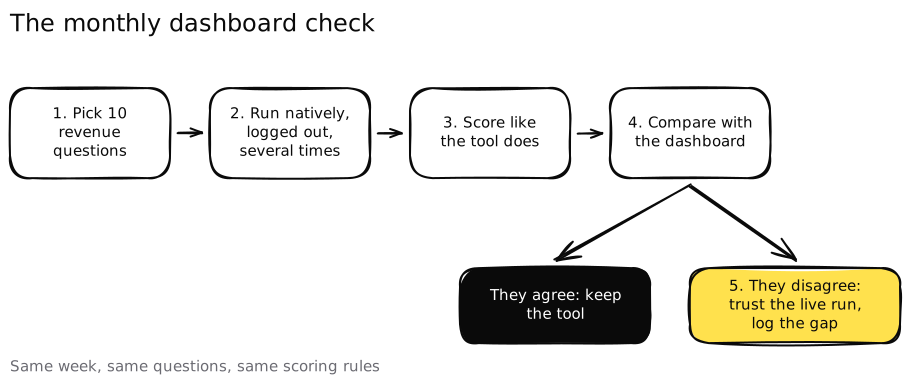 A monthly afternoon spent checking the tool is cheaper than a quarter spent trusting a broken one.
Step 1: Pick ten questions that matter to revenue
Choose ten questions from your tracked list. Pick the ones closest to a purchase, such as comparisons, “best X for Y” and alternatives questions, plus one or two validation questions like “is [your brand] legit?” Validation questions separate a trust problem from a findability problem. Avoid any question with your brand name in it, unless it’s a validation question.
Step 2: Run each one natively, logged out
Open each engine in a private window, logged out, in the country your buyers are in. Ask each question in the buyer’s words, several times. A logged-out run strips away the history and personalisation of your own account, which is the closest you’ll get to a stranger asking. Note the date, engine and mode for every run.
Step 3: Score the answers the way the tool does
For each answer, log three things. Were you named? In what position? How were you described? Add the cited sources. Use the same definitions as your tool, so if the tool counts a citation as a mention, so do you. Otherwise you’re comparing two different numbers and the check proves nothing.
Step 4: Compare and look for patterns, not single misses
Line your results up against the tool’s numbers for the same questions and the same week. One missing mention is noise. A pattern is a finding. Watch for an engine where the tool is consistently more generous than the live run, sources in the tool that never appear in the app, and competitors the tool reports that the live answers don’t name. Those are the signs of an API gap.
Step 5: Trust the live run and write the gap down
Where the tool and the live run disagree, the live run is what buyers saw. Log the gap with its date. Two months of the same gap on the same engine is a reason to ask the vendor about its method, or to stop reporting that engine from the tool. Keep the log. When someone in leadership types your top question into ChatGPT mid-meeting and sees nothing, you want to have found that first.
Tool, managed service or both
A tool and a managed service do different jobs, and the honest answer is that many teams need only the first.
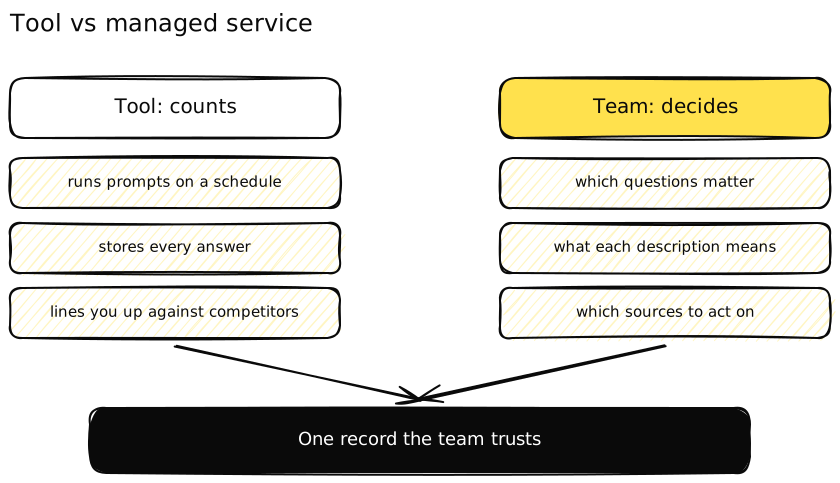 Tools count, people decide. The question is how much deciding you need help with.
A tool is enough when you have someone in house who can write a question list with sales, read answers critically and act on them. Buy the cheapest tool that covers your engines, track questions sales has signed off, and run the monthly check above. That’s a complete setup for many B2B and B2C teams. In house works well with three people, one who ships pages fast, one with real standing in your buyers’ communities, and one who owns the CRM and routing. Our GEO agency vs in-house guide covers that split.
A managed service earns its fee when the hard part is the judgment. Which questions matter? Why does Perplexity cite a three year old thread about you? What should be published, where, and by whom? A service should run questions natively, report appearance rates rather than ranks, read how each engine describes you, and turn the sources into work. Ours treats an existing tool as the record and never as the gate. If an agency’s report is a screenshot of the same dashboard you could buy for $29, that’s the answer to whether it’s worth it. Our guide to choosing a GEO agency has the questions to ask.
Both is common in larger teams. The tool keeps the daily history, the people run the native checks, write the question set and decide what to do. If you’re not sure which you need, an AI visibility audit is a cheaper first step than either a year of software or a retainer.
AI brand tracking for B2B vs B2C
The method is the same, the questions differ.
B2B. Buyers ask for shortlists, comparisons and alternatives, and they ask validation questions before a call. Weight your question set toward “best X for [use case]”, “X vs Y” and “alternatives to [competitor]”. Read how engines describe your positioning, because a wrong category label sends you onto the wrong shortlists. Track the sources each answer cites, since review directories and practitioner discussions in online communities show up often. Our GEO for B2B guide goes deeper.
B2C. Questions are shorter, more numerous and more local. “Best [product] under [price]” and “is [brand] worth it” matter more than vendor comparisons. Product-level tracking matters too, and some tools now track individual products against your catalogue. Consumer forums and review sites carry more weight in the sources. Check accuracy on prices and availability, because an engine quoting last year’s price loses the sale before your site gets a visit.
A buyer checklist for AI brand tracking
Run any tool or service through the same list before you commit.
- Engines. Does the quoted price cover every engine your buyers use, or only three?
- Collection. Are answers collected through an API, a scraper or the live app? Ask for it in writing.
- Sampling. How many times is each question run per period, and is the result shown as an appearance rate or a rank?
- Questions. Who writes the list, and has sales signed it off? How many include your brand name?
- Description. Does it show how you’re described, or only whether you’re named?
- Sources. Does it list cited pages, not just domains, so you can act on them?
- Method changes. How are they announced, and can you still compare with last quarter?
- The live check. Will you, or the vendor, check a sample against a native logged-out run every month?
A tool that passes these is worth paying for at almost any price on the table above. One that fails the second question will give you clean charts of something buyers never saw.
Get a personalised case study
Pick your industry and we'll email you the case closest to your business, numbers included.
Frequently asked questions
What is AI brand tracking?
AI brand tracking is the practice of running a fixed set of buyer questions through AI assistants such as ChatGPT, Gemini, Perplexity, Claude and Google's AI features, then recording whether your brand is named, where it appears, how it's described and which sources the answer cites. It's different from social listening, which counts mentions of your brand on social media and news sites.
How much do AI brand tracking tools cost?
On the vendors' own pricing pages, checked on 19 October 2026, entry plans run from $29 a month (Otterly, 15 prompts) to $250 a month (Scrunch Core, 125 prompts). Semrush's AI Visibility Toolkit is $99 for 25 prompts, Peec starts at €85 for 50 prompts and Ahrefs Brand Radar custom prompts start at $50. Profound publishes a free trial and custom enterprise pricing.
What are the best Profound alternatives?
It depends on the job. For a low-cost record of a short question list, Otterly or the Semrush toolkit. For daily tracking across three engines with unlimited users, Peec. For a market-wide view without writing prompts, Ahrefs Brand Radar's index. For more engines on a self-serve plan, compare add-on costs carefully, because engine coverage is where prices climb.
Can I track my brand in ChatGPT for free?
Yes, by hand. Open ChatGPT logged out in a private window, ask the questions your buyers ask, and log whether you're named, in what position, how you're described and which sources are cited. Repeat each question several times, because answers vary run to run. It's slow, but it's the reference any paid tool should be checked against.
Do AI visibility tools show what buyers really see?
Not always. Some query engines through an API, which can behave differently from the app people use. Surfer compared 1,000 prompts through APIs and scraped interfaces and found brand overlap of only 21.3% to 31.6% after cleaning up names. Ask each vendor how answers are collected, and check a sample against a live logged-out run.
Do I need a tool or an agency for AI brand tracking?
If you only need a record, a tool is enough, and the cheapest one that covers your engines is usually the right one. You need a team when the hard part is deciding which questions matter, what the answers mean and what to publish next. Many teams do both, using the tool as the record and people for the judgment.