
GEO Agency vs In-House: A Decision Framework

Othmane Khadri · Founder, Earleads

Summary
Choosing between a GEO agency and in-house comes down to three people. In-house GEO works when you have someone who ships pages fast, someone with real standing in your buyers' communities, and someone who owns the CRM and routing. With all three, you need a method, not an agency. Missing one, hire specialists for that gap and keep one internal owner.
On this page
- GEO agency vs in-house: the short answer
- What GEO work needs, whoever does it
- The three in-house roles that decide it
- What in-house GEO really costs
- When a GEO agency is worth it
- Why large teams hire outside specialists anyway
- The hybrid GEO model: who owns what
- A decision framework in five steps
- What a GEO handover must include
- B2B vs B2C: what changes in the decision
GEO agency vs in-house: the short answer
The choice between a GEO agency and in-house GEO is a staffing question before it’s a vendor question. Generative engine optimization gets your brand named and cited when buyers ask ChatGPT, Perplexity, Gemini, Claude or Google’s AI features about your category. The work needs pages shipped fast, honest presence in the communities answers draw from, and attribution into your CRM. If your team covers all three, keep it in-house. If it covers two, hire for the third. If it covers none, an agency is cheaper than three hires.
The stakes are higher than a year ago. In G2’s March 2026 survey of 1,076 B2B software buyers, 51% said they now start research in an AI chatbot more often than in Google, up from 29% the year before, and 69% said they picked a different vendor than planned because of a chatbot recommendation (G2, April 2026). Consumer buyers ask the same engines which running shoe, stroller or skincare brand to buy. Getting the operating model wrong costs a year of answers.
A quick word on who’s writing this. Earleads is a GEO agency, so we have a stake in the answer. That’s why this guide is built around the case where you shouldn’t hire us, and why it ends with what any agency, ours included, must hand back.
| In-house | GEO agency | Hybrid | |
|---|---|---|---|
| Pick it when | You already have the three roles below | You have none of the three and need to start now | You have one or two roles and one person who can own it |
| Strength | Product truth, speed of approval, knowledge stays | Method, multi-engine measurement, community depth | Ownership inside, specialist skill outside |
| Main risk | Measurement quietly stops after a few months | Reach reported instead of results, nothing left at the end | The owner has no time and becomes a forwarding address |
| What you need to make it work | A written method | A handover clause | A named owner with authority |
What GEO work needs, whoever does it
Before comparing models, list the jobs. Every serious GEO program runs the same five, whether a team, an agency or a mix does them.
- Tracking the questions buyers ask. A list of buyer questions approved by sales, run in each engine on a schedule, with your appearance, position and description recorded. Single runs are noise. SparkToro’s study of 2,961 runs found “a <1 in 100 chance” that ChatGPT or Google’s AI returns the same list of brands twice, and concluded that “visibility % across dozens to hundreds of prompts run multiple times is a reasonable metric” (SparkToro).
- Fixing and publishing pages. Crawler access, rendering, comparison pages, refreshes. Google says “there are no additional requirements to appear in AI Overviews or AI Mode, nor other special optimizations necessary” (Google Search Central), so this is mostly good search work done quickly.
- Community presence. Useful answers in the forums, online communities and discussion threads that engines cite for your questions.
- Mentions and outreach. Getting named on the pages answers already read. Ahrefs found branded web mentions correlate with AI Overview brand visibility at 0.664, against 0.218 for backlinks, across 75,000 brands (Ahrefs).
- Attribution. Joining what was published to branded search, signups, demos or orders, and recording the AI source on the CRM record.
Most role lists in other guides map these jobs to titles like strategist, writer and analyst. That framing misses what actually gates results inside a company. The jobs that stall are the ones that need authority or history, not skill.
The three in-house roles that decide it
In-house GEO works with three people. Not three titles, three capabilities. If you have them, what you’re missing is a method, and a method can be written down. If you don’t, no amount of tooling replaces them.
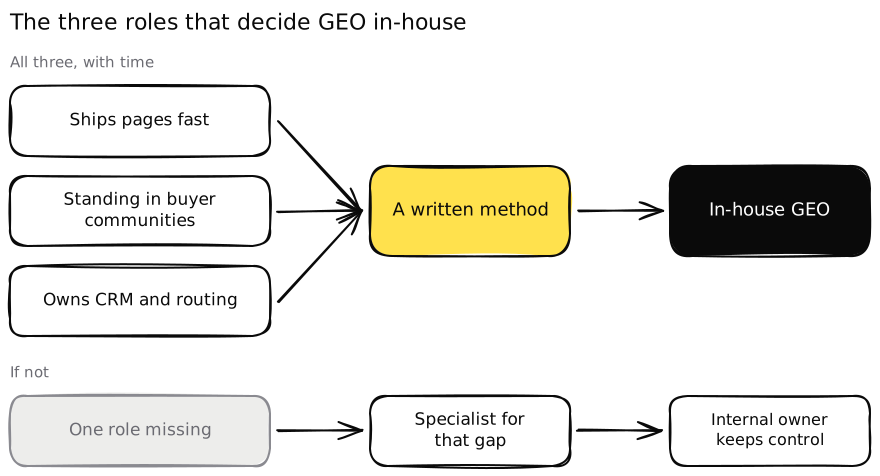 Three roles plus a method is an in-house program. A missing role is where a specialist earns its fee.
Role 1: someone who ships pages fast
The slowest part of most GEO programs isn’t strategy. It’s a site fix sitting in a developer backlog for a quarter. What slows a start is implementation, not access. In our own engagements every site fix is written as a ticket a developer can ship in under a day, ordered by revenue, and if a client can’t ship we take the website work on.
Inside a company this role is whoever can push a comparison page, a crawler fix or a pricing correction live this week without a three-team review. It might be a web developer, a technical SEO with deploy rights, or a content lead with CMS access and a friendly engineer. Test it simply. Ask how long the last small site change took from request to live. If the answer is in weeks, you don’t have this role yet, whatever the org chart says.
Role 2: someone with real standing in your buyers’ communities
AI answers lean heavily on community threads, and communities are built to reject outsiders who show up to sell. Wikipedia’s rules are a fair example of how seriously this is taken. Paid editors are told “you must disclose your employer, client, and affiliation with respect to any contribution for which you receive, or expect to receive, compensation” (Wikipedia). Forums have their own versions, written and unwritten.
So this role is a person, not a job description. Someone with a real history in the places your buyers ask questions, who knows which communities welcome a vendor’s answer and which remove any mention of one. A product manager who has answered questions in a practitioner forum for years counts. A new hire with a fresh account doesn’t. Knowing which threads to leave alone is most of the skill, and it can’t be bought in a week.
Role 3: someone who owns the CRM and routing
AI sends citations more than clicks. A buyer reads an answer, then types your domain or searches your brand, so referral reports undercount what happened. The person in this role makes sure the evidence lands somewhere. A “how did you hear about us” field at signup, the AI source written onto the CRM record, identified companies gated against your real ICP and routed to an owner with a brief. For a store, it’s promo codes and daily units read against what was published.
Without this role, an in-house program can’t prove anything, and programs that can’t prove anything get cut at the next budget review. We wrote up the setup in AI search analytics and the board view in GEO KPIs.
With all three, you need a method, not an agency
If those three people exist and have time, an agency mostly sells you a process. That process is learnable. Write down the approved question list, the engines, the run schedule, the rule for which questions go to your site and which go to community threads, and the monthly report. Then run it. The AI visibility audit guide lists what a baseline should contain if you build it yourself.
What in-house GEO really costs
In-house GEO costs salaries, and salaries are the number buyers underestimate. Median US pay in May 2025, according to the Bureau of Labor Statistics, was $92,650 for web developers, $78,760 for market research analysts and $74,750 for public relations specialists. Those are medians before benefits, tools and management time, and none of them comes with community history attached.
In the UK, Gripped puts a mid-level GEO specialist at £55,000 to £75,000 base, or £70,000 to £95,000 with employer costs, against agency retainers of £3,000 to £8,000 a month (Gripped). For published agency price ranges and what moves them, see our GEO pricing guide.
The honest comparison isn’t one salary against one retainer. It’s the loaded cost of the roles you’d actually add, against a fee plus the internal hours the fee still needs. Large teams usually have one or two of the three roles already, which is why the answer for them is rarely all or nothing.
When a GEO agency is worth it
A GEO agency earns its fee in four situations.
- You have none of the three roles and need a program running this quarter, not after a hiring cycle.
- Measurement is the gap. Running buyer questions natively in five engines, many times each, twice a month, is tedious and easy to let slip. API-based tools don’t always show what buyers see, so someone has to check the live answers.
- Community depth is the gap. You need people with history in many communities across categories, roles and regions, and you can’t hire that history.
- Stakeholders need an outside voice. More on this below, because it matters most for large teams.
When not to hire anyone yet
There are cases where no agency is the right answer, ours included. Don’t hire for volume as the brief, because reach isn’t what gets cited. Don’t hire if you need results inside 30 days. Don’t hire if your category is small enough that the honest total opportunity is small, and run that maths before any proposal. And don’t pay for attribution before there’s traffic to attribute. In those cases, fix crawler access and your most important pages first, then revisit.
Why large teams hire outside specialists anyway
Large teams often have all three roles somewhere in the building and still bring in outside specialists. The reason is less about skill than about who gets listened to. An internal SEO lead asking legal to approve a comparison page, or asking engineering to prioritise a rendering fix, is one request in a long queue. The same request backed by an outside audit with a named finding tends to move.
That’s a real benefit, and it’s worth paying for deliberately rather than by accident. The model that works for large teams is one internal owner plus specialists. The owner holds the question list, the product truth, the approvals and the roadmap. The specialists bring the method, the measurement or the community depth, and the outside weight when a backlog needs to move. Google’s own advice on hiring an SEO points the same way. It suggests asking “Will you share with me all the changes you make to my site, and provide detailed information about your recommendations?” (Google Search Central). An outside specialist who explains every change leaves your owner stronger, not more dependent.
The hybrid GEO model: who owns what
A hybrid only works if the split is written down. Without it, the internal owner becomes a forwarding address and the agency fills the vacuum with whatever is easiest to report.
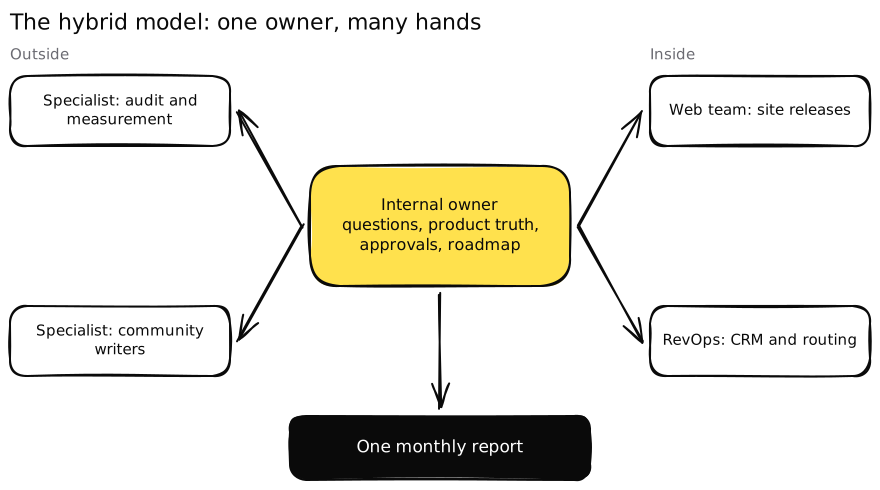 One owner decides. Specialists and internal teams execute against numbers the owner baselined.
| Job | Internal owner | Outside specialist | Internal teams |
|---|---|---|---|
| Buyer question list | Approves every question | Drafts from sales language, runs it live | Sales flags new questions |
| Product truth and claims | Signs off in writing | Asks before writing | Legal or compliance reviews |
| Site fixes and pages | Prioritises by revenue | Writes tickets a developer can ship fast | Web team releases |
| Community presence | Names off-limits communities | Named writers with real history | Subject experts answer when asked |
| Measurement | Owns the baseline | Runs native checks, reconciles results | Analytics gives read access |
| CRM and routing | Owns the definition of a good lead | Recommends fields and sources | RevOps implements |
The internal owner doesn’t need to be senior, but they need authority. They approve the question list before anything is measured, so nobody picks prompts that flatter a dashboard. They approve brand phrasing once per batch. And they decide, at a fixed checkpoint, whether the specialists stay.
A decision framework in five steps
Run this before you talk to any vendor. It takes a working session, not a project.
Step 1: Audit the three roles honestly
For each role, name the person and the hours they can give. “Our SEO lead could do it” isn’t an answer unless you know what they’d stop doing. Ask the shipping question from Role 1. Check whether the community person has a history anyone in those communities would recognise.
Step 2: Write the 2 or 3 numbers that matter
Pick numbers you already track and write today’s value next to each. Share of answers on buyer questions that don’t name you, branded search, and demos, signups or orders. If you can’t write a baseline, attribution is your first gap, whatever you decide next. An outside baseline, like our AI visibility audit, is a useful check on your own numbers either way.
Step 3: Size the opportunity before the budget
Count the buyer questions, the engines and the markets. Each extra language needs native writers. If the honest total is small, stop here and fix foundations instead.
Step 4: Pick the model from the gaps
All three roles with time means in-house with a written method. One or two roles means hybrid, with specialists hired for the named gap. None means an agency, with a handover clause from day one. Use the twelve questions in how to choose a GEO agency on every finalist.
Step 5: Set the checkpoint and the exit
Decide now when you’ll judge it and on what. Month one is for reach and whether posts survive moderation, month two for first citations, month three for share of answers. Don’t kill a program at week six, and don’t let it run a year without evidence. Write the handover terms into the contract before anyone starts.
What a GEO handover must include
A handover is the test of whether you hired a partner or rented a dashboard. Most guides stop at “keep your accounts in your name,” which is necessary but nowhere near enough. Google’s own guidance is a good floor for access. During an audit, “only grant read access to Search Console (at this stage, don’t grant them write access)” (Google Search Central). The agency is added as a user on your property. It never creates its own.
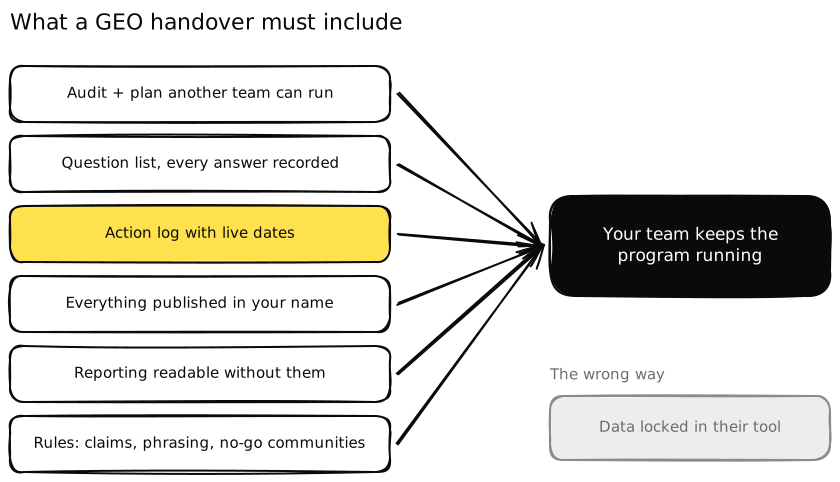 If your team can’t keep running the program the day after the contract ends, the handover failed.
Beyond access, insist on six things.
- The audit and the plan, yours from delivery. Written so any team could run it without the agency. Ours is the client’s from day 10 of the audit, whether or not they hire us, and the hosted audit page stays live for a year.
- The approved question list, with every answer recorded. Every question, every engine, every run, in a spreadsheet you can open without a login.
- The action log. Every page and thread with its live date. Without it you can’t tell a result from a coincidence, and the next team starts blind.
- Everything published in your name stays yours. Pages on your site, posts on your channels, listings and profiles.
- Reporting your team can read without the agency. Commitments and targets kept apart, measured and correlated never merged into one number, so the next person can continue the series.
- The rules that made it work. Off-limits communities, approved brand phrasing, the claims legal signed off. This is institutional knowledge, and it’s the part most often lost.
If a vendor resists any of these, treat it as a red flag on the same level as a guaranteed ChatGPT ranking. As Google puts it, “No one can guarantee a #1 ranking on Google,” and nobody controls what an AI engine recommends either.
B2B vs B2C: what changes in the decision
The three roles are the same in both, but their weight shifts.
B2B: routing is the hard role
B2B buyers ask comparison and committee questions, and the result shows up as a demo request or a named account weeks later. The CRM role carries the most weight. If nobody can tell sales which accounts arrived through AI answers, the program will look like it does nothing. Large B2B teams usually have strong RevOps and a slow website, so the gap is often Role 1, and specialists help most with the shipping and the community work. See GEO for B2B for how agents shortlist vendors.
B2C and ecommerce: community is the hard role
Consumer buyers ask product and “is it worth it” questions, and they trust other buyers’ experience. Community standing carries the most weight, and it’s the hardest role to hire. Attribution is easier, through promo codes and daily units against what went live. Consumer brands often keep site and CRM work in-house and bring in specialists for community presence across many categories at once.
Get a personalised case study
Pick your industry and we'll email you the case closest to your business, numbers included.
Frequently asked questions
Should I hire a GEO agency or build an in-house team?
Build in-house if you already have three people. One who ships pages fast, one with real standing in the communities your buyers use, and one who owns the CRM and lead routing. Then you need a method, not an agency. If one of those is missing, or nobody internal has the time to own the program, bring in specialists for the gap and keep the ownership inside.
What roles does an in-house GEO team need?
Three capabilities matter more than titles. A person who can publish and fix pages within days, not quarters. A person with genuine history in the forums, online communities and publications your buyers read. And a person who owns the CRM, so an AI-referred buyer gets routed to an owner and recorded. Tracking and analysis can sit with any of the three.
How much does in-house GEO cost compared with an agency?
In-house cost is mostly salaries. US Bureau of Labor Statistics medians for May 2025 were $92,650 for web developers, $78,760 for market research analysts and $74,750 for public relations specialists, before benefits and tools. Gripped puts UK agency retainers at £3,000 to £8,000 a month. Compare the loaded cost of the people you would add, not the fee alone.
What is a hybrid GEO model?
A hybrid GEO model keeps one internal owner who controls the question list, approvals, product truth and the roadmap, and brings in outside specialists for the work the team can't staff. Usually that's the audit, multi-engine measurement or community work. The owner decides and the specialists execute against numbers the owner baselined. It's the shape most large teams end up with.
What should a GEO agency hand over when the contract ends?
At minimum, the audit and the plan, the approved question list with every answer recorded, the full action log with live dates, every page and post published in your name, and reporting your team can read without the agency. Accounts for analytics, Search Console and tools should already be in your company's name, with the agency added as a user, never the owner.
When is a GEO agency not worth it?
When the brief is volume, when you need results inside 30 days, or when the category is so small that the honest total opportunity doesn't cover the fee. It's also premature to pay for attribution before there's traffic to attribute. In those cases fix the site foundations first, or run a small internal test before you hire anyone.