Agentic Commerce Explained: UCP, ACP and Agent Checkout

Othmane Khadri · Founder, Earleads

Summary
Agentic commerce is shopping where an AI agent finds, compares and buys for a person. Two open protocols carry it. Google's Universal Commerce Protocol powers checkout in AI Mode and Gemini, and the OpenAI and Stripe Agentic Commerce Protocol powers Copilot Checkout. In every live version, the brand stays the merchant of record.
On this page
- What is agentic commerce?
- Protocols vs checkouts: two layers people mix up
- Google’s Universal Commerce Protocol (UCP)
- OpenAI and Stripe’s Agentic Commerce Protocol (ACP)
- Shopify’s agent checkout
- Microsoft Copilot Checkout
- Perplexity Instant Buy
- UCP vs ACP and every agent checkout, compared
- Step 1: Map where your buyers already ask AI
- Step 2: Turn on the routes your platform already gives you
- Step 3: Make the product record agent proof
- Step 4: Decide your agent policy at checkout
- What changes for B2B brands?
- What we don’t know yet
What is agentic commerce?
Agentic commerce is shopping where an AI agent does the work a person used to do in twenty browser tabs. The shopper says “running shoes for flat feet, under $120, delivered by Saturday.” The agent searches, compares price and stock across stores, and, with the shopper’s approval, buys.
Shopify’s definition is a good one to start from. Agentic commerce is “an online shopping model where AI agents make decisions across the entire shopping journey, from product discovery through checkout and post-purchase support.” The difference from a chatbot is the last step. A chatbot recommends. An agent acts.
For a brand, that splits the problem in two. First, the agent has to find and trust your product. We’ve covered that side in our guides to Shopify Catalog and Perplexity shopping. Second, the agent has to be able to buy it. That second half runs on a handful of new protocols and checkouts, and it’s where most of the confusion sits.
This guide explains each one as it stands in October 2026, verified on the owner’s own pages. It covers Google’s Universal Commerce Protocol, the OpenAI and Stripe Agentic Commerce Protocol, what happened to ChatGPT Instant Checkout, Shopify’s agent checkout, Microsoft’s Copilot Checkout and Perplexity’s Instant Buy. Then it lays out what a brand should do this quarter.
Protocols vs checkouts: two layers people mix up
Most explainers treat “UCP vs ACP” as the whole story. It isn’t. There are two layers, and you deal with them differently.
Protocols are the shared language between an AI agent and a merchant’s systems. They define how an agent asks for a product, builds a cart, gets a total with tax and shipping, passes a payment token and tracks the order. UCP and ACP are protocols. You rarely touch them directly.
Checkouts are the places shoppers actually buy. Google’s checkout in AI Mode, Copilot Checkout and Perplexity’s Instant Buy are checkouts. Each runs on one protocol or payment rail underneath, and each has its own entry route for merchants.
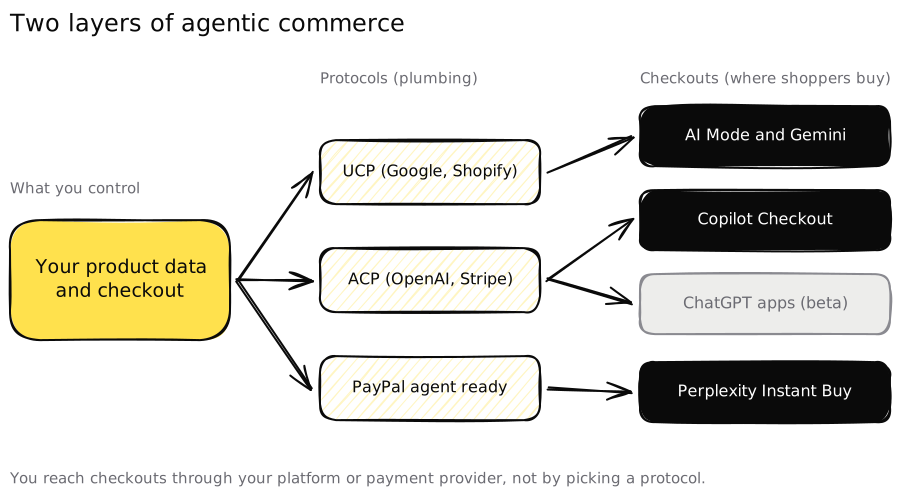 You join checkouts through platforms and payment providers. The protocols are the plumbing behind them.
This matters because the practical question is never “should we pick UCP or ACP.” It’s “which checkouts do our buyers use, and which of our platforms already connects us to them.”
Google’s Universal Commerce Protocol (UCP)
Google announced UCP on January 11, 2026 at the National Retail Federation’s show in New York. Google calls it “a new open standard for agentic commerce that works across the entire shopping journey”, and it was co-developed with Shopify, Etsy, Wayfair, Target and Walmart. More than 20 others endorsed it at launch, including Adyen, American Express, Best Buy, Mastercard, Stripe, The Home Depot, Visa and Zalando.
What it does. The protocol’s own site lists five capabilities, namely catalog search, cart building, checkout with tax and dynamic pricing, identity linking through OAuth 2.0, and order management with shipment tracking. It’s published under the Apache 2.0 license and works over REST, JSON-RPC and MCP, alongside Google’s Agent Payments Protocol (AP2) and Agent2Agent (A2A).
Where shoppers see it. Google’s developer page for UCP says it “enables direct, instant purchases across AI surfaces like AI Mode in Google Search and the Gemini app.” At launch that meant checkout from eligible US retailers, paid with Google Pay.
Who owns the sale. Google is explicit. “You remain the Merchant of Record. Keep all of your customer data and relationships.” Google repeated the point in May 2026, saying “the retailer always remains the merchant of record.”
How merchants get in. Onboarding starts from your existing Merchant Center account and shopping feeds. Google offers native checkout by default and an embedded checkout, shown in an iframe, for approved merchants with complex needs. There’s a waitlist form for merchants who want to integrate.
Where it’s heading. At Google Marketing Live on May 20, 2026, Google announced Universal Cart, a cart that works across retailers and across Search and Gemini, and Affirm and Klarna buy now, pay later options inside Google Pay. It named Nike, Sephora, Target, Ulta Beauty, Walmart, Wayfair and Shopify merchants such as Fenty and Steve Madden among participating retailers. It also said UCP checkout “will roll out across Canada and Australia in the coming months, and later to the U.K.,” and that UCP is extending to hotel booking and local food delivery.
Shopify’s engineering team wrote its own account the same day as the launch. “We co-developed UCP with Google to create an open standard for AI agents to connect and transact with any merchant,” it says, and its embedded checkout piece builds on Shopify’s existing Checkout Kit.
OpenAI and Stripe’s Agentic Commerce Protocol (ACP)
OpenAI and Stripe launched ACP on September 29, 2025, together with Instant Checkout in ChatGPT. The protocol’s GitHub repository describes it as “an interaction model and open standard for connecting buyers, their AI agents, and businesses to complete purchases seamlessly.” It’s maintained by OpenAI and Stripe, licensed under Apache 2.0 and still marked beta. The latest stable version, dated April 17, 2026, added cart, feed, orders, authentication and MCP support.
Who owns the sale. OpenAI’s commerce docs say “OpenAI is not the merchant of record in the Agentic Commerce Protocol.” The protocol site adds that businesses keep control of which products can be sold, how they’re presented and how orders are fulfilled.
Payments. Stripe built a Shared Payment Token so an agent can pay “without exposing the buyer’s payment credentials”. You don’t have to process with Stripe, though. Stripe says companies on other providers can still adopt ACP, and OpenAI’s docs list Adyen, Checkout.com, Fiserv, PayPal, Stripe and Worldpay as supporting providers.
Who uses it. ChatGPT, first. Microsoft also said in January 2026 that it’s adopting ACP for Copilot Checkout, more on that below. So ACP isn’t an OpenAI only rail anymore.
What happened to ChatGPT Instant Checkout
This is where most articles are out of date. At launch, OpenAI said US ChatGPT users on Free, Plus and Pro could buy directly from US Etsy sellers in the chat, with over a million Shopify merchants to follow. Merchants paid a small fee on completed purchases, and OpenAI stated that “Instant Checkout items are not preferred in product results.”
Then OpenAI changed course. In March 2026 an OpenAI spokesperson told Digital Commerce 360, “We’re prioritizing making ChatGPT search and product discovery great, with ACP serving as the infrastructure that connects users to merchants across the full shopping journey. Instant Checkout is moving to Apps, where purchases can happen more seamlessly.”
OpenAI’s developer docs now match that. The Apps SDK monetization page says “checkout with the ChatGPT payment sheet is limited to select marketplaces today,” in a private beta, with plans to extend to more marketplaces and physical goods retailers. Until then, OpenAI writes, “we recommend routing purchase flows to your standard external checkout.” Shopify’s help center describes the same reality for its merchants. ChatGPT is a discovery channel, and buyers finish on your store’s checkout in an in app browser or a new tab.
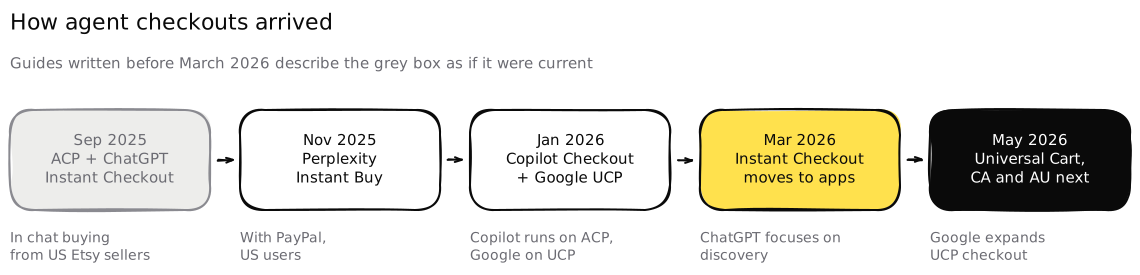 Checkout in ChatGPT moved to apps in March 2026. Any guide that predates it describes a flow merchants can’t join today.
What still matters in ChatGPT is the feed. OpenAI’s commerce page asks merchants to “provide a structured product feed so ChatGPT accurately indexes and displays your products with up-to-date price and availability.” Discovery is where ChatGPT is putting its effort.
Shopify’s agent checkout
Shopify sits under several of these checkouts at once, so it’s worth treating separately. Through Agentic Storefronts, which Shopify says are “active by default for eligible stores,” products reach ChatGPT, Google AI Mode and Gemini, Microsoft Copilot and Meta.
How the sale closes depends on the channel:
- Google, Microsoft Copilot and Meta. If you have direct checkout activated, shoppers buy inside the channel through Shopify powered direct checkout.
- ChatGPT. Shoppers complete the purchase on your online store checkout, in ChatGPT’s in app browser or a new tab on the web.
Brands that don’t run a Shopify store can still use this route. Shopify’s Agentic plan promises to “syndicate your products to AI chats and let shoppers check out in conversations, no Shopify online store required,” and lists ChatGPT, Google AI Mode and Gemini, Copilot, Perplexity and the Shop app. The plan page shows no monthly fee, with card rates charged when products sell.
Shopify is also opening checkout to agents that browse the web. In September 2026, it added WebMCP tools named get_checkout, update_checkout and complete_checkout so browser based agents can finish a purchase with the buyer’s authorization, TechCrunch reported. That’s how independent agents like Instinct buy from Shopify stores, which we cover in how to get recommended by AI agents like Instinct.
Microsoft Copilot Checkout
Microsoft launched Copilot Checkout on January 8, 2026, rolling out in the US on Copilot.com. Its announcement promises “no redirect, no friction, and you stay the merchant of record.” Launch partners were PayPal, Shopify and Stripe.
Entry is simple for Shopify merchants, who Microsoft said “will be automatically enrolled following an opt-out window.” Merchants who want to onboard with PayPal or Stripe apply through Microsoft’s form. Underneath, Microsoft says it’s adopting ACP “to ensure merchant onboarding is seamless and scalable.”
Perplexity Instant Buy
Perplexity’s checkout runs with PayPal rather than either of the two big protocols. Perplexity’s help center says Instant Buy lets US users “search for and buy products from a wide range of merchants directly on Perplexity.” The shopper clicks Instant Buy, enters details once, and “your order and payment are securely sent directly to the merchant for fulfillment.”
Two limits matter. Perplexity says it “only support[s] Instant Buy with merchants who are compatible with our agentic checkout experience,” and Instant Buy isn’t available on Enterprise Pro or Enterprise Max plans. At the November 2025 launch, PayPal said retailers are paid directly and “remain at the center of the customer relationship,” with merchants reaching Perplexity through PayPal’s store sync and agent ready services.
Perplexity also states that product listings aren’t sponsored and that it’s more likely to recommend merchants with deeper product details such as availability, reviews, pricing and specs. Our Perplexity shopping guide covers the merchant program and ranking in full.
UCP vs ACP and every agent checkout, compared
Here’s each checkout as its owner describes it, checked on October 12, 2026.
| Checkout | Runs on | Where shoppers buy | Merchant of record | How a brand gets in | Status, October 2026 |
|---|---|---|---|---|---|
| Google agentic checkout | UCP | AI Mode in Search, Gemini | The retailer | Merchant Center feeds plus UCP integration or waitlist; Shopify direct checkout | Live for eligible US retailers; Canada and Australia announced, UK later |
| ChatGPT Instant Checkout | ACP | ChatGPT apps, payment sheet | Not OpenAI | Product feed for discovery; checkout beta for select marketplaces | Moved to apps in March 2026; OpenAI recommends your own checkout |
| Shopify agent checkout | Shopify checkout, UCP co-developer | Google, Copilot, Meta in channel; ChatGPT on your store | You, on your Shopify checkout | Agentic Storefronts, on by default; Agentic plan without a Shopify store | Live |
| Copilot Checkout | ACP | Copilot.com | The merchant | Shopify auto enrollment after opt-out window; PayPal or Stripe | Live in the US since January 2026 |
| Perplexity Instant Buy | PayPal agent ready | Perplexity answers | Order goes to the merchant, paid directly | PayPal store sync and agent ready; compatible merchants | Live for US users |
Three things stand out once it’s laid out like this.
- The merchant keeps the customer everywhere. Every owner page says some version of it. The agent is a new storefront, not a new retailer standing between you and the buyer.
- The protocol split is not a war you have to pick a side in. Shopify co-developed UCP and also reaches Copilot, which runs on ACP. PayPal and Stripe sit under several checkouts. Your platform and payment provider usually pick for you.
- Discovery is ahead of checkout. ChatGPT, the biggest assistant, sends buyers to your own checkout. Fixing the data agents read pays off on every surface, whether or not the purchase happens in chat.
Step 1: Map where your buyers already ask AI
Start from demand, not protocols. Write 10 requests your buyers would give an assistant, with real constraints like a budget, a size, a deadline and a use case. Run each in ChatGPT, Google AI Mode, Gemini, Copilot and Perplexity, and note where products show up, whether yours are among them, and whether a buy button appears.
This tells you which checkouts are worth effort for your category. A furniture brand that never appears in Perplexity’s product cards has a discovery problem before it has a checkout problem. Our guide to what an AI visibility audit should show you explains how to keep this honest, since AI answers vary between runs.
Step 2: Turn on the routes your platform already gives you
Most brands can reach several agent checkouts this quarter without writing code.
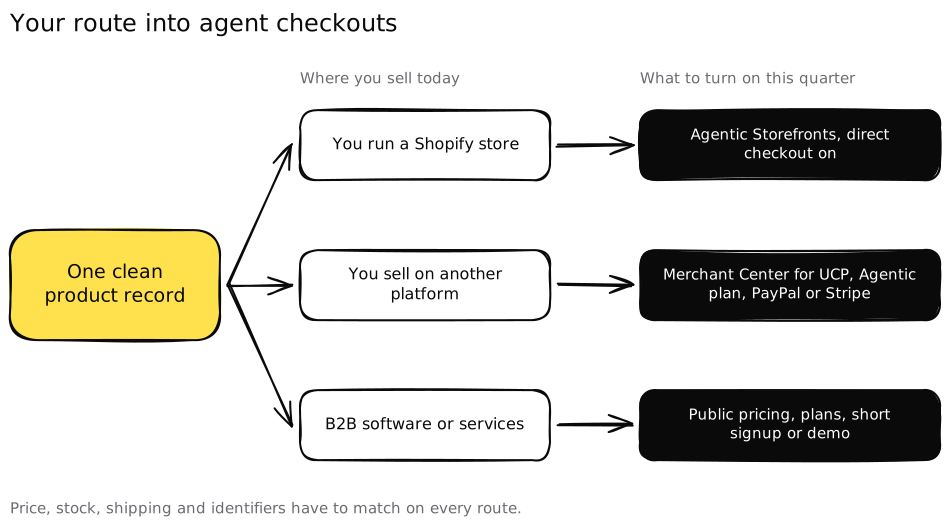 Every route starts from the same product record, so clean it once and each checkout inherits it.
- You run a Shopify store. Open Sales channels, then Agentic, in your admin. Confirm the channels you want are on and that direct checkout is activated for Google, Copilot and Meta. If you were auto enrolled in Copilot Checkout and didn’t notice, this is where you’ll find it.
- You sell on another platform. Check Merchant Center health first, since it’s the entry ticket to Google’s UCP checkout, then ask to join through Google’s waitlist form. Look at Shopify’s Agentic plan if you want one feed into several AI channels without moving your store. If you process with PayPal or Stripe, ask them about Copilot Checkout and, for PayPal, Perplexity Instant Buy.
- You’re a large retailer with your own stack. This is the case for building UCP or ACP endpoints directly. Both specs are public on GitHub, and Google’s page lists native SDKs.
Step 3: Make the product record agent proof
Every checkout above reads the same few facts, and a wrong one costs the sale after the agent has already picked you. Before you widen distribution, check:
- Price matches everywhere. Feed, product page and checkout show the same number, sale prices included. Google has long required price and availability to match the landing page.
- Stock is live per variant. A sold out size that reads as available becomes a failed order.
- Shipping and returns are stated. An agent asked for “by Saturday” can’t pick a product with no delivery promise.
- Identifiers are filled in. GTINs and clear option names like “Size” and “Color” let agents match the exact item.
Our Shopify Catalog guide has a 12 point version of this checklist tied to the fields Shopify names, and most of it applies to Merchant Center and OpenAI feeds too.
Step 4: Decide your agent policy at checkout
Agent checkout fails in boring places. A forced account creation, a CAPTCHA on the cart, a popup over the payment form. Walk your own checkout as a first time buyer and count the steps an agent can’t pass.
Then make a deliberate call. TechCrunch’s report noted that some large retailers block agents from buying on users’ behalf. That can be the right choice for a brand with fraud or margin reasons. It should be a decision someone signs off on, with the cost written down, not a bot rule set years ago for a different problem. Our readiness check for AI shopping agents has a 10 minute test for this.
What changes for B2B brands?
Agentic commerce reads like a consumer story, and today’s checkouts mostly are. B2B splits into two cases.
B2B brands selling physical products, such as office supplies, lab equipment, packaging or spare parts, face the same feeds and checkouts as consumer brands. Exact part numbers, quantity pricing and accurate stock matter even more, because a procurement agent buying 40 units can’t settle for “similar.”
Software and service companies won’t see a buy button in AI Mode soon. Agents still shape their deals, because buyers ask assistants for vendor shortlists. The same three facts decide who makes the list. That means a public price an agent can check against a budget, plans it can compare, and a trial or demo request short enough to finish without a sales call. Our guides to AI agent optimization and GEO for B2B cover that side.
What we don’t know yet
A guide that hides the open questions is selling something. As of October 2026:
- How each agent ranks merchants. For merchants selling the same product, OpenAI said its original checkout weighed availability, price, quality and whether a merchant is the primary seller. Google and Microsoft describe features, not ranking.
- Whether the protocols converge. UCP and ACP overlap and both are moving fast. ACP is still marked beta, and UCP’s repository was updated as recently as October 11, 2026.
- How much in chat checkout buyers want. OpenAI’s retreat to apps suggests the answer varies by category. Google and Microsoft are pushing ahead.
- When checkouts reach other countries. Google has announced Canada, Australia and the UK. Most other checkouts are US only.
Our view is to spend on what helps every agent at once. That means accurate product data, a checkout an agent can finish and a presence in the sources assistants trust. Treat any single protocol as a bet sized to the channel it reaches.
That’s the work we do at Earleads for B2B and B2C brands, from product data and checkout checks to the sources AI answers rely on. If you’d like to see where you stand first, our free AI visibility audit checks how ChatGPT, Gemini, Perplexity and AI Overviews answer your buyers’ questions.
Frequently asked questions
What is agentic commerce in simple terms?
It's online shopping where an AI agent does the legwork. The shopper describes what they want, and the agent searches products, compares prices and stock, and can complete the purchase with the shopper's approval. Shopify defines it as a model where AI agents act across the whole journey, from product discovery through checkout and post purchase support.
What is the difference between UCP and ACP?
Both are open standards under the Apache 2.0 license. Google's Universal Commerce Protocol was co-developed with Shopify, Etsy, Wayfair, Target and Walmart and powers checkout in AI Mode and Gemini. The Agentic Commerce Protocol is maintained by OpenAI and Stripe, sits under ChatGPT commerce and was adopted by Microsoft for Copilot Checkout. In both, the brand stays the merchant of record.
Is ChatGPT Instant Checkout still available?
Not in its original form. In March 2026 an OpenAI spokesperson said Instant Checkout is moving to apps, with ChatGPT focusing on search and product discovery. OpenAI's developer docs now say checkout with the ChatGPT payment sheet is limited to select marketplaces in a private beta and recommend routing purchases to your standard external checkout.
How do I enable Google's agentic checkout for my products?
Google's checkout in AI Mode and Gemini runs on the Universal Commerce Protocol and starts from your Merchant Center account and shopping feeds. Google's developer page offers native checkout by default and an embedded option for approved merchants, plus a waitlist form. Shopify stores reach it through Agentic Storefronts with direct checkout turned on.
Do I need to build UCP or ACP myself?
Usually not. Most brands reach agent checkouts through a platform or payment provider that already speaks the protocols. Shopify merchants get Agentic Storefronts by default, PayPal and Stripe offer onboarding for Copilot Checkout, and PayPal powers Perplexity's Instant Buy. Building directly makes sense mainly for large retailers with their own commerce stack.
Does agentic commerce matter for B2B companies?
Yes, but differently. B2B brands selling physical products such as supplies or equipment face the same feeds and checkouts as consumer brands. Software and service companies won't see an agent checkout soon, but agents already build their vendor shortlists, so public pricing, clear plans and a short signup or demo flow decide whether they make it.