
AI Agent Optimization: Be Found, Checked and Bought

Othmane Khadri · Founder, Earleads

Summary
AI agent optimization is the work of making your brand easy for AI agents to find, verify and transact with. GEO wins a mention in an answer. Agent optimization wins the errand, meaning the agent can locate you, confirm your prices and facts, and then book, buy or shortlist you without a human filling the gaps.
On this page
- What is AI agent optimization?
- AI agent optimization vs GEO
- How an AI agent runs an errand
- Step 1: Be findable
- Step 2: Be verifiable
- Step 3: Be transactable
- What changes for B2B and B2C
- What we don’t know yet about AI agents
- How to measure AI agent optimization
- Doing it in house or with an AI agent optimization agency
What is AI agent optimization?
AI agent optimization is the work of making your brand easy for AI agents to find, verify and transact with. An agent doesn’t stop at telling someone about you. It checks whether you have the table, the size or the plan they need, then books, buys or puts you on the shortlist. You optimize for that whole errand, not just the first mention.
Search the term and you’ll see a second meaning. Most results for “ai agent optimization” are about tuning the agents themselves, such as Microsoft’s agent optimizer for Foundry or research tools that cut an agent’s token costs. That’s engineering work on the agent. This guide is about the other side of the table, the brands those agents are choosing between. You’ll also see it sold as agentic SEO, agentic search optimization, agent engine optimization or building an agent ready website. Same discipline, different labels.
A short word on who’s writing. Earleads helps B2B and B2C brands get picked by AI search and AI agents, so we sell a version of what this guide describes. We won’t rank anyone here. Read it as a framework you can hold any agency or in house plan against, ours included.
AI agent optimization vs GEO
Generative engine optimization (GEO) gets your brand named and cited when someone asks ChatGPT, Gemini, Claude or Perplexity a question. We’ve written about how to judge a GEO agency and what an AI visibility audit should show you. Both stop at the answer. That was fine while AI only talked.
Agents act. Google says the agentic booking in AI Mode can “find real-time availability for restaurants that meet your specific needs” across reservation partners (Google, August 2025). By November 2025 Google said “agentic booking for restaurants is rolling out this week on AI Mode in the U.S.” and that booking for event tickets and local appointments was open to all US Labs users (Google, November 2025). In April 2026 it brought restaurant booking to the UK with TheFork, SevenRooms, ResDiary, OpenTable and others (Google UK).
Once an agent does the errand, there are new ways to lose. You can be cited and still not be booked.
| GEO (answers) | AI agent optimization (errands) | |
|---|---|---|
| What the user asked for | Information or a short list | A booking, an order or a shortlist |
| What decides it | Sources the model trusts, clear pages | The same sources, plus facts the agent can check and an action it can finish |
| Where you drop out | You aren’t in the sources | Not in the sources, facts don’t match, or the flow blocks the agent |
| Who reaches your site | Often the person, after the answer | Often a crawler or an agent, sometimes no person at all |
| What to measure | Mentions and citations per question | Mentions, then picks, then completed actions per errand |
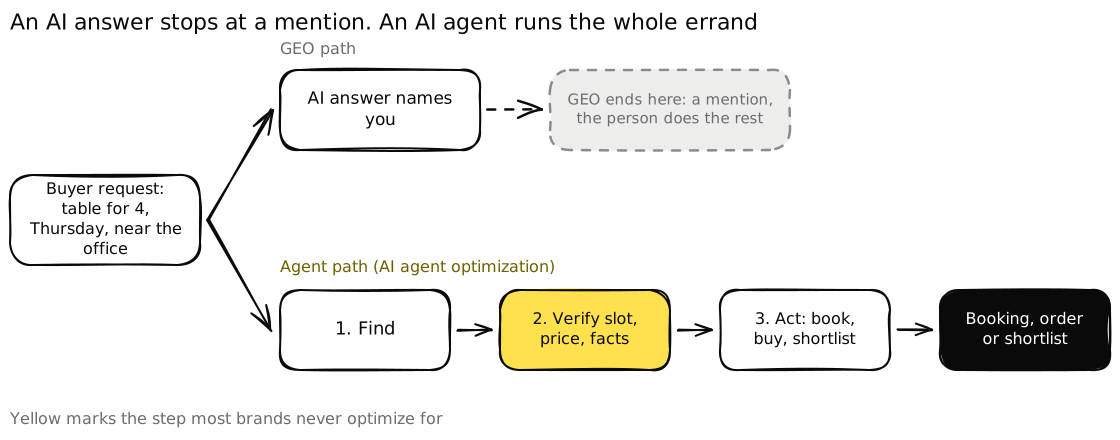 GEO stops at the answer. An agent keeps going, and each extra step is a new place to lose the buyer.
Our read is that GEO is the first third of AI agent optimization, not a separate project. If agents can’t find you, nothing downstream matters. But a brand that only works on mentions will keep losing errands it was already named in.
How an AI agent runs an errand
Nobody outside OpenAI, Google, Perplexity or the agent startups has a full picture of how their agents rank options. What’s public is enough to sketch the shape of an errand, and it’s the same shape across B2C and B2B.
- Interpret. The agent turns “a quiet dinner for four near the office on Thursday” or “three payroll tools for a 60 person team in two countries” into constraints.
- Find. It searches the web, the catalogs and partner platforms it can reach, and leans on what its language model already believes about the category.
- Verify. It checks each candidate against the constraints. Is there a slot at 8pm? Is that price current? Does the tool actually support both countries?
- Act. It books, buys, fills in a form, or hands back a shortlist with reasons.
Each step drops brands. A restaurant the agent can’t find is out at step 2. A store whose feed says “in stock” while the page says “sold out” is out at step 3. A booking flow that throws a CAPTCHA at a legitimate agent loses at step 4, often after the agent had already chosen it.
That’s why we frame AI agent optimization as three jobs. Be findable, be verifiable, be transactable.
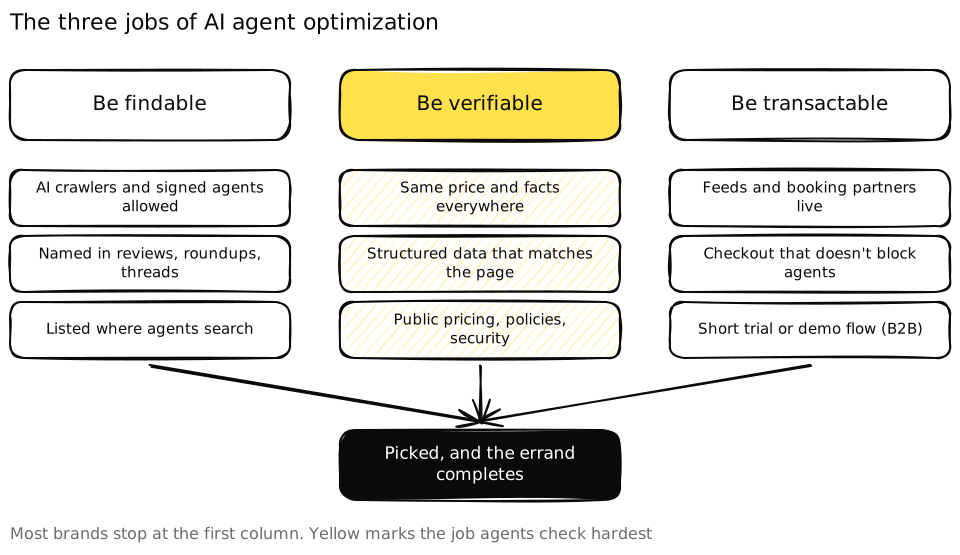 Most brands work on the first job. The second and third are where errands are won or lost.
Step 1: Be findable
Being findable means an agent can reach your pages and already has reasons to look for you. It has two halves, access and reputation.
Access. AI companies run several bots, and blocking the wrong one quietly removes you. OpenAI says OAI-SearchBot “is used to surface websites in search results in ChatGPT’s search features,” while GPTBot crawls content that may be used for training, and ChatGPT-User visits pages for certain user actions (OpenAI bots documentation). Blocking GPTBot is a training decision. Blocking OAI-SearchBot is a visibility decision. Plenty of sites made the second by accident.
Agents that browse for a person are a third category. Cloudflare calls them signed agents, “generally directed by an end user,” which sign their requests with Web Bot Auth so a site can verify who sent them. Its first cohort included ChatGPT agent, Block’s Goose, Browserbase and Anchor Browser, and Cloudflare customers can allow or block signed agents as a group (Cloudflare, August 2025). If your site runs behind Cloudflare, check that setting before you check anything else. Our store readiness check walks through the crawler tests one by one.
Reputation. An agent picks from what its model already believes and from what it reads in the moment. Both reward agreement across independent sources. Your site, your reviews, the comparison articles that rank for your category, community threads and press should describe you in the same terms. We covered this upstream work in how to get recommended by AI agents, so we’ll keep it short here. Get named where your buyers already look, in their words, and make the description match everywhere.
What about llms.txt? Its own site describes it as “a proposal to standardise on using an /llms.txt file to provide information to help agents use a website” (llmstxt.org). It’s cheap and harmless. Neither OpenAI’s bot documentation nor Google’s crawler documentation that we checked mentions it, so we treat it as a nice extra, never as the fix.
Step 2: Be verifiable
Being verifiable means an agent can check that you meet the request and believe what it reads. This is the job most brands skip, because a human visitor forgives small inconsistencies and an agent doesn’t.
Picture the agent comparing three candidates. One says “from $49” on the homepage, $59 on the pricing page and $54 in a review roundup. The other two say the same number everywhere. A careful agent has no way to know which of the first brand’s numbers is true, and the easy move is to recommend someone else.
What verifiable looks like in practice:
- One set of facts, everywhere. Name, category, price or starting price, availability, locations, hours, delivery or onboarding time. The same values on your site, your feeds, your profiles and your structured data.
- Facts in plain text, not only in images or scripts. Prices inside a carousel graphic or a calculator that needs three clicks are invisible to most crawlers.
- Structured data that matches the page. Google says Organization markup helps it “better understand your organization’s administrative details and disambiguate your organization,” and it supports properties such as
sameAs,hasMerchantReturnPolicyandhasShippingService(Google Search Central). Product and Offer markup do the same job for prices and stock. - Policies an agent can quote. Returns, cancellation, refunds, contract length. If the agent has to guess, it guesses against you.
- Third party proof that agrees with you. Reviews and directory listings written in language that matches how you describe yourself.
For B2C, verifiable mostly means price, size, stock and delivery date per variant, which Shopify’s own data backs up. Shopify lists “data quality, relevance, availability, pricing, and engagement signals” as what decides which products surface to agents (Shopify).
For B2B, verifiable means public pages for the questions procurement asks. Pricing or published starting prices, integrations, security and compliance, regions served, and honest comparison pages. Our view is that B2B brands hiding every number behind a demo form will feel agents first. An agent asked for “three tools with per seat pricing inside our budget” can’t shortlist a vendor whose price it can’t see.
Step 3: Be transactable
Being transactable means the agent can finish the job once it picks you. That’s a booking, an order, a trial signup or a demo request, done without a human stepping in to fix a broken step.
The rails are being built in public, and most of them are still early:
- Bookings. Google’s AI Mode books through partner platforms such as OpenTable, Resy, Tock, Ticketmaster, StubHub, SeatGeek and Booksy. Google has also said that “in the future” people will be able to finish booking flights and hotels directly in AI Mode, working with partners including Booking.com, Expedia and Marriott (Google, November 2025). For restaurants, venues, salons and local services, being live and accurate on those platforms is now part of being bookable by an agent.
- Checkout. Google’s Universal Commerce Protocol powers agentic checkout in AI Mode and Gemini through Merchant Center, with the merchant staying merchant of record. OpenAI’s checkout plans shifted in March 2026, when a spokesperson said “Instant Checkout is moving to Apps” (Digital Commerce 360). Shopify opened checkout to browser based agents through WebMCP, while some large retailers block agents, as TechCrunch reported.
- Payments. Google’s Agent Payments Protocol (AP2) is an open protocol “to securely initiate and transact agent-led payments across platforms,” shaped with more than 60 organizations including Adyen, American Express, Mastercard and PayPal. Its Cart Mandate creates “a secure, unchangeable record of the exact items and price” (Google Cloud, September 2025).
- Actions on your own site. Chrome’s WebMCP “lets you provide rules for interaction between web applications and agents,” and it entered an origin trial in Chrome 149 (Chrome for Developers, June 2026). Microsoft’s NLWeb takes a similar idea further, and Microsoft says “every NLWeb instance is also a Model Context Protocol (MCP) server” (Microsoft, May 2025).
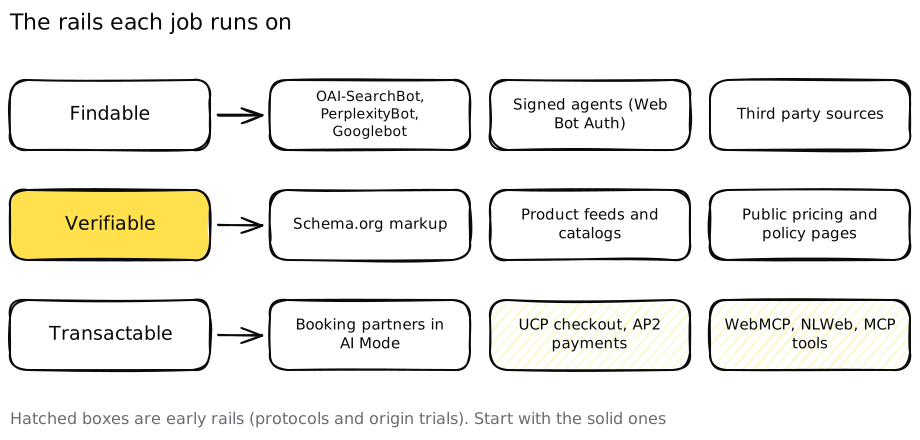 Each job has its own rails. Only some are mature, so start with the ones your buyers’ agents already use.
You don’t need all of these. Pick by where your buyers’ errands already happen. A restaurant should care about reservation partners long before WebMCP. A Shopify store should care about catalog quality before AP2. A B2B software company should care about a signup or demo flow that works without a phone call before any protocol at all.
Then walk your own flow as an agent would. Every forced account creation, surprise fee at the last step, CAPTCHA and “contact us for pricing” is a place an agent can stall. Blocking agents can be the right call for some businesses. Make it a decision with a known cost, not a firewall default nobody remembers setting.
What changes for B2B and B2C
The three jobs are the same on both sides. What sits inside them differs.
B2C. Errands are short and specific. “Trail shoes, size 10, under $150, here by Friday.” “A table for four, Thursday, near Soho.” Being findable means being in the catalogs and booking platforms agents search. Being verifiable means per variant prices, stock and delivery windows that match across feed, page and checkout. Being transactable means checkout or booking that works for a signed agent. Speed matters here, because Google’s dining booking and Shopify’s agent channels are already live for many brands.
B2B. Errands are longer and the agent usually stops at a shortlist. “Find three SOC 2 compliant payroll tools for a 60 person team in the US and Germany, with pricing.” Being findable means coverage in comparison articles, review platforms and communities your category reads. Being verifiable means public pricing, integrations, security and regions pages. Being transactable means a free trial, a self serve plan, or a demo request form short enough that an agent, or a buyer an agent briefed, finishes it.
The mistake we see on both sides is treating agents as a future channel. A restaurant that ignores its booking partners or a SaaS company that hides pricing is already losing errands it never hears about.
What we don’t know yet about AI agents
A lot, and a guide that hides that is selling you something. The open questions today:
- How agents rank options. Google, OpenAI and Perplexity describe their features, not their ranking methods.
- Which standards win. UCP, the Agentic Commerce Protocol, AP2, WebMCP, NLWeb and MCP overlap. Some will merge or fade. WebMCP is still an origin trial.
- Whether paid placement arrives inside agents. None of the agent booking or shopping features above publishes a paid route to being picked today.
- How much agent traffic you already get. Many agents browse like a normal browser, and analytics tools don’t separate them well yet.
- Whether llms.txt matters. It’s a proposal, and the major crawler documentation we checked doesn’t mention it.
Our position is to invest in what helps every agent at once, meaning access, consistent facts and a flow that finishes, and to treat any single protocol as a bet sized to your channel.
How to measure AI agent optimization
You can’t log into a dashboard that shows where every agent ranks you. You can measure the parts you can reach.
- Write a fixed list of errands. Twenty to forty, in your buyers’ words, with real constraints like budget, size, location, date or team size.
- Run them on a schedule. Monthly across ChatGPT, Gemini and AI Mode, Perplexity and Copilot, several runs each, since AI answers vary from run to run.
- Log four outcomes per errand. Mentioned, picked or shortlisted, facts stated correctly, and whether the action could be completed.
- Check the plumbing. Crawler access in robots.txt and your firewall, feed health in Merchant Center or Shopify, live status on booking partners.
- Watch what comes back. AI referral sessions, bookings and orders from AI surfaces, and demo requests that mention an AI tool in “how did you hear about us.”
Keep the errand list fixed so changes mean something. The column we’d watch hardest is “facts stated correctly.” A brand that’s picked but described with the wrong price is one sync away from losing the sale.
Doing it in house or with an AI agent optimization agency
Most of this work is in house work dressed up as something new. Fixing a robots rule, aligning prices across pages, publishing a pricing page and cleaning a feed don’t need an agency. A small team can cover the basics in a few focused sprints.
An AI agent optimization agency earns its fee on the parts that are hard to staff. Getting named in third party sources at scale, running errand tracking across engines every month, and connecting AI referrals to pipeline or orders. If you hire one, ask four questions. Which of the three jobs do you cover? Which errands will you track, and can we approve them? What do you change outside our website? How will we see the effect on bookings, orders or pipeline? The same rubric from our GEO agency guide applies, and so does the rule about guarantees. Nobody controls what the agents pick.
If you’d like an outside read first, our free AI visibility audit shows whether AI answers name you for the questions your buyers ask and which of the three jobs to fix first.
Frequently asked questions
What is AI agent optimization?
AI agent optimization is making a brand easy for AI agents to find, verify and transact with. Agents like the booking feature in Google's AI Mode don't stop at an answer. They check availability, compare prices and complete bookings or purchases, so the work covers sources and crawler access, consistent machine readable facts, and checkout or booking flows an agent can finish.
Is AI agent optimization the same as GEO?
No, though they overlap. Generative engine optimization aims to get your brand named and cited in AI answers. AI agent optimization starts there, then adds two jobs GEO usually skips. An agent has to verify your facts, such as live price, stock or opening hours, and it has to complete an action, such as a booking, an order or a vendor shortlist.
What is agentic SEO?
Agentic SEO is another name for optimizing a website so AI agents can discover it, understand it and act on it. Some vendors use it narrowly for technical work like structured data and WebMCP tools. We treat agentic SEO and AI agent optimization as the same discipline, with three jobs, being findable, being verifiable and being transactable.
What makes a website agent ready?
An agent ready website lets AI crawlers and user directed agents reach its pages, states prices, availability and policies in plain text and structured data that match each other, and has a booking or checkout flow that doesn't block a signed, legitimate agent. For B2B, it also publishes pricing, integration and security pages an agent can read without a demo form.
Do I need llms.txt for AI agents?
It's optional. llms.txt is described on its own site as a proposal to standardise a file that helps agents use a website. It's cheap to add and it does no harm, but none of the crawler documentation from OpenAI or Google that we checked mentions it. Fix crawler access, structured data and consistent facts first, then add llms.txt if you have time.
Can an AI agent optimization agency guarantee agents will pick my brand?
No. OpenAI, Google, Perplexity and the companies building shopping and booking agents decide what their systems pick, and none publishes a full ranking method. A credible AI agent optimization agency improves the inputs those systems read, meaning sources, data and transaction access, then measures picks on a fixed list of buyer errands. Walk away from anyone promising a placement.