Knowledge Graph Optimization for Enterprise Brands

Othmane Khadri · Founder, Earleads

Summary
Knowledge graph optimization is the work of getting Google's Knowledge Graph and AI assistants to recognize each of your companies, brands and products as a separate, correctly described entity. You map the entities, write one dated fact sheet per entity, mark up the relationships, make outside sources agree, and re-check how each engine describes you.
On this page
- What is knowledge graph optimization?
- Why enterprise brands get confused in AI answers
- Step 1: Map every entity you actually are
- Step 2: Write one dated fact sheet per entity
- Step 3: Read how each engine describes each entity today
- Step 4: Mark up the relationships with Organization schema
- Step 5: Make the outside sources agree
- Step 6: Re-run until each description holds
- Dictionary-word names and namesakes
- Renames, acquisitions and retired products
- What changes for B2B and B2C companies
- What knowledge graph optimization can’t do
What is knowledge graph optimization?
Knowledge graph optimization is the work of making sure search engines and AI assistants know which entities you are, how they relate and which facts belong to each one. An entity is a thing that can be identified without ambiguity, like a company, a brand, a product, a person or a place. Google stores what it knows about entities in its Knowledge Graph, which held “over 500 billion facts about five billion entities” when Google last described it publicly (Google).
You see the Knowledge Graph most clearly in the knowledge panel, the box on the right of a branded Google search. But the same question sits under every AI answer. Before ChatGPT, Perplexity, Gemini, Claude or Google’s AI Overviews can say anything useful about you, they have to settle which “you” the question is about. Then they attach facts to it.
For a company with one name and one product, that’s usually easy. For an enterprise with a parent company, several brands, dozens of products, regional entities and an acquisition or two, it often isn’t. That’s where entity SEO stops being a markup task and becomes a governance job.
Brand entity optimization is the same work seen from the brand side. You decide what each entity is called, what it does, who owns it and what it’s not. Then you make every source engines read say the same thing.
Why enterprise brands get confused in AI answers
Engines don’t confuse big companies because they know too little. They confuse them because they read too many sources that disagree. Google says facts in the Knowledge Graph “come from a variety of sources that compile factual information” (Google). AI answers that search the web work the same way. When those sources describe your brands with different names, parents and one-liners, the answer blends them.
These are the patterns that show up most when you read how engines describe a large company.
| Confusion pattern | What the answer says | Usual cause | First fix |
|---|---|---|---|
| Parent and brand blended | Features of one brand credited to another, or the parent described as a single product | Brand pages that never state the parent, press releases using brand names loosely | One entity home per brand, parent named on each |
| Product mistaken for the company | The company described as only its best-known product | The flagship product has more coverage than the company | Company About page that lists every product line, linked both ways |
| Dictionary-word name | A description of the word, or an answer about the wrong topic | The common meaning outweighs the brand in everything engines read | Pair the name with its category everywhere you control |
| Namesake company | Another company’s founders, location or funding | A louder company with the same or a similar name | Disambiguating facts on your pages and listings, “different from” in Wikidata |
| Acquired brand | The acquired brand presented as independent, or both companies’ facts merged | Listings and articles written before the deal | State the relationship on both sites and in every listing |
| Retired product or old name | A product you stopped selling recommended as current | Comparison pages and threads that were never updated | Dated plain-text facts, then correct the cited sources |
The cost is rarely visible in analytics. A buyer asks about your enterprise plan and gets the pricing of a sister brand. A shopper asks for a product and gets a description of the word your product is named after. Nobody clicks, so nothing gets logged. The AI reputation management guide covers the general correction loop. This article is about getting the entities themselves right, since most of those errors start there.
Step 1: Map every entity you actually are
Start with an inventory, not with markup. List every legal entity, brand, product line, product and executive who speaks for the company in public. Add regional entities and any brand you’ve acquired, retired or renamed.
For each one, decide whether it should exist as a separate entity. A brand with its own buyers, its own site and its own coverage should. A feature, a pricing tier or a campaign name usually shouldn’t, and treating it as one creates more confusion than it fixes.
Then give each entity an entity home. That’s the one URL that describes it best and that every other source should point back to. For the parent it’s usually the About page. For a brand, it’s the brand’s home page or About page. For a product, it’s the product page, not a blog post announcing the launch.
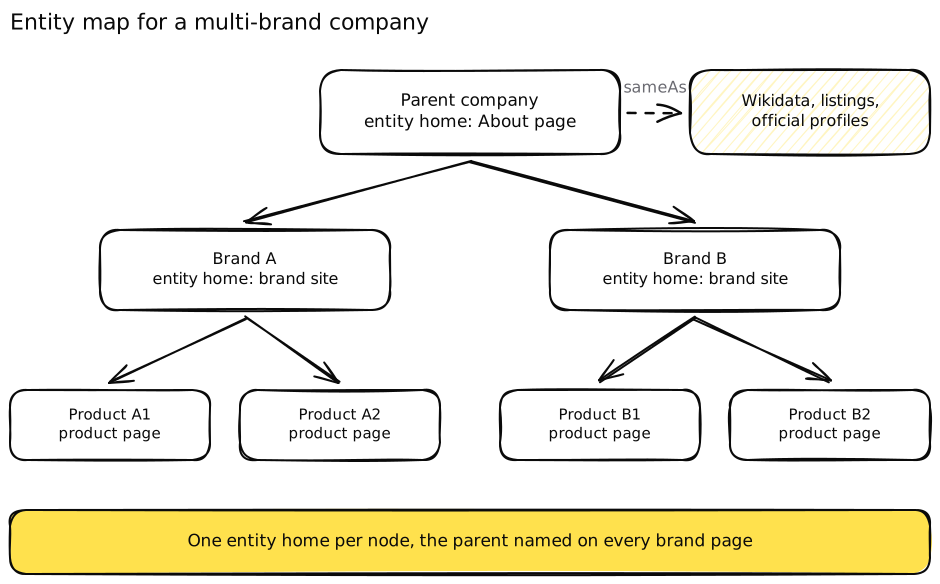 One entity home per node, with the parent named on every brand page and its outside profiles linked through sameAs.
Write the relationships down in plain words before you write any code. Who owns whom, which products belong to which brand, which brand serves which market. If that map isn’t clear inside the company, no engine will work it out from outside.
Step 2: Write one dated fact sheet per entity
Each entity gets a short fact sheet that the whole company treats as the source of truth. Keep it boring and specific:
- The official name, plus other names it goes by and old names
- A one-line description that names the category, the same sentence everywhere
- The parent organization, and the brands or products underneath
- Founding year, headquarters and the markets it serves
- The people who speak for it in public
- What it is not, when there’s a namesake or a dictionary meaning to separate from
- The date the sheet was last checked
Product truth belongs to the company, in writing. Legal, product marketing and sales should agree on the sheet before anything is published, because every later step copies from it. Publish the facts as dated plain text on the entity home, in the page copy rather than in an image or a downloadable PDF.
The one-line description does more work than it looks. When a press release, a directory listing, a partner page and your own About page all repeat “Name is a [category] for [audience]”, the description becomes hard to blend with anything else.
Step 3: Read how each engine describes each entity today
Before changing anything, record what engines say now. Ask validation questions about each entity by name, such as “what is Name”, “who owns Name”, “is Name legit” and “Name vs [sister brand]”. Run them in ChatGPT, Perplexity, Gemini, Claude and Google’s AI features, in the apps buyers use rather than through an API, because API answers aren’t what buyers see.
Read three things in each answer. Does the right entity appear, is it in the right category, and which facts belong to someone else? Then list each factual claim (pricing, products, positioning, leadership), mark what’s wrong or stale, and note the source each answer leans on in its citations.
Run each question several times. SparkToro had 600 volunteers run 12 prompts 2,961 times and found a less than 1 in 100 chance that ChatGPT or Google’s AI would give the same list of brands in any two responses (SparkToro). One run can make a blended description look fixed, or make a fixed one look broken.
Ask sales and support to log any AI claim a prospect or customer repeats. The most expensive wrong answer is often the one sales hears first, on a call, with the prospect reading it back to them. Every Earleads audit includes this accuracy check, entity by entity, with the source behind each wrong claim. What an AI visibility audit should show you explains what that document should contain.
Step 4: Mark up the relationships with Organization schema
Organization schema is how your site states the fact sheet in a format machines read without guessing. Google says Organization structured data helps it “disambiguate your organization in search results”, and recommends placing it on the home page or a page that describes the organization, such as the About page (Google).
The properties that matter most for a multi-brand company:
name,alternateNameandlegalName. The name you want used, the other names you go by and the registered name if it’s different.description. The same one-line description as the fact sheet.sameAs. Schema.org defines it as the “URL of a reference Web page that unambiguously indicates the item’s identity” (schema.org). Point it at the profiles that describe this exact entity, such as the Wikidata item, the official social profiles and the main directory listings.parentOrganizationandsubOrganization. These say who owns whom, “e.g., as a subsidiary” in schema.org’s words. Use them on the parent and on each brand, so the relationship is stated from both ends.brand. For brands the organization maintains that aren’t separate companies.disambiguatingDescription. “A short description of the item used to disambiguate from other, similar items” (schema.org). Useful when a namesake or a dictionary meaning keeps winning.
Keep expectations honest. Google’s own guidance on AI features says “There’s also no special schema.org structured data that you need to add”, and asks you to make sure “your structured data matches the visible text on the page” (Google). Markup doesn’t unlock AI answers. It’s one more source that agrees with the others, and markup that contradicts the visible page is worse than none.
If brands live on subdomains, each can carry its own WebSite markup for its site name. Google supports site names for domains and subdomains but not for subdirectories (Google). Brands that live in folders under the parent domain depend even more on clear page copy and listings.
Step 5: Make the outside sources agree
Most of what engines know about you comes from pages you don’t own. That’s where enterprise entity work usually falls apart, because each listing was filled in by a different team in a different year.
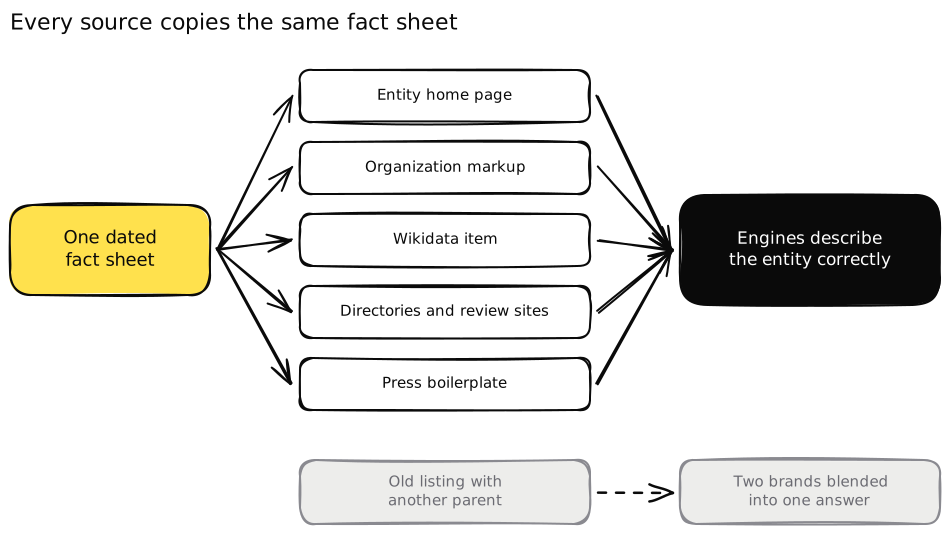 Every source copies from the same fact sheet. Conflicting sources are what turn two brands into one answer.
Work through them in the order engines cite them, using the citations from Step 3:
- Wikidata. An item is acceptable if it describes “a clearly identifiable conceptual or material entity that can be described using serious and publicly available references” (Wikidata). Link brands to the parent with “parent organization or unit” and its inverse “child organization or unit” (Wikidata). Add old names as aliases. Cite real sources on every statement.
- Wikipedia. If an article exists, don’t edit it yourself. Wikipedia’s conflict of interest guideline says affected editors are “strongly discouraged from editing affected articles directly” and should propose changes on the talk page (Wikipedia).
- Knowledge panels. An official representative can claim a panel and suggest changes, verifying through YouTube, Search Console, Twitter or Facebook. Google notes that “not all knowledge panels are claimable”, and local businesses manage theirs through a Business Profile instead (Google).
- Directories, review sites and data providers. Software directories, review platforms, company databases, app stores and marketplaces. They often show up in the citations for “what is” and “is it legit” questions. Check the name, parent, category and description on each.
- Press boilerplate and partner pages. The “About Name” paragraph at the bottom of every press release gets copied for years. Fix it once, then ask partners and resellers to update their descriptions.
- Articles and community threads. Cited comparison articles and forum threads still carry old facts. Ask authors for a one-line correction and answer in threads with the right facts, as a person, not as an ad.
Mentions matter here more than links. Ahrefs studied 75,000 brands and found branded web mentions correlated with AI Overview brand visibility at 0.664, against 0.218 for backlinks (Ahrefs). Every consistent mention of the right name next to the right category is a vote for the right entity. Our guide on how to get cited by AI covers earning those mentions.
Step 6: Re-run until each description holds
Go back to the validation questions from Step 3 on a fixed schedule. You’re looking for each entity described correctly, in the right category, with its own facts, across several runs in each engine. A correct answer once isn’t a fix.
When an answer is still wrong, read its citations again. The error almost always traces to a source you haven’t corrected yet, or one that contradicts the fact sheet. Fix that source, publish the correct version on pages engines already read, and run the question again.
Answers that search the web can change once the cited pages are updated and recrawled. Answers from training data change much later, as consistent sources build up and newer models ship. That’s why the outside sources in Step 5 keep paying off after the obvious fixes. AI brand tracking covers how to keep this running without checking every question by hand.
Dictionary-word names and namesakes
A brand named after an ordinary word starts at a disadvantage. Ask an engine about it with no context and it may describe the word, because the word has far more written about it than your company does. A namesake company creates the same problem with a different winner.
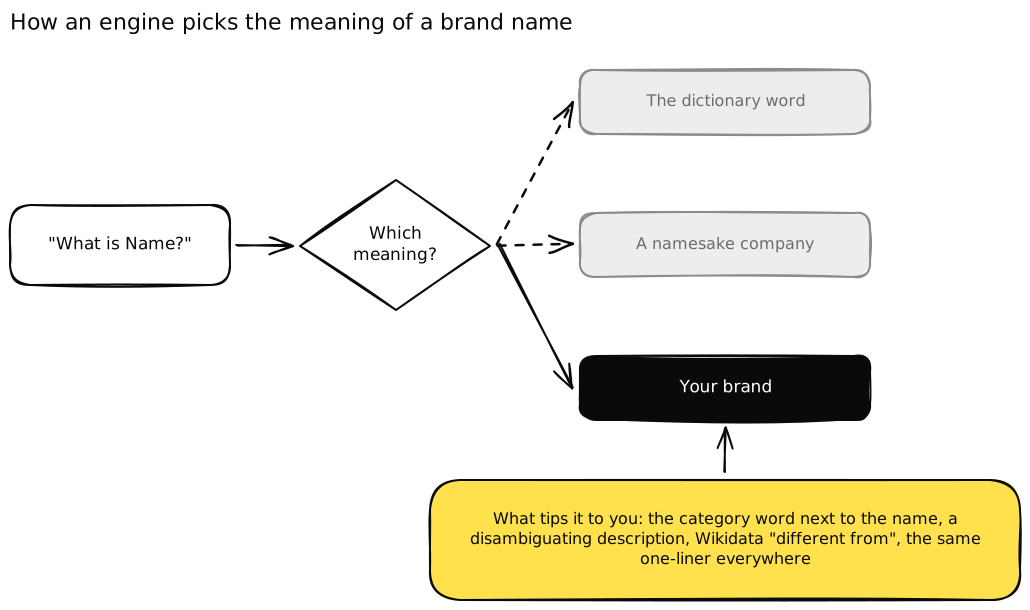 Engines pick the meaning with the strongest signals. Pair the name with its category everywhere you control.
You can’t make the word less common, but you can make the brand easy to tell apart:
- Pair the name with its category in titles, the first line of the About page, social bios, listings and press boilerplate. “Name, the [category] for [audience]” reads as a different entity from “name”.
- State what you’re not on the entity home and in
disambiguatingDescription, when a namesake keeps winning. - Use Wikidata’s “different from” property. It exists for an “item that is different from another item, with which it may be confused” (Wikidata). Add it to your item when the namesake has one.
- Track the bare name and the name with its category as separate questions. The bare name shows whether engines have learned you. The paired one shows what they say once they know which entity is meant.
A related risk is the label. Engines can file a brand under the wrong tier, such as “a beginner tool” when it serves large teams. That’s a description problem rather than an identity problem, and the fix is the same consistent one-liner in every source.
Renames, acquisitions and retired products
Entities change. When a brand is renamed, track both names, write “New, formerly Old” in every source you control and keep the old name as an alternateName and a Wikidata alias. The full playbook is in how to get AI to learn your new name.
After an acquisition, decide first whether the acquired brand is absorbed or kept. If it’s kept, both sites, both Wikidata items and every listing should state the parent in one plain sentence. If it’s absorbed, redirect its pages page by page and say “Old, now part of New” wherever you can.
Retired products need a dated line on the page that replaced them, such as “Product was retired in [month, year] and replaced by New Product”. Without it, engines keep recommending the old one from comparison pages written before the change.
What changes for B2B and B2C companies
B2B. Buying committees check the same vendor several times, from different angles. Procurement asks about the legal entity, security asks about the parent and the data location, and the end user asks about the product. Each of those questions has to reach the right entity. The enterprise GEO strategy guide covers which questions to prioritise. Software directories, review sites, company databases and analyst profiles matter most here.
B2C. Shoppers ask about products, not companies, and they act on the first answer. Product names, regional sites, marketplace listings, app stores and product feeds are where entities split or merge. A product named after a common word, or sold under different names by country, needs the same fact sheet discipline as a corporate brand. Consistent names and categories in product feeds and marketplace titles do much of the work.
What knowledge graph optimization can’t do
Nobody controls what an assistant says, so be wary of anyone who promises a knowledge panel or a specific AI answer by a given date. Google’s own Knowledge Graph Search API is “not suitable for use as a production-critical service” and “returns only individual matching entities, rather than graphs of interconnected entities” (Google). Any tool claiming to show your exact standing inside the graph is estimating.
What you control is the trail. One map of your entities, one fact sheet per entity, markup that matches the page, outside sources that agree, and a record of how each engine describes each entity over time. You can request an audit to see where your entities stand today.
Get a personalised case study
Pick your industry and we'll email you the case closest to your business, numbers included.
Frequently asked questions
What is the difference between entity SEO and knowledge graph optimization?
They overlap almost completely. Entity SEO is the broader practice of helping search engines understand the things your pages are about, such as companies, products and people. Knowledge graph optimization is the part focused on how your own entities are recorded and described, in Google's Knowledge Graph and in the sources AI assistants read. For a brand, it's the same work seen from two sides.
How do I get a Google knowledge panel for my company?
You can't request one directly. Google generates knowledge panels automatically from sources it trusts. What helps is a clear About page with Organization markup, consistent profiles linked through sameAs, a Wikidata item if you meet its notability policy, and independent coverage that states the same facts. Once a panel appears, an official representative can claim it and suggest changes.
Does schema markup make ChatGPT understand my brand?
Not on its own, and nobody outside OpenAI can show exactly how it's used. Google says its AI features need no special schema and that markup should match the visible text on the page. Treat Organization markup as one consistent statement of facts among many. The pages, listings and articles that AI answers cite carry at least as much weight.
Should each of our brands have its own Wikidata item?
Only when the brand is a clearly identifiable entity that serious public sources describe, which is Wikidata's own test. A product line with its own coverage usually qualifies. A feature or a campaign name usually doesn't. When items exist, link them with parent and child organization properties, so the graph shows who owns what instead of leaving engines to guess.
How long does knowledge graph optimization take to show results?
There's no reliable timeline. Answers that search the web can change once the sources they cite are updated and recrawled. Knowledge panels refresh on Google's schedule. Answers drawn from a model's training data move only as consistent sources accumulate and newer models ship. Judge progress by re-running the same validation questions until each entity is described correctly across several runs.
Does entity SEO matter for consumer brands?
Yes, often more. Consumer brands tend to run many product names, regional sites and marketplace listings, and shoppers ask assistants which product to buy rather than which company to hire. A product that gets blended with a sister product, or with an unrelated item of the same name, loses the recommendation at the moment someone is ready to buy.