Forum Marketing for B2B: Earn Citations in AI Answers

Othmane Khadri · Founder, Earleads

Summary
Forum marketing for B2B means answering buyer questions in online communities so that AI engines, which quote discussion forums heavily, find your brand inside the threads they cite. It works when each thread gets one play (comment, recreate or leave alone), the title is the buyer's literal question, and a named person with real history in that community writes it.
On this page
- What forum marketing for B2B means now
- Why forum threads feed AI answers
- What gets a forum thread cited
- How to run forum marketing for B2B
- Step 1: Map the buyer questions and the communities
- Step 2: Read each community’s rules before you write a word
- Step 3: Give every thread one play
- Step 4: Write an answer worth quoting
- Step 5: Order the work by citations, not upvotes
- Step 6: Measure what forum work actually moves
- Honest participation rules for B2B forum marketing
- Community-led growth: your own community counts too
- Forum marketing for B2B vs B2C
- Common forum marketing mistakes
What forum marketing for B2B means now
Forum marketing used to mean signatures, profile links and dropping a URL into any thread that would hold still. That version is dead, and moderators killed it long before AI did. The version that matters now is quieter. Buyers ask questions in online communities, AI engines read those threads, and the answers they write lean on what practitioners said there.
So forum marketing for B2B is the work of being present, usefully and honestly, in the threads that answer your buyers’ questions. A finance lead asks whether anyone has moved off a legacy expense tool. An IT manager asks which device management platform handles a mixed fleet. A founder asks what people pay for payroll in Germany. Those threads get read by humans for years, and they get read by ChatGPT, Perplexity and Google’s AI features every time someone asks the same thing.
It isn’t only B2B. A consumer brand faces the same mechanics on “is this worth it” and “what did you switch to” questions, and the plays below work the same way. The difference is where the conversations happen, which we cover near the end.
There are two halves to the work. One is participating in communities you don’t own, which is most of this guide. The other is running your own community, usually called community-led growth, which has its own section. At Earleads we treat both as part of AI visibility, because both decide what engines find when a buyer asks.
Why forum threads feed AI answers
The citation studies agree that online communities are a major AI search source. They disagree on how major, which is itself the lesson.
On Perplexity, forums lead. Ahrefs tracks the domains Perplexity cites across 3.1 million US queries on every topic. In its September 2026 update, the most cited domain is a discussion forum, with 21.6% of citations among the top 50 sources, ahead of YouTube at 20.8% and Wikipedia at 6.3%.
A year earlier, the picture looked different. Ahrefs’ June 2025 comparison of 76.7 million AI Overviews and roughly 957,000 ChatGPT and 953,500 Perplexity prompts found that the largest discussion forum and Quora ranked high only in AI Overviews, at 7.4% and 3.6% of mentions. Neither made ChatGPT’s or Perplexity’s top ten at the time. “It seems Google favors user generated content sites,” the study concluded.
And the mix can swing inside a quarter. Semrush followed 230,000 prompts for 13 weeks in 2025. It found the largest discussion forum was cited in close to 60% of ChatGPT responses in early August and around 10% by mid-September, while its share stayed consistent on Google AI Mode and Perplexity.
Why do engines go to forums at all? Because a large share of buyer questions are about experience, not facts. “Did switching work for you” and “what broke when you migrated” have no good answer on a vendor’s site. Google’s own documentation describes its forum markup as designed for any forum-style site “where people collectively share first-hand perspectives”. That’s the content type engines reach for when the question is personal.
There’s a second reason forum work counts even when a thread isn’t the cited source. Ahrefs studied 75,000 brands and found branded web mentions correlated with AI Overview visibility at 0.664, against 0.218 for backlinks. Correlation isn’t causation, but a brand named in a useful forum answer is exactly that kind of mention, link or no link.
The practical conclusion is to stop planning around one engine’s current numbers. Check which sources answer your own buyer questions, on each engine, and plan from that. Our guide to AI search ranking factors covers the wider set of studies.
What gets a forum thread cited
Most forum marketing advice says “add value” and stops. The useful question is narrower. Of all the threads on a topic, which ones do engines actually quote?
Reach isn’t the signal. In the community programmes we run, only a small minority of threads ever get quoted, and rarely the viral ones. Low-view threads that answer a buyer’s question produce the citations. A team that reports views and upvotes is reporting the part that doesn’t compound.
| Thread trait | Why engines quote it | What to do |
|---|---|---|
| The title is the literal buyer question | It matches the words a buyer types into an engine | Write titles in buyer language, not category jargon |
| It’s a comparison, migration or alternatives thread | These are the questions buyers ask when building a shortlist | Prioritise “X vs Y”, “moving off X” and “X alternative” questions |
| The brand is in the post body | A thread can only be cited for a brand it names | Name the brand once in the body, where it answers the question |
| It’s a question, not a story | Question posts tend to survive moderation where story posts get removed | Frame new threads as genuine questions |
| One topic, one thread | Cross-posts on the same question cannibalise each other | Pick one community per question |
Two more patterns are worth knowing. Threads removed after indexing often keep being cited, so a removal isn’t always the end of a thread’s life in AI answers, though it’s never a tactic to plan for. And migration threads (“what are people moving to before X shuts down”) tend to win because they catch buyers at the exact moment a shortlist forms.
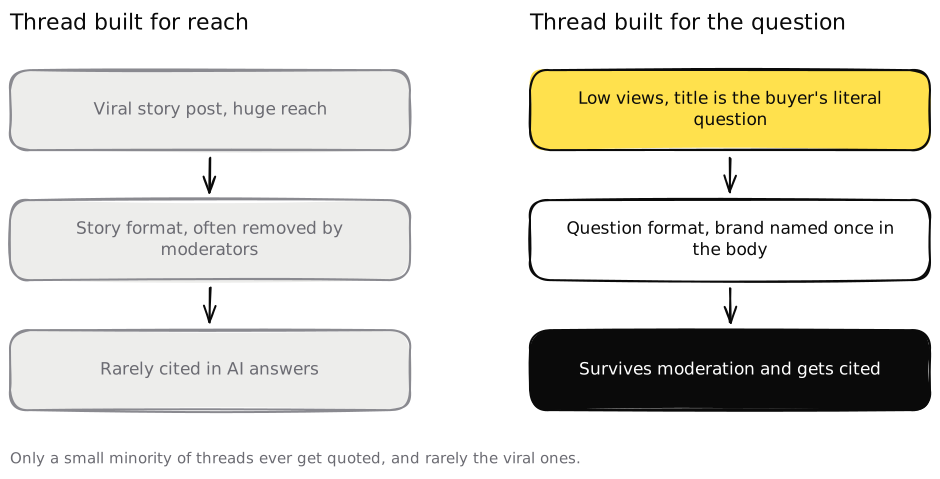 Engines quote the thread that answers the question, not the one with the most views.
How to run forum marketing for B2B
The six steps below follow the order the work actually runs in, from mapping to measurement. They apply to B2B and B2C brands alike, and they assume a human writes and submits every post.
Step 1: Map the buyer questions and the communities
Start with the questions, not the communities. We build 30 to 40 buyer questions from positioning and sales language rather than a keyword tool, then map 40 or more communities where those questions get asked, across nine categories such as category, role, stage, regional and rant communities. At least a fifth of them should be non-obvious.
The non-obvious ones are where competitors aren’t. For a B2B payroll product, the obvious community is the one about payroll software. The less obvious ones are where accountants talk shop, where first-time founders ask about hiring abroad, regional communities for the countries you serve, and the rant communities where people vent about the tool they want to leave. A B2C running shoe brand would map running clubs, injury recovery groups and local race communities, not only the shoe review forum.
Then assign each question a home. First-person experience questions (“did this work for you”) belong in community threads. Named comparisons (“X vs Y pricing”) belong on your own site, where you control the facts. Trying to win a comparison in a forum, or an experience question on a product page, fights the way engines pick sources. We cover the on-site half in how to get cited by AI.
Step 2: Read each community’s rules before you write a word
Every community on the map gets tagged by its self-promotion rules. Most publish them, and moderators enforce them faster than any brand team expects.
Stack Overflow’s help center is a good example of how specific those rules get. It warns that “the community here tends to vote down overt self-promotion and flag it as spam”. It allows answers about your own product, but says that if you mention it, “you must disclose your affiliation in your post.” And it names the pattern that gets accounts flagged: “If you respond only to questions where the answer can be something you’re selling, they’ll assume you’re just here to sell.”
Read three things for each community before posting. The written rules, usually pinned or in the sidebar. Recent removals, if the community shows them, which tell you how the rules are enforced in practice. And how existing vendor replies are received. Then tag the community, roughly, as one that welcomes disclosed vendor answers, one that tolerates a mention only when someone asks for options, or one that removes any vendor mention at all.
The client also names communities that are off limits for its own reasons, such as a partner’s community or a regulated audience. That list overrides everything else on the map.
Step 3: Give every thread one play
With the map tagged, each thread gets exactly one of three plays. Not a blend, and not “comment everywhere and see”.
| Play | When it fits | What you do | The usual mistake |
|---|---|---|---|
| Comment | The thread is open and still answers a live buyer question | Add a genuinely useful answer that solves the asker’s problem | Replying with a pitch instead of an answer |
| Recreate | The thread is locked, archived or thin, but the question still gets cited | Publish a better thread against the same question, in a community that allows it | Copying the old thread’s title into five communities |
| Leave alone | The community removes any vendor mention | Nothing. Answer the question somewhere else | Posting anyway and losing the account and the trust |
Knowing which communities to leave alone is most of the skill. It’s also the play that never shows up in a monthly post count, which is why teams paid on volume rarely respect it.
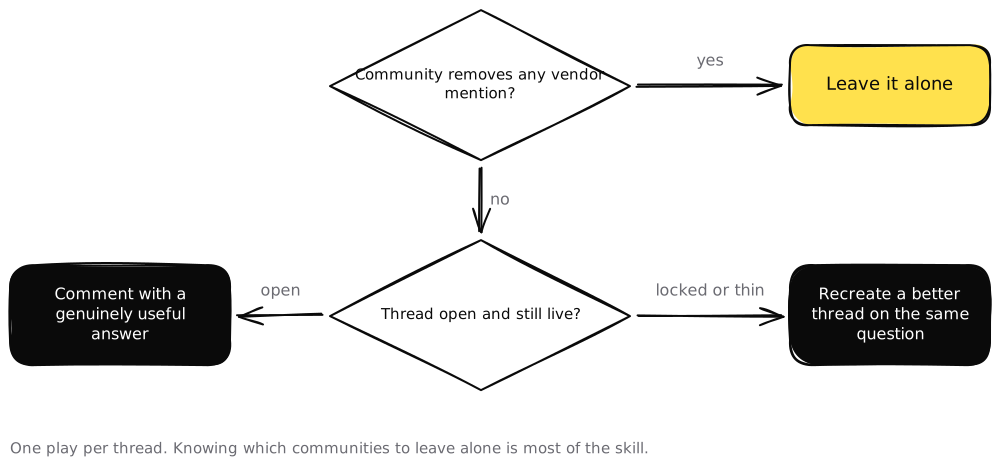 One play per thread. The leave-alone branch protects everything else on the map.
Step 4: Write an answer worth quoting
A forum reply has two readers, the person who asked and the engine that may quote it later. The same things serve both.
- Solve the problem first. The asker should be able to act on your answer without clicking anything. Stack Overflow’s advice to “always solve the asker’s problem” holds in any community.
- Never be the only option. Name two or three options and who each suits, including where your brand isn’t the right fit. The brand appears once, only where it answers the question.
- Use concrete detail. Limits, integrations, setup time, what it doesn’t do. A vague “we’re great for teams like yours” gives an engine nothing to quote and a moderator a reason to remove it.
- Write like a practitioner. First-hand experience in plain language, not campaign copy. The client approves how the brand is described before anything goes live.
- Disclose who you are where the community’s rules or the law ask for it, in the post itself.
For a recreated thread, the same rules apply to the post, plus the traits from the table above. The title is the buyer’s literal question, the post is framed as a question rather than a story, and the brand sits in the body so the thread can be cited for it.
A reply in this spirit might read like this, written by someone at the vendor with history in that community.
Full disclosure, I work at one of the tools below. For a team your size the three worth testing are A, B and C. A is the cheapest but has no SSO. B has the best accounting sync. C is where I work, and it’s strongest if you pay people in several countries. If you’re US only, it’s probably more than you need.
The reply is useful even if the reader never picks the author’s product. That’s the test.
Step 5: Order the work by citations, not upvotes
Once the map exists, the order of work matters more than the volume. We order threads by how often engines cite them, not by upvotes or views.
In practice, run your buyer questions through the engines and note which threads they already cite. Those threads come first. If one is open, it’s a comment. If it’s locked or thin, it’s a candidate to recreate. A thread engines already trust on your question is worth more than a popular thread on a neighbouring topic.
Volume follows from the category, not from a package. Our rule of thumb is about half the monthly mentions of the category leader, spread across communities rather than concentrated in one. Concentration looks like a campaign, and moderators notice campaigns. Keep one topic to one thread, since two threads on the same question split the citations between them.
Step 6: Measure what forum work actually moves
Forum work shows up in a predictable order. In our experience, community reach moves first, then citations of those threads, then the brand being named in answers, then Google rankings. Engines often cite a thread before it reaches Google’s top 20, and Perplexity tends to cite earliest, which we cover in Perplexity SEO for B2B.
That order sets what to judge each month. Month one is reach and whether posts survive moderation. Month two is first citations, since threads earn far more citations in their second month than their first. Month three is share of answers. Killing a programme at week six judges it before it could work.
Measure share of answers on buyer questions that don’t name you, not referral clicks. AI answers send citations more than visits, and a buyer who reads your name in an answer often types your domain later. Our guide to AI share of voice covers the maths. And because citations churn, as the Semrush swing above shows, the useful question isn’t “did we get cited” but “when does it hold”.
Honest participation rules for B2B forum marketing
Forum work is the part of AI visibility where a careless team can do real damage, to the brand and to the communities themselves. These are the rules we hold to, as a public standard.
- A human submits every post. Nothing is auto-posted, ever.
- Everything is written by a named person with real history in that community, not an account created for the campaign.
- The brand is never the only option and appears once, only where it answers the question.
- The client approves how the brand is described and which communities are off limits.
- Work is ordered by how often engines cite a thread, not by upvotes.
Outside rules apply too, and they’re stricter than many brand teams assume. Many communities require disclosure in writing, as Stack Overflow’s does. In the US, the FTC’s endorsement guidance tells employees who promote their company’s products on social media to disclose the relationship, and says “listing your employer on your profile page isn’t enough”. Its 2024 rule on fake reviews also prohibits certain reviews and testimonials by company insiders that don’t “clearly and conspicuously disclose” the connection. None of this is legal advice. Check the rules for your market, and in regulated categories follow the stricter process in GEO for regulated industries.
When you hire help, ask who writes the posts and get the names. If the answer is a number of posts per month and nothing else, that’s the answer to worry about. Our guide to choosing a GEO agency lists the other questions.
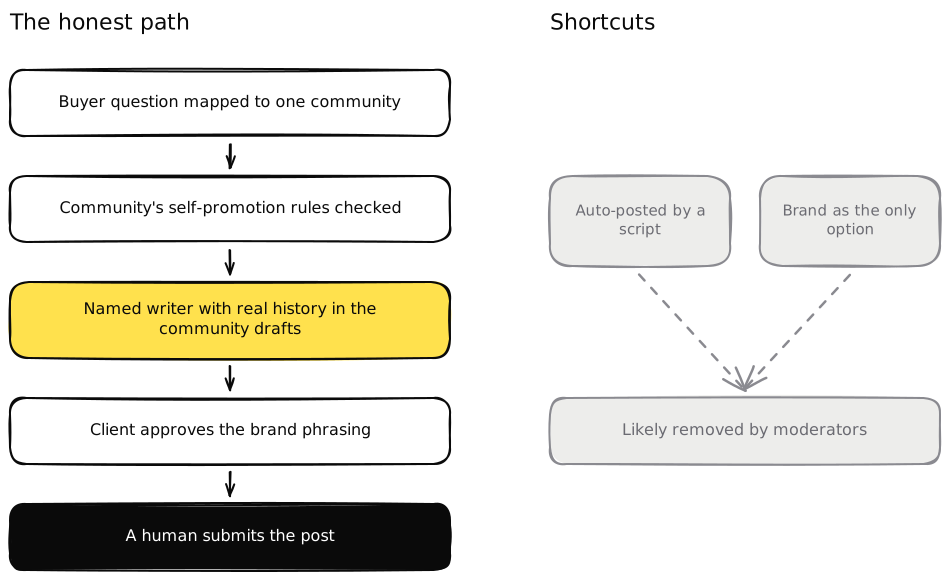 Every post passes the same gates, and the shortcuts are the posts moderators remove.
Community-led growth: your own community counts too
Community-led growth in B2B usually means a community the brand runs, where customers help each other with setup, migrations and edge cases. It’s worth having for its own sake. For AI search, it helps under one condition. The threads have to be public and crawlable.
A community behind a login is invisible to AI crawlers. So is a help forum that renders every post through JavaScript the crawler can’t run. If your customers answer each other’s questions in a gated space, engines will never quote them, however good the answers are. Our checklist for blocking AI crawlers by accident applies to community platforms as much as to marketing sites.
For public communities, Google supports discussion forum structured data. Its documentation says to use DiscussionForumPosting markup only for user-generated posts, and “don’t use this markup for content that’s primarily authored by the publishers”. In other words, it’s for your customers’ threads, not your announcements dressed up as discussion.
An owned community complements work in independent communities. It doesn’t replace it. When a buyer asks which tool to choose, engines tend to look for opinions from places the vendor doesn’t control. Your community answers “how do I do X in your product”. Independent communities answer “should I buy it”.
Forum marketing for B2B vs B2C
B2B: the thread is a reference for a committee. One person asks, and several people read the answer before a shortlist forms. The communities are role and practitioner spaces, the questions are about migration, integrations, security and cost, and a good thread keeps getting read long after it’s posted. Our guide to GEO for B2B covers how those answers feed vendor shortlists.
B2C: the thread is a personal recommendation. “Is this worth it for someone who travels a lot” is answered from experience, and communities are organised around hobbies, life stages and places. Volume is higher and threads move faster, but the plays are the same. Comment where it helps, recreate where the best thread is locked, and leave alone communities that don’t want brands in them.
Common forum marketing mistakes
Briefing for reach. Viral threads rarely become citations. Threads titled with a buyer’s question do.
Cross-posting the same question. Five threads on one question compete with each other. Pick one community per question.
Telling stories instead of asking questions. Question posts tend to survive moderation where story posts get removed.
Making the brand the only answer. A reply that names one option reads as an ad, to moderators and to engines.
Ignoring the leave-alone list. Posting where vendors are banned costs the account and the community’s trust, and it’s the one mistake that’s hard to undo.
Automating posts. Nothing that represents a brand in a community should be posted by a script.
Judging the work by referral clicks. Measure share of answers and how engines describe you, over at least three months. An AI visibility audit should show which threads engines already cite on your buyer questions before anyone writes a reply, and you can request one here.
Get a personalised case study
Pick your industry and we'll email you the case closest to your business, numbers included.
Frequently asked questions
What is forum marketing for B2B?
It's the work of answering buyer questions in the online communities where buyers already ask them, so that people and AI engines find a useful, honest answer that names your brand where it fits. It isn't link dropping or ads. Done well, each thread gets one deliberate play, the brand appears once and never as the only option, and a named person with history in that community writes every post.
Why do AI engines cite forum threads?
Because many buyer questions are about experience, and forums are where people describe theirs. Ahrefs' September 2026 data on 3.1 million US queries puts a discussion forum first among Perplexity's cited domains, at 21.6% of citations in its top 50. Google describes its forum markup as being for sites where people share first-hand perspectives. The mix shifts by engine and month, so check your own questions.
Should my brand comment on a thread, start a new one, or stay out?
Decide thread by thread. Comment when the thread is open and you can add a genuinely useful answer. Recreate when it's locked or thin, by publishing a better thread against the same question. Leave it alone when the community removes any vendor mention. Knowing which communities fall in that last group is most of the skill, and ignoring it costs you the account and the trust.
Do I need to disclose that I work for the brand?
In most communities, yes, and the rules say so in writing. Stack Overflow requires anyone who mentions their product to disclose the affiliation in the post itself. The FTC tells employees promoting their company's products on social media to disclose the relationship and says a profile listing isn't enough. Read each community's rules, and take legal advice for your market.
What is community-led growth in B2B, and does it help AI search?
Community-led growth is growth driven by customers and practitioners helping each other, often in a community the brand runs. It can help AI search when the community is public and crawlable, because engines can read and cite its threads. Content behind a login is invisible to them. It complements work in independent communities rather than replacing it, since engines cite where buyers already talk.
How long does forum marketing take to show up in AI answers?
Expect an order rather than a date. In our experience, reach moves in the first month, citations of the threads build in the second and third, then the brand gets named in answers, and Google rankings move last. Engines often cite a thread before it reaches Google's top 20. Judge month one on reach and moderation survival, and don't kill the work at week six.