Digital PR for AI Search: Earning the Mentions AI Cites

Othmane Khadri · Founder, Earleads

Summary
Digital PR for AI search is earning brand mentions on the pages AI answers already read. Ahrefs found brand mentions track AI visibility about three times more closely than backlinks. Start with the pages cited on your buyer questions, give listicle authors concrete detail engines can lift, turn customer proof into LinkedIn articles, and never pay for reviews or rankings.
On this page
- What digital PR for AI search is
- Why brand mentions in AI answers matter more than links
- Step 1: Start from buyer questions, not a media list
- Step 2: Pitch the pages AI already cites first
- Step 3: Write listicle entries an engine can lift
- Step 4: Turn customer proof into LinkedIn articles
- Step 5: Give journalists something new to report
- Step 6: Measure share of answers, not referrals or reach
- Where we draw the line on paid placements
- Digital PR for B2B vs B2C brands
- Common digital PR for AI search mistakes
What digital PR for AI search is
Digital PR for AI search is the work of getting your brand named, accurately and in context, on the third-party pages that AI answers read. When a buyer asks ChatGPT for the best payroll tool for a 40-person company, or asks Perplexity which running shoe suits flat feet, the engine assembles its answer from pages other people wrote. Roundups, comparison articles, news coverage, review platforms, discussion forums and LinkedIn articles. If your brand is named there, it can be named in the answer. If it isn’t, your own site rarely makes up the difference.
Classic digital PR had a clear scoreboard. Earn a link from a high-authority domain and watch rankings move. That logic still works for Google’s blue links. AI answers work differently. They quote sentences, they name brands, and they lean on a fairly small set of pages for each question. So the target changes from “the most authoritative site that will link to us” to “the pages engines already cite when our buyers ask”.
The table below sets the two briefs side by side.
| Classic digital PR | Digital PR for AI search | |
|---|---|---|
| Target | High-authority domains | Pages already cited on your buyer questions |
| What you want | A followed backlink | An accurate mention, in context |
| What a good entry contains | A link and a quote | Price, integrations, limits, who it suits |
| Scoreboard | Links, domain rating, reach | Share of answers, branded search, signup answers |
| Pace | Campaign bursts | A standing list, rerun every month |
The rest of this guide covers the evidence behind that shift, a six step method, and where we draw the line on paid placements.
Why brand mentions in AI answers matter more than links
The best supported finding in the field comes from Ahrefs. It studied 75,000 brands and measured how closely different signals tracked their visibility in Google’s AI Overviews. Branded web mentions came first, with a Spearman correlation of 0.664. Branded anchors followed at 0.527 and branded search volume at 0.392. Backlinks trailed at 0.218 (Ahrefs, May 2025). Being talked about tracked AI visibility about three times more closely than being linked to.
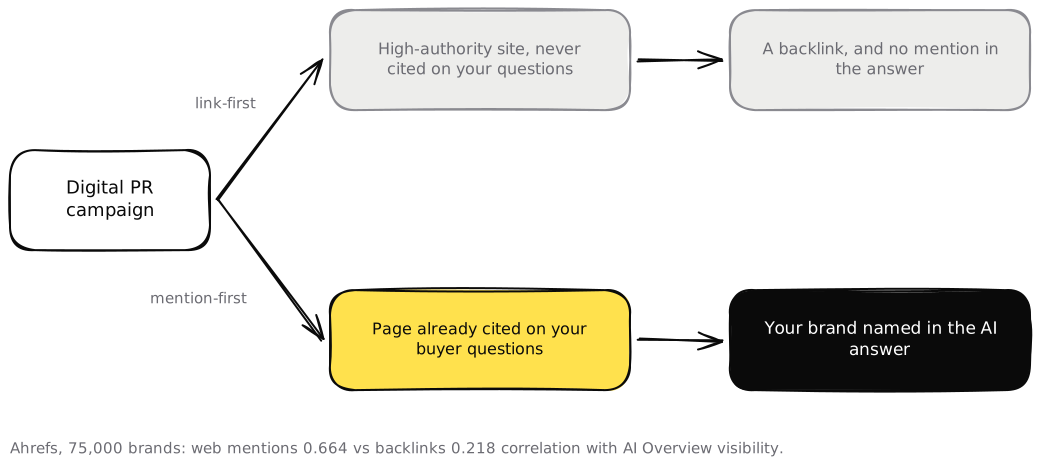 Same effort, different target. Mentions on cited pages are what engines repeat.
Ahrefs is careful about what that means. In its own words, “correlation ≠ causation”, and every factor it studied showed “moderate to very weak correlations on the Spearman scale”. Large brands get mentioned more and linked more, so some of the pattern is size. A follow-up in December 2025 pointed the same way across ChatGPT and AI Mode, with branded web mentions near the top in every engine (Ahrefs, December 2025). We cover both studies in more detail in our review of AI search ranking factors.
The source mix tells the same story from the other side. Muck Rack’s “What Is AI Reading?” study analysed more than 25 million links cited by ChatGPT, Claude and Gemini across 17 industries. Earned media made up 84% of citations, journalism alone 27%, and paid or advertorial content 0.3%. The earned share stayed between 82% and 89% across three editions since July 2025 (Muck Rack, May 2026). Engines quote what others say about you, and they almost never quote what you paid to place.
That’s why unlinked brand mentions deserve a place in the brief. An engine reads the sentence around your name, not the anchor tag. A roundup that describes your product clearly, without a link, can do more for an AI answer than a followed link buried in an author bio.
Step 1: Start from buyer questions, not a media list
Most PR plans start with a list of publications. Digital PR for AI search starts with the questions your buyers ask an engine before they shortlist anyone.
Build that list from positioning and sales language, not from a keyword tool. Use the phrasing prospects use on calls. “Which expense tool works for a team across three countries.” “Is there a cheaper alternative to [competitor] for a small studio.” “What do people use for meal planning with a toddler.” Have sales sign off the list before anything is measured, so nobody picks questions that flatter a dashboard.
Then run each question natively in ChatGPT, Perplexity, Gemini, Claude and Google’s AI features, on the same subscriptions your buyers use. API answers aren’t what buyers see. For each answer, record three things. Whether you appear against named competitors. Your position when you do. And how the engine describes you, because “a beginner tool” is a different problem from being invisible.
Keep only the questions where an answer exists and you’re missing from its sources. Those are the questions digital PR can move. Our guide to AI share of voice covers how to turn these runs into a number you can report.
Step 2: Pitch the pages AI already cites first
Every answer in Step 1 comes with sources. Open them and log every URL. You’ll see the same few page types again and again. Publisher roundups, comparison posts, review platforms, news coverage, community threads, LinkedIn articles and category directories.
Sort the URLs into three groups. Your own pages, competitors’ pages and third-party pages. The third-party group is your outreach list, and it’s already ranked for you by how often engines cite each page. That’s the first move we make on the off-site side, and it’s the one most PR plans skip. Outreach goes to the pages engines already quote on the buyer questions, not to the highest-authority sites.
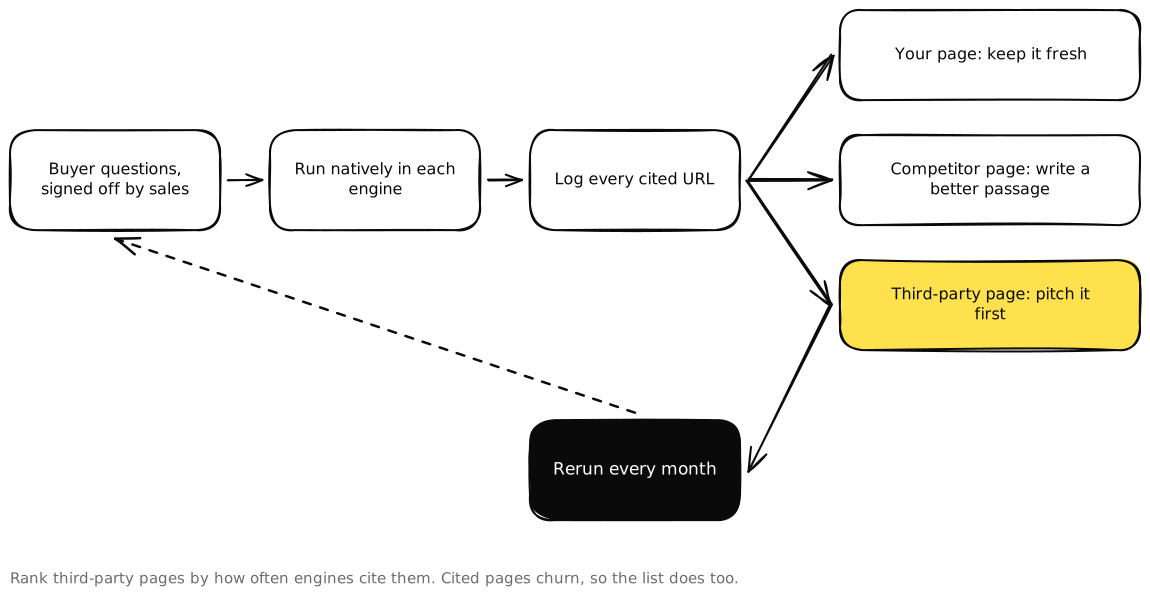 The engines rank your outreach list for you. Rerun it monthly, because cited pages churn.
The reasoning is simple. A page that’s already cited has passed whatever filter the engine applies. Getting named on it changes an answer the engine is already writing. A feature in a famous publication that never appears in your category’s answers may be good for the brand, but it won’t move AI visibility on those questions.
A good pitch to a cited page is short and checkable. Tell the author what the product does, who it’s for, what it costs and what it doesn’t do, with links to pages where each fact can be verified. Offer a named person they can quote. Don’t send a press release. An author updating a roundup needs facts, not adjectives.
This list isn’t a one-off. Cited pages change as authors update articles and engines refresh their sources. Rerun the questions every month and work the new entries first. Our guide on how to get cited by AI covers what to do when the cited page is your own or a competitor’s.
Step 3: Write listicle entries an engine can lift
“Best X” lists are the single biggest source type in many shortlist answers. Ahrefs analysed ChatGPT responses to 750 top-of-funnel prompts and found “best X” blog lists made up 43.8% of all page types cited. The same study found a strong trend towards brands that ranked higher in the list.
Peec AI looked at nearly 200,000 AI responses across eight engines. Brands ranked first in frequently cited third-party listicles tended to appear earlier in AI answers, by about 1.17 positions in B2B SaaS and 1.80 positions in US finance. It also found that “maximum impact is often reached after just a few repeated placements” (Peec AI, May 2026). The study is observational and only covers listicles engines retrieve often, which is one more reason to start from Step 2’s list.
But a listicle spot isn’t a recommendation. Answers often name two of the ten entries on a page they cite. An engine needs a reason to pick yours, and that reason is concrete detail it can lift into a sentence.
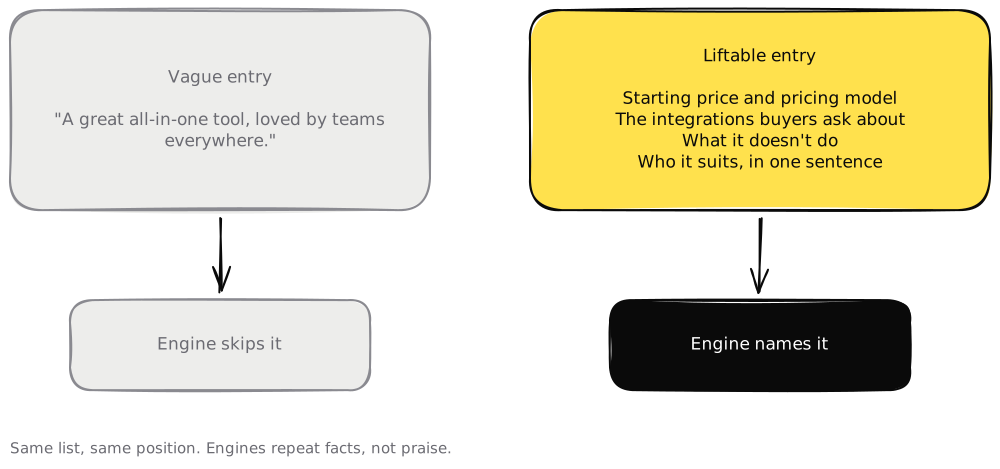 Engines repeat facts, not praise. Give the author the facts.
Give every author the same short fact sheet.
- Pricing. The starting price, the pricing model and what the free tier or trial includes.
- Integrations or compatibility. The five that buyers ask about most, not the full list.
- Limits. What the product doesn’t do, and the team size, budget or use case it doesn’t fit.
- Who it suits. One sentence, specific enough to match a buyer question.
- A dated proof point. A public review score, a certification or a customer story the author can link.
Limits feel risky to hand over. They’re the most useful line in the entry. An engine answering “best CRM for a two-person agency” needs to know which tools are too heavy for that, and an entry that says so is easier to cite honestly.
One rule on your own site. We never rank a client first in its own “best of” page. Ahrefs found self-promotional lists can still show up in ChatGPT answers, but in February 2026 Lily Ray linked visibility drops of 29% to 49% at several SaaS and B2B brands to self-promotional listicles, calling them “a major likely culprit”. Google hasn’t confirmed it, and her reading is hedged. The risk is still real, and honest comparison pages do the same job without it.
Step 4: Turn customer proof into LinkedIn articles
Testimonials on your own site help conversion. They carry less weight in AI answers, which lean on what others say about a brand, as Muck Rack’s earned media figures show. The same story told by the customer, under the customer’s own name, on a platform engines read, is a different asset.
LinkedIn is one of those platforms. Semrush analysed 325,000 prompts across ChatGPT Search, Google AI Mode and Perplexity and found LinkedIn was the second most cited domain, appearing in 11% of AI responses on average. Articles made up roughly half to two thirds of the LinkedIn content cited, and articles of 500 to 2,000 words were cited the most. On ChatGPT Search and AI Mode, individual members accounted for 59% of LinkedIn citations, and members with fewer than 500 followers were just as likely to be cited as bigger accounts (Semrush, March 2026).
So customer proof works best as a LinkedIn article written by the customer, about the problem they had and how they solved it. Your brand appears once, where it’s part of the answer. A finance lead describing how they closed the books faster across two entities. A clinic owner explaining how they cut no-shows. A buyer question in the title, the steps in the body, a named author with a real job title.
Two rules keep this honest. No customer is named without their written permission, and we publish at most one case study per account per quarter. Never write the article and post it as them. If the customer doesn’t want to write from scratch, interview them and help them shape a draft they edit and publish in their own words. Our enterprise GEO strategy guide shows how these articles fit into a wider plan for a niche.
Step 5: Give journalists something new to report
Press coverage still matters. Muck Rack found journalism made up 27% of AI citations, and that industry trend questions pulled journalism citations at more than double the rate of how-to questions (Muck Rack, May 2026). When a buyer asks “what’s changing in [category] this year”, engines look for reporting.
Reporters need something new. Data only you hold, a clear view on a change in your market, or a named expert who answers on deadline. A finding from your own product data, anonymised and dated, gives a journalist a reason to name you and gives an engine a fact to repeat. A comment on someone else’s news gets you a line at best.
Keep the claims checkable. Publish the method and the full numbers on your own site, in plain text, with a date. When a reporter quotes you and an engine cites the article, the engine can also find the source page. In regulated markets, any statement about a regulation should link its primary source, and the client’s compliance owner signs off anything naming the brand.
Step 6: Measure share of answers, not referrals or reach
This is where most digital PR reporting goes wrong. Coverage reports count reach. AI visibility reports count referral clicks. Both miss the point.
Reach is the wrong brief. Views and mentions are easy to count, but in our community work, high-reach threads often earn no citations while focused threads built on a literal buyer question earn them all. An agency reporting reach is reporting the part that doesn’t compound.
Referrals are the wrong scoreboard too. AI sends citations, not clicks. Buyers read the answer, remember the name, and type your domain later. Judge AI visibility by referral traffic and you’ll cancel the channel buyers now use to build shortlists.
Measure these instead.
- Share of answers on buyer questions that don’t name you, by engine, against three named competitors.
- How engines describe you, checked against what’s true today.
- Branded search lift against the weeks mentions went live.
- A “how did you hear about us” field at signup or checkout. It’s the only way to catch the buyer an engine told about you who then typed your domain.
- An action log of every placement with its live date. Without it you can’t tell a result from a coincidence.
Our guide to GEO KPIs covers how to report these to a board without merging them into one flattering number.
Where we draw the line on paid placements
Some cited pages sell placements. Some sell the top spot. Our line is simple.
We pay placement fees for relevant links inside an earned placement budget the client approves line by line. Fees come out of that budget, never on top of it. We never pay for reviews, testimonials or a ranking position in someone else’s list.
The line isn’t only about taste. Google’s spam policies list “exchanging money for links, or posts that contain links” as link spam, unless the link is marked with rel=“sponsored” or rel=“nofollow” (Google Search Central). In the US, the FTC’s final rule on fake reviews and testimonials bans fake reviews and bans paying for reviews that express a particular sentiment, with civil penalties for knowing violators (FTC, August 2024). A bought first place in a “best of” list sits close to both lines, and buyers who find out stop trusting the list and you.
There’s also a practical reason. Muck Rack found paid and advertorial content made up 0.3% of AI citations. Money spent on a ranking position buys a spot engines largely ignore. Money spent on making your entry true, specific and checkable is spent on what they quote. Our GEO pricing guide covers how the placement budget fits into a quote.
Digital PR for B2B vs B2C brands
B2B: the answer feeds a committee. A buyer asks for a shortlist, then shares it with finance, IT and procurement. The pages engines cite lean towards software roundups, review platforms, comparison posts and LinkedIn articles. Entries need pricing model, integrations, security and implementation time, because those are the questions the committee will ask next. In regulated markets such as finance, health and HR, buyers lean on curated directories, so accurate listings are part of the PR work. Our guide to forum marketing for B2B covers the community side of the same work.
B2C: the answer settles a personal situation. “Best stroller for a small car.” “Which protein powder doesn’t upset my stomach.” The pages engines cite lean towards product roundups, review sites, consumer publications and discussion forums. Entries need price, sizes or variants, the specific problem the product solves and who it isn’t for. Gift guides and seasonal roundups are often refreshed each year, so a pitch timed to the author’s update cycle lands better than one sent at random.
Common digital PR for AI search mistakes
Chasing authority over citation. A famous outlet that engines never cite on your questions won’t move your answers. Start from the cited list.
Pitching adjectives. “Award-winning” and “loved by teams” give an engine nothing to repeat. Send price, limits and who it suits.
Buying the top spot. It buys a position engines largely ignore, and it puts the brand on the wrong side of Google and FTC rules.
Ranking yourself first on your own site. It still shows up in some answers, and it’s the pattern linked to sharp Google visibility drops.
Writing testimonials for customers. A customer story is only proof if the customer wrote and published it, with permission.
Ignoring wrong answers. If an engine repeats a stale price or a retired feature, find the cited source and correct it there. We cover that work in AI reputation management.
Reporting reach. It’s easy to count and it doesn’t compound. Report share of answers on the questions that don’t name you.
An AI visibility audit shows which third-party pages engines already cite on your buyer questions, which is the outreach list this whole method starts from. You can request one here, or see how we work on the Earleads home page.
Get a personalised case study
Pick your industry and we'll email you the case closest to your business, numbers included.
Frequently asked questions
What is digital PR for AI search?
It's the work of getting your brand named, accurately and in context, on the third-party pages that AI answers read. That includes press coverage, roundups, comparison articles, review platforms, discussion forums and LinkedIn articles. Classic digital PR aimed at links from high-authority sites. Digital PR for AI search aims at mentions on the specific pages engines cite when your buyers ask questions.
Do brand mentions without a link help AI visibility?
The evidence says they matter more than links. Ahrefs studied 75,000 brands and found branded web mentions correlated with AI Overview visibility at 0.664, against 0.218 for backlinks. Ahrefs is clear that correlation isn't causation, and big brands get both. Still, an engine writes from the sentences around your name, so an unlinked mention on a cited page carries real weight.
Which outlets should digital PR for AI search target first?
The pages already cited when your buyers ask questions, not the highest-authority sites on a media list. Run your buyer questions in ChatGPT, Perplexity, Gemini and Google's AI features, log every cited URL, and sort out the third-party pages. A roundup an engine already quotes on your exact question is worth more than a feature in a big publication it never retrieves.
Should I pay to be included in a best of list?
We don't pay for a ranking position in someone else's list, and we don't pay for reviews or testimonials. Placement fees for a relevant link can be fine inside a budget the client approves line by line, marked as sponsored where Google's policy requires it. Google treats paid links without rel="sponsored" or rel="nofollow" as link spam.
How do I measure digital PR for AI search?
Not by referral clicks or coverage reach. Track share of answers on buyer questions that don't name you, by engine, against named competitors. Add branded search lift against the weeks mentions went live, and a "how did you hear about us" field at signup. Log every placement with its live date, so a result can be traced back to the work that earned it.
How is digital PR for AI search different for B2B and B2C brands?
The pages engines cite differ. B2B answers lean on software roundups, review platforms, analyst-style comparisons, LinkedIn articles and, in regulated markets, curated directories. B2C answers lean on product roundups, review sites, consumer publications and community discussions. The method is the same for both. Find the cited pages, give their authors verifiable detail, and keep every claim true where you control it.