
GEO ROI: How to Build the Business Case Your CFO Signs

Othmane Khadri · Founder, Earleads

Summary
GEO ROI is the value of the customers AI search brings you, set against what the programme costs. Because AI sends citations rather than clicks, a credible business case doesn't multiply referral traffic. It tests cost per citation against customer value, keeps measured and correlated return apart, caps the upside at what the category leader already earns, and agrees a day 90 readout before any money is spent.
On this page
- What is GEO ROI?
- Why most GEO ROI formulas fail a CFO’s first question
- The unit test: cost per citation against customer value
- Measured return vs correlated return
- How to build a GEO business case in six steps
- Step 1: Run the opportunity maths before you ask for budget
- Step 2: Split the cost into commitments and targets
- Step 3: Set up the three records on day one
- Step 4: Model the upside with a ceiling, not a multiplier
- Step 5: Agree the kill criteria before you start
- Step 6: Run the day 90 readout
- A worked GEO ROI example
- GEO ROI for B2B vs B2C
- When the honest GEO business case says no
- What your CFO will ask, and what to answer
What is GEO ROI?
GEO ROI is the return on generative engine optimization. It’s the value of the customers that AI search brings you, set against what you spend to appear in the answers that ChatGPT, Perplexity, Gemini, Claude and Google’s AI features give your buyers.
The definition is easy. The maths is where most business cases fall apart. Read the top results for “GEO ROI” and you’ll find the same formula again and again (AI referral traffic times conversion rate times lifetime value, divided by spend), followed by a worked example that lands somewhere between a 30x and a 160x return. A CFO reads that, asks two questions, and the case is gone.
This guide shows how to build a GEO business case that survives those questions. It covers the unit test we use (cost per citation against customer value), how to keep measured and correlated return apart, how to model the upside without inflating it, the kill criteria to agree in advance, and what the day 90 readout should look like. A word on who’s writing. Earleads runs AI search visibility programmes for B2B and B2C brands, and the method below is how we frame the money with clients after the audit. You can apply all of it without hiring anyone.
If you need the board metrics, our guide to GEO KPIs covers them. If you need the tracking setup (GA4 channel groups, HubSpot, the signup question), AI search analytics walks through it. This article is the layer a finance team cares about, whether the programme is worth the money.
Why most GEO ROI formulas fail a CFO’s first question
The standard formula breaks in two places, and they pull in opposite directions.
It undercounts the effect. AI sends citations, not clicks. A buyer asks ChatGPT for a shortlist, reads three names, and searches one of them a week later. That visit lands as branded search or direct traffic, not as an AI referral. Conductor’s 2026 benchmarks, built on 13,770 domains, found AI referral traffic “accounts for 1.08% of all website traffic” (Conductor). Google says clicks from AI Overviews and AI Mode are reported “in the Performance report, within the ‘Web’ search type” (Google Search Central), so they don’t appear as AI at all. A formula that starts from referrals starts from a fraction of the real number.
Then it overcorrects with assumptions. To get a big multiple out of a small traffic number, the worked examples assume a lift (a 30% jump in leads, a visibility score doubling) and apply a conversion premium from someone else’s study. The premiums are real but specific. Ahrefs found “AI search visitors convert at a 23x higher rate than traditional organic search visitors for Ahrefs,” on a site where AI search was 0.5% of traffic and 12.1% of signups (Ahrefs). Semrush found the average AI search visitor “is 4.4 times as valuable as the average visit from traditional organic search, based on conversion rate” (Semrush). Those are useful signals that AI visitors arrive further along. They aren’t your conversion rate, and a CFO knows it.
So the first question (“where does this number come from?”) exposes an assumption, and the second (“what if it’s half that?”) takes the multiple from heroic to unknown. A business case that survives starts somewhere else.
The unit test: cost per citation against customer value
The test we use at day 90 is simple. What does a citation cost, compared with what a customer is worth?
Cost per citation is programme spend over a period divided by the citations it earned on your tracked buyer questions. Count a citation as a distinct question and engine pair where one of your pages, listings or community threads is cited, across repeated runs. A single run doesn’t count. SparkToro had 600 volunteers run 12 prompts 2,961 times and found a “<1 in 100 chance” that two answers would give the same list of brands, while visibility across prompts run multiple times “is a reasonable metric” (SparkToro). Our guide to AI share of voice covers how many runs make a number hold.
Customer value is what finance already uses. Gross margin over the customer lifetime for B2B, or margin per order times repeat rate for B2C. Don’t invent a new one for GEO. If the CFO’s model says a customer is worth a certain amount, use that amount.
Put the two side by side and the business case becomes a question a finance team can answer. How many citations does it take to produce one customer, and does that many citations cost less than the customer is worth? If a citation costs more than a customer is worth, the honest answer is to say so and change the plan or stop.
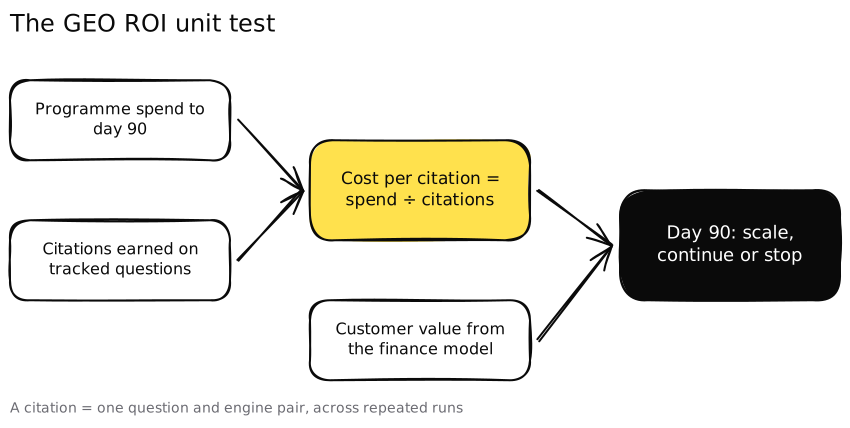 One unit price, one value the CFO already trusts, one decision at day 90.
This test has a useful property. It doesn’t need a perfect attribution model to be informative. Even a rough number of customers per citation, checked against the signup answers and CRM records below, tells you whether you’re within an order of magnitude of paying back.
Measured return vs correlated return
Every GEO ROI number is one of two kinds, and the case only survives if they stay apart.
- Measured return. Customers or deals with an AI source written on the CRM record. Signups, demo requests or orders where the “how did you hear about us” answer names an assistant. AI referral sessions that converted. Each of these can be pulled up and checked one by one.
- Correlated return. Branded search lift in the weeks after citations landed. Direct traffic lift over the same weeks. Pipeline growth in a period when GEO was the main new activity. These moved at the right time and you have reasons to believe the work caused them, but you can’t point at a single customer.
Both belong in the readout. They never belong added together into one “AI influenced revenue” figure. The first time someone in finance pulls that figure apart and finds most of it is correlation, they’ll discount every number you’ve shown them. Report the measured return as the floor of the ROI and the correlated return as the evidence that the floor is low.
How to build a GEO business case in six steps
The steps run in order, and the first one can end the project. That’s the point.
Step 1: Run the opportunity maths before you ask for budget
Start with the size of the prize, not the programme. Three numbers are enough.
- How many buyers ask the questions. Use the questions that lead to your product (shortlists, comparisons, “best X for Y”), sourced from sales calls and lost deal notes, and estimate demand from search volume on the same topics and from how often they come up in your own pipeline.
- Who wins those answers today. Run the questions natively in each engine many times and record each brand’s share of answers. The category leader’s share is the most useful number in the whole case, because it’s the realistic ceiling.
- What a customer is worth. From the finance model, as above.
If few buyers ask, a customer is worth little, or the leader’s share is small because engines barely answer the questions, the honest total is small. Say so now. We run this maths before proposing anything, and sometimes the right answer is that GEO isn’t worth paying for yet. It’s far cheaper to learn that in a spreadsheet than at day 90.
Step 2: Split the cost into commitments and targets
A CFO will ask what they’re buying. The answer has two parts.
Commitments are volumes the team controls. Pages published or refreshed, comparison pages shipped, community threads posted, listings corrected, site fixes released. These are priced and promised.
Targets are what engines and buyers do in response. Citations, share of answers, branded search, customers. These are forecast, never guaranteed. Anyone who guarantees that ChatGPT will recommend you is guaranteeing something nobody controls.
Write the full cost on one line, including the parts that usually hide. Internal time (an approver for claims, a developer for site fixes), any earned placement budget, and tooling. Then show what moves the price. Our GEO pricing guide breaks down the cost drivers (questions and engines tracked, markets and languages, community volume, who ships site changes), and GEO agency vs in-house covers the in-house version of the same budget.
Step 3: Set up the three records on day one
ROI can only be measured from the day you start recording. Three records, joined, are enough to defend a result.
- Search Console for branded search impressions and clicks, week by week.
- Product analytics or the CRM for the path from landing page to signup to paid, with the AI source written onto the record when you know it.
- An action log of every page, refresh, listing and thread, with the date it went live and the question it targets. Without it you can’t tell a result from a coincidence.
Add the free text “how did you hear about us” field at signup, demo request or checkout before anything ships. It’s the only way to catch the visitor ChatGPT told about you who then typed your domain. For B2B, identify the companies behind visits, check them against your own ICP and route them to an owner, using the visit for timing only. For ecommerce, use promo codes and daily units against what was published. The full setup is in AI search analytics.
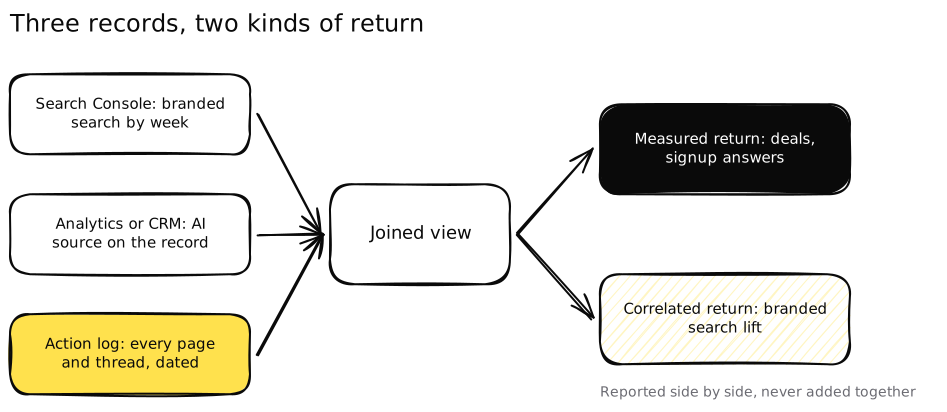 Three records joined. Without the dated action log, every result is a coincidence.
Step 4: Model the upside with a ceiling, not a multiplier
This is where most GEO business cases inflate. The fix is to model three cases and give each one a hard limit.
Floor. Measured return only, at your current share of answers. What you can already see in signup answers and CRM records, projected forward. Often small. Show it anyway, because it’s the number nobody can argue with.
Base. Your share of answers moves part of the way toward the leader’s share on the tracked questions. Scale your measured AI customers in proportion to that move, and say plainly that proportional scaling is an assumption. Use your own conversion rates, not a premium from another company’s study.
Ceiling. You reach the leader’s current share. Never model a share above what the leader already earns, and never multiply by a conversion premium on top. If the ceiling still doesn’t pay back, the base case won’t either.
Three rules keep the model honest. Every input comes from your own data or is labelled as an assumption. Correlated return sits next to the model as supporting evidence, not inside it. And the model is written down before the programme starts, so nobody can tune it to the result later.
Step 5: Agree the kill criteria before you start
A CFO signs faster when the case already says what would make it fail. Agree three things up front.
- What’s judged when. In our experience the order is community reach first, then citations of the new pages and threads, then the brand named in answers, then Google rankings. Judge month 1 on commitments and reach, month 2 on first citations, month 3 on share of answers. Cancelling at week 6 for lack of revenue usually measures work that hasn’t been cited yet.
- The stop line. For example, if cost per citation at day 90 is above what a customer is worth and the floor shows no movement, the programme stops or changes shape.
- Who decides. One owner on the business side and one on finance, named in the case.
Step 6: Run the day 90 readout
The readout is one page, and it ends in one of three decisions. Scale, continue as planned, or stop.
It shows, in this order:
- Commitments against plan. What shipped, what didn’t and why.
- Citations earned on the tracked questions, by engine, and what each piece of work earned.
- Cost per citation against customer value.
- Measured return. Customers and deals with an AI source, and signup answers naming an assistant.
- Correlated return, labelled as such. Branded search lift against the weeks citations landed.
- Where the model stood. Actual against floor, base and ceiling.
- The decision, with the reason in one sentence.
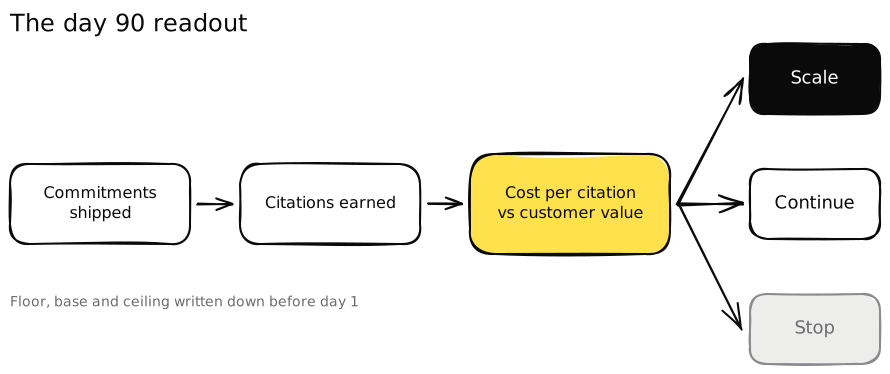 Every day 90 readout ends in one of three decisions, written down.
Report the months that disappoint the same way as the ones that don’t. A quiet month that looks quiet is what makes the good months believable to finance.
A worked GEO ROI example
Every figure below is invented for a fictional B2B software company and only shows the format. None of it is a benchmark or a client result.
The company tracks 50 buyer questions. At baseline it appears in 10% of answers and the leader appears in 45%. A customer is worth $12,000 in gross margin over its lifetime. The programme costs $15,000 a month, so $45,000 to day 90.
| Line | Day 90 (fictional) | Kind |
|---|---|---|
| Commitments shipped | 38 of 42 items | Measured |
| Citations earned on tracked questions | 60 question and engine pairs | Measured |
| Cost per citation | $750 | Measured |
| Customers to break even | 4 ($45,000 ÷ $12,000) | Arithmetic |
| Deals with AI source on CRM record | 3 | Measured |
| Signups naming an assistant | 11 | Measured |
| Branded search impressions | Up after weeks 4 and 7 | Correlated |
| Share of answers | 10% to 19% | Measured |
Reading it. The measured floor is 3 customers, $36,000 of lifetime value against $45,000 spent, so the programme hasn’t paid back on measured return alone. But it’s close, the signup answers and branded search both point the same way, and share of answers is moving. With 16 citations’ worth of spend covered by each customer, the unit test is within reach. The decision is to continue as planned, with the next readout at day 180 against the same model.
Notice what the example doesn’t do. It doesn’t multiply 11 signups by a conversion premium, it doesn’t add branded search to revenue, and it doesn’t project the 45% ceiling as if it were the plan.
GEO ROI for B2B vs B2C
The method stays the same. The inputs change.
B2B. Customer value is high and deals are few, so a handful of measured deals can settle the unit test. Sales cycles are long, so at day 90 judge pipeline with an AI source on the record, not closed revenue. The questions are shortlists and comparisons, which are usually won on your own site with honest comparison pages. Ask sales to log any AI claim a prospect repeats, because a wrong answer quoted on a call is a cost too. GEO for B2B goes deeper.
B2C. Customer value per order is lower and volume is higher, so the measured return comes from daily units, promo codes and the signup or checkout question against the action log. Questions lean on first-person experience (“is X worth it”, “best X for Y”), which engines often answer from community threads and reviews. Repeat rate matters more than first order value in the customer value line, so get it from finance rather than guessing.
When the honest GEO business case says no
A business case that can only say yes isn’t a business case. GEO usually isn’t worth funding yet when one of these is true.
- The category is small. Few buyers ask the questions, so even the ceiling case is a small number.
- There’s no traffic to attribute. Don’t pay for attribution infrastructure before there’s anything for it to measure.
- The brief is volume or results inside 30 days. Citations compound over months, and volume isn’t what gets a brand cited.
- Nobody can ship. If site fixes sit in a backlog for a quarter, the commitments won’t land and the ROI can’t either.
Saying no in Step 1 costs a spreadsheet. Saying no at day 90 costs a quarter. Our guide to what an AI visibility audit should show you covers how to get the opportunity numbers before any commitment, and how to choose a GEO agency covers what to ask anyone who quotes you a multiple before they’ve seen your data.
What your CFO will ask, and what to answer
“Where does this number come from?” Point at the record. Measured return comes from named CRM records and signup answers. Correlated return is labelled and kept out of the total.
“What if it’s half that?” Show the floor. It’s built from measured data only, so halving the assumptions doesn’t touch it.
“Why not just measure clicks?” Because AI sends citations, not clicks, and Google counts its own AI feature clicks inside normal search traffic. Judge GEO by referrals and you’ll cancel the channel buyers use to build shortlists.
“What makes us stop?” The kill criteria from Step 5, agreed before a dollar was spent.
“Why mentions, not links?” Ahrefs found branded web mentions correlate with AI Overview brand visibility at 0.664, against 0.218 for backlinks, across 75,000 brands (Ahrefs). The work earns citations on pages engines already read, which is what the cost per citation counts.
A GEO business case that holds up isn’t the one with the biggest multiple. It’s the one where every number traces to a record, the upside has a ceiling, and the day 90 decision is written down before the work begins.
Get a personalised case study
Pick your industry and we'll email you the case closest to your business, numbers included.
Frequently asked questions
How do you calculate GEO ROI?
Add up the value of customers you can tie to AI search, using CRM records with an AI source and signup answers that name an assistant, and divide by the full programme cost. Report correlated signals such as branded search lift beside that number, never inside it. Then run the unit test at day 90, comparing what a citation costs with what a customer is worth.
What is cost per citation?
Cost per citation is total GEO spend over a period divided by the citations it earned on your tracked buyer questions, counted as distinct question and engine pairs where your page, listing or community thread is cited across repeated runs. It turns visibility into a unit price, so you can ask how many citations it takes to win one customer and whether that customer is worth it.
Why does AI referral traffic undercount GEO ROI?
Most people who read an AI answer don't click its sources. They remember the name and search it later or type the domain. Conductor's 2026 benchmarks put AI referral traffic at 1.08% of website traffic, and Google reports clicks from its AI features inside normal Web search traffic in Search Console. A model built only on referrals will report a fraction of the real effect.
How long does it take to see GEO ROI?
Expect an order, not a date. Community reach moves in the first month, citations tend to compound in months two and three, and share of answers is fair to judge from month three. That's why the business case sets a day 90 readout. Calling ROI at week six usually measures work that hasn't had time to be cited yet.
What should a GEO business case include?
The size of the opportunity, a cost split into commitments the team controls and targets it doesn't, the three records that will prove the result, an upside model with a floor, a base and a ceiling, kill criteria agreed in advance, and the format of the day 90 readout. A CFO signs a case that already says what would make it fail.
Is GEO worth it for small companies?
Sometimes not, and the opportunity maths should tell you before you spend. If few buyers ask the questions that lead to your product, or a customer is worth little, even a cheap citation may never pay back. A small category can still be worth winning, but the case has to show the honest total first and the upside second.